The 18th NADA Auto Show runs 25–30 August 2026 (Bhadra 9–14, 2083) at Bhrikutimandap Exhibition Hall, Kathmandu, branded HP Presents NADA Auto Show 2026 and falling in NADA's 50th anniversary year. Dates, venue and organiser details are on our NADA Auto Show 2026 event page.
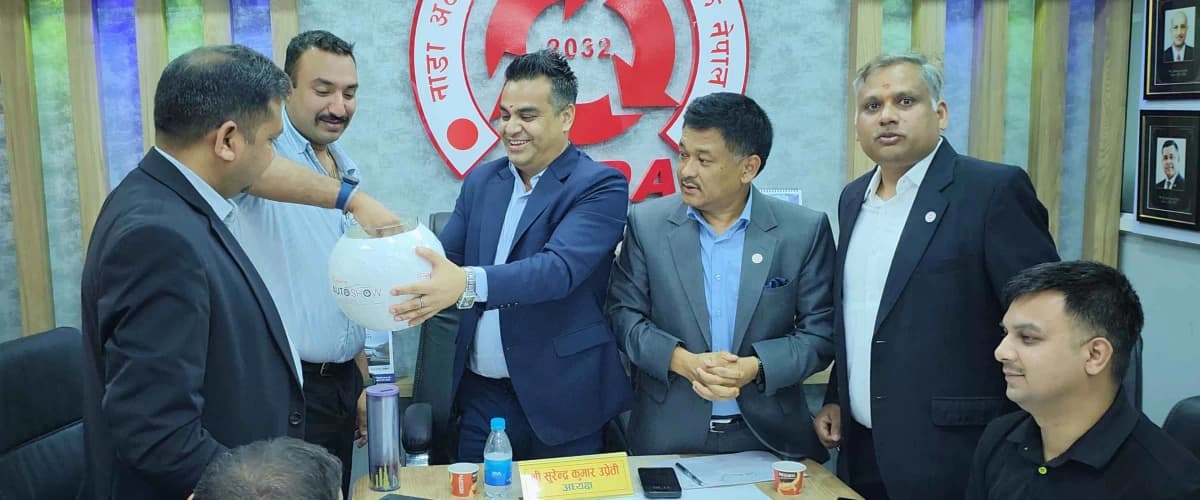
Stalls were allocated by lucky draw in early July, and the split tells you what this show is: 19 passenger-vehicle brands, 10 two-wheeler brands, 17 light-commercial-vehicle brands, plus 76 smaller stalls for 45 auto-component companies — 46 vehicle-brand stalls in all.
That LCV number is the point. Seventeen light-commercial stalls is the largest single vehicle category at the show, and it is the clearest reason a fleet operator or a business buyer should come here rather than to NAIMA three weeks earlier. NADA has been going since 1975 and spans the whole trade — importers, dealers, spare parts, lubricants, accessories, helmets, banks and insurers. NAIMA, formed in 2025, represents vehicle importers only.
Which brands are here, and which are not
On four wheels: Tata, Suzuki, Skoda, Deepal, Nammi (Dongfeng), Avatr, GAC Aion, Xpeng, Dongfeng/Dyun, Riddara and Geely. On two wheels, Yamaha and Hero are the NADA-exclusive brands, with Royal Enfield expected at both shows.
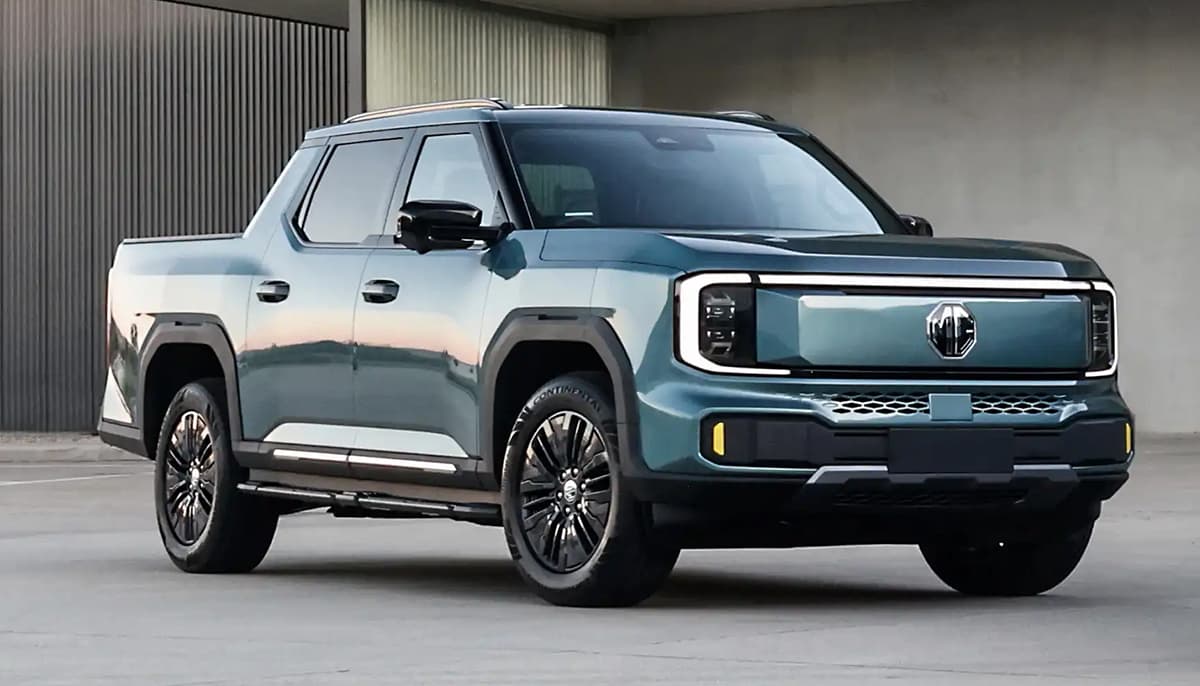
Around 17 to 18 four-wheeler brands are expected at NADA against roughly two dozen at NAIMA, and NADA compensates with commercial vehicles, components and Made-in-Nepal products. Toyota, Nissan, Hyundai, Kia, MG, BYD, Honda, Bajaj and TVS have gone to NAIMA instead. For context on what NADA does with spectacle, the 2025 edition brought a flying taxi — displayed, not flown — plus humanoid and animal robots, and ran at effectively 100% EV participation with just one internal-combustion brand present.
About the prices in this article
Where a vehicle is already on sale here, the figure is the real current Nepal ex-showroom price from our catalog and the name links to its price page. Where it is not yet on sale, we ran it through the Nepal AutoMart price predictor, which estimates a Nepal band from the home-market price anchored on how that brand actually prices its existing Nepal range. Those are labelled estimate, they are deliberately wide, and a distributor's announcement overrides every one of them.
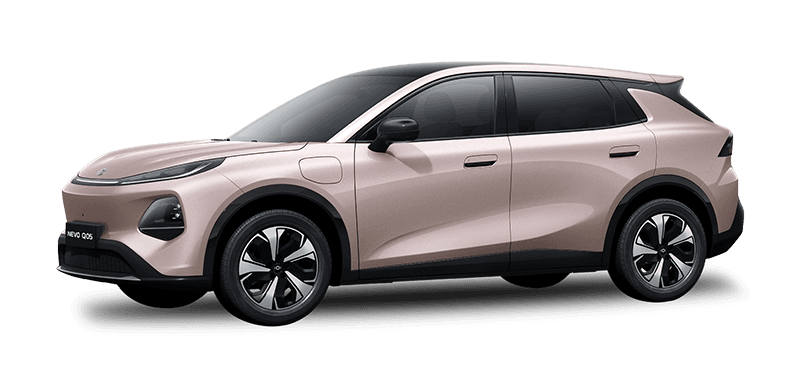
The confirmed new brand: Deepal Nevo Q05
Nevo is Changan's second EV brand in Nepal after Deepal, and MAW Vriddhi will sell it through existing Deepal showrooms. Reporting is inconsistent on the final badge — it has appeared as both Nevo Q05 and Deepal Nevo Q05, and MAW Vriddhi at one point said the Nepali name was not settled. Whatever it is called, it becomes the fifth Deepal-family product here after the S05, S07, L07 and E07, and the most affordable of them.
The Nepal car is expected to come from Changan's Thailand plant: a 120 kW, 190 Nm front-drive motor, a 51.9 kWh LFP battery with CATL cells, 160 kW DC fast charging for a 30–80% top-up in about 15 minutes, a 14.6-inch screen, and ADAS covering adaptive cruise, lane assist, autonomous emergency braking and blind-spot monitoring. It is 4,435 mm long on a 2,735 mm wheelbase. The exterior was drawn by Klaus Zyciora, formerly Head of Design at BMW, it has won a Golden A' Design Award, and it is a genuine volume seller rather than an export experiment — 71,600 units in the first half of 2026 and China's segment leader for three consecutive months. Europe and the UK get it from 2027 as the Changan E06.
Our predictor estimates Rs 42–56 lakh, which would sit below the Deepal S05 at Rs 57.99–62.99 lakh — consistent with it being the range's new entry point. It is positioned against the BYD Atto 3, which sells here at Rs 56.90–67.80 lakh.
Two things to check on the stand. First, the motor. Earlier reporting said the Nepali version would use a motor under 100 kW to sit in a lower Nepali tax band, while the Thailand figure is 120 kW. Both cannot be true, and that single number moves the price bracket materially. Second, the range claim: do not rely on the 642 km NEDC figure. NEDC is the most generous cycle in use, and the honest real-world expectation in Nepal is around 330–370 km.
Suzuki e Vitara — the Japanese answer
Suzuki's first-ever EV is the most credible Japanese-badged electric SUV for the Nepali mid-market, and it is the one launch here where the price is already public and the car is already in our catalog: Rs 48.99 lakh to Rs 59.49 lakh across four variants, with bookings having opened at the WADA Auto Show in Pokhara back in March.

Two batteries — 49 kWh and 61 kWh with 106 kW and 128 kW motors — for up to 500 km claimed on the larger pack, using BYD Blade battery cells, developed with Toyota at Suzuki's India plant. It is 4,275 mm long on a 2,700 mm wheelbase with 180 mm ground clearance, 18-inch wheels, a panoramic sunroof, a floating dual-screen setup with a 10.25-inch infotainment and 10.1-inch cluster, wireless CarPlay and Android Auto, and Level 2 ADAS with lane keep assist, adaptive cruise, blind-spot monitoring and a 360-degree camera. It has seven airbags, TPMS, discs at all four corners, an electronic parking brake with auto hold, hill descent control and AVAS.
For the large group of Nepali buyers who still equate Japanese with resale value and service depth, this is the only real option at the price in a segment otherwise entirely Chinese. Hill descent control and 180 mm of clearance are the specs that actually matter here. Worth noting: the Indian e Vitara sells at ₹15.99–20.01 lakh, which is NPR 25.58–32.02 lakh at the currency peg — so the Nepali price is the clearest single illustration in this article of what our EV import structure costs a buyer.
Tata: two updates and one big maybe
Tata is NADA's anchor passenger brand and Sipradi is the country's largest distributor.
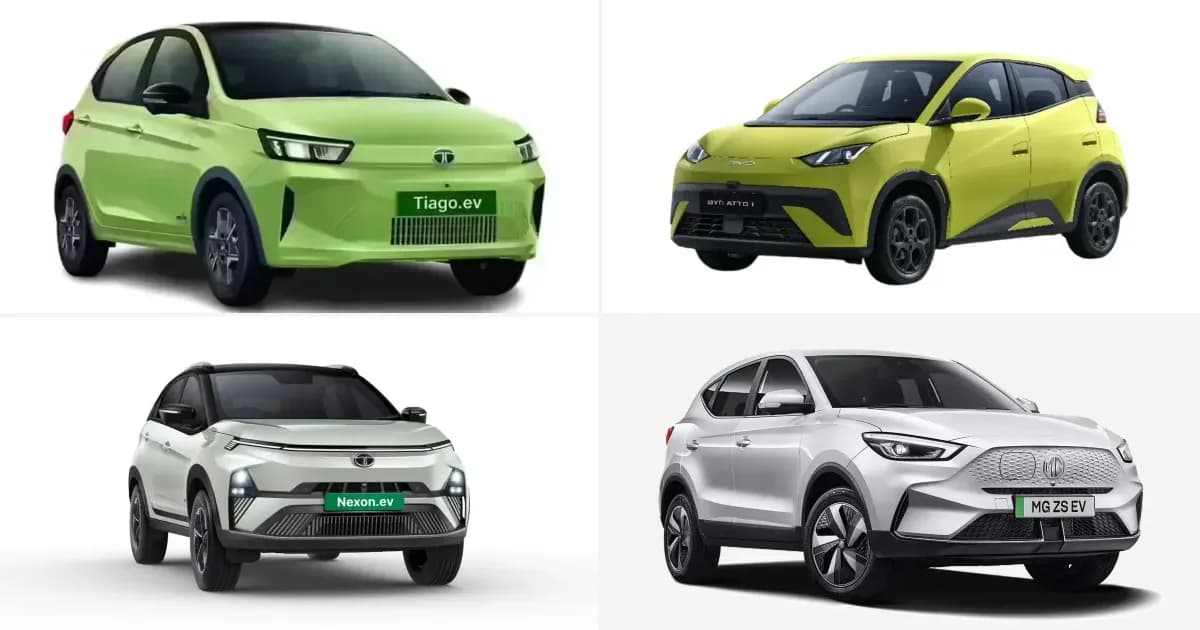
Updated Punch EV and Tiago EV are expected. The Punch EV sells at Rs 33.99–39.99 lakh and the Tiago EV at Rs 27.49–29.99 lakh. Punch EV specifics today: acti.ev architecture, 25 kWh and 35 kWh packs, up to 421 km MIDC, 190 mm ground clearance, a 366-litre boot, 10.2-inch dual displays, ventilated front seats, six-speaker Harman audio, six airbags, ESP, ISOFIX and four-level regenerative braking — with the best-supported EV warranty at the price in Nepal, 8 years or 160,000 km on battery and motor. The facelifted Tiago.ev is expected to sharpen equipment and styling rather than change the battery formula.
Tata Sierra EV — the wildcard, and read this part carefully. It launched in India at ₹18.79 lakh introductory ex-showroom with the top Empowered A QWD at ₹25.99 lakh, on Acti.ev+ with 63 kWh and 75 kWh packs, rear-wheel drive and quad-wheel-drive, up to 504 Nm from the dual-motor car and a claimed 500-plus km. Indian deliveries started 15 July.
Sipradi has not committed to launching it in Nepal. Our predictor estimates Rs 65–82 lakh, which lines up with independent third-party estimates under the FY 2083/84 EV tax structure of roughly Rs 62–66 lakh for the 63 kWh Pure and Rs 82–88 lakh for the 75 kWh quad-wheel-drive. It would sit above the Curvv EV at Rs 56.99–58.99 lakh, currently Tata's most expensive EV here.
Separately, one Nepali outlet has been promoting an "under Rs 40–42 lakh" Sierra figure. That number is not supported by ₹18.79 lakh Indian pricing plus Nepal's duty load, and we would not republish it. If the Sierra does land, the nameplate carries more emotional weight with Nepali buyers over 40 than any other Tata badge, and quad-wheel-drive at this price point has no direct rival here.
Deepal, Avatr and the premium end
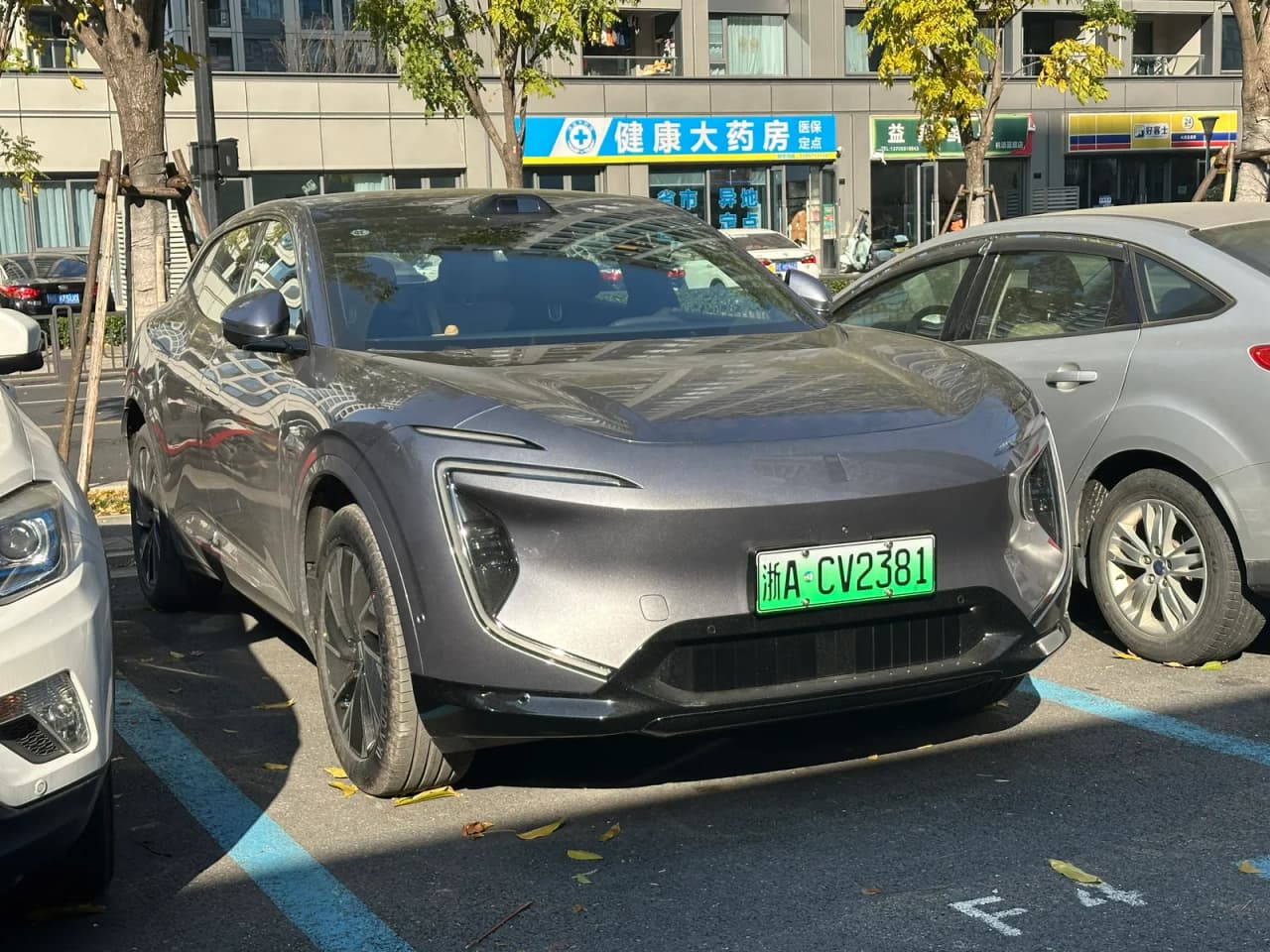
AVATR 07 has already physically arrived in Nepal through MAW Vriddhi with sales preparation under way, but the official price is still unannounced — timing complicated by the government's EV tax revision in the new budget. Avatr is Changan's premium joint venture with CATL and Huawei. In China it comes as a battery EV with roughly 82.16 kWh, up to 252 kW and 365 Nm for up to 650 km CLTC and a 30–80% charge in about 10 minutes, or as an extended-range car with a 39.05 kWh pack, up to 245 km of electric-only range and around 1,115 km combined. The test vehicle reported in Nepal was described with a 190 kW motor and an 82 kWh battery, which suggests Nepal may get a different specification from the current China car.
Predictor estimate: Rs 75–98 lakh, against Chinese pricing from about RMB 219,900. For context, the Deepal E07 spans Rs 109.90 lakh to Rs 199.99 lakh at the top of the MAW portfolio.
The reality check on this one is important. Avatr imported fewer than 10 units into Nepal in the last fiscal year. This is a low-volume halo product, not a volume play, and service depth is the question to ask rather than specification.
Geely, Aion and the compact-EV candidates
Geely EX2 — sold in China as the Geely Xingyuan, and this is the same car Proton sells in Nepal as the e.MAS 5. It would create an entry point below the Galaxy EX5, which sells here at Rs 57.99–67.99 lakh. China specification runs roughly 30 kWh or 40 kWh LFP with 58 kW or 85 kW motors for about 310, 410 or up to 480 km CLTC, rear-wheel drive, a 70-litre front luggage compartment, up to a 14.6-inch screen and up to six airbags. Our predictor estimates Rs 32–42 lakh, though its Nepali twin sets a sharper marker: the e.MAS 5 launched at Rs 29,99,999 on the road, so the bottom of that range now looks high. Useful context on how good that car is: the Xingyuan sold 465,775 units in China in 2025, the country's single best-selling car.
GAC Aion UT — CG Motors has been preparing this entry-level electric hatchback, which would sit below the Aion Y and V. China specification is up to 100 kW and about 145 Nm from a 44.1 kWh LFP pack for up to 420 km CLTC, 4,270 mm long on a 2,750 mm wheelbase, with a smaller-battery version around 320 km. Predictor estimate: Rs 26–36 lakh, our lowest-confidence car estimate on this list. Aion has underperformed here — 35 EVs imported last fiscal year — and the UT with sharp pricing is the brand's turnaround attempt.

BAW E7 Pro — LRR Motors plans to unveil this electric mini car in early August, so ahead of NADA, but it will be on display through the show season. A 22.29 kWh battery, a 30 kW motor, 260 km claimed and a 100 km/h top speed, at around Rs 19–24 lakh on both the distributor's indication and our own estimate. That is second-car and city-runabout territory, against the MG Comet at Rs 18.75–22.74 lakh, the Wuling Air EV at Rs 24.99–30.99 lakh and the Seres Mini EV at Rs 16.49–17.99 lakh, currently Nepal's cheapest EV. BAW also imported fewer than 10 EVs here last fiscal year — ask about the after-sales network, not the range.
The brands to watch without announced models
Xpeng, Riddara, Dongfeng Nammi/Dyun, Geely and Skoda are all confirmed participants, and none has publicly announced a 2026 launch model. Some useful positioning:
- Xpeng showed the X9 MPV as NADA 2025's most premium exhibit; 21 units imported last fiscal year. The X9 should not be counted as a fresh 2026 launch.
- Riddara is Geely's electric pickup brand, which matters given those 17 LCV stalls. The RD6 is already on sale here and the RD6 ECON 4x4 launched before this show, so expect a display rather than a debut.
- Dongfeng Nammi is a genuine volume player — the Nammi Box at Rs 32.49–36.49 lakh and the Nammi Vigo at Rs 40.99–43.99 lakh.
- Skoda is the only major European brand on NADA's passenger list. The Kylaq launched in Nepal in February at Rs 45.90–69.90 lakh and will likely be the stand's main attraction — again, a display rather than a launch.
- GAC Aion brought the UT hatchback to NADA 2025 as a turnaround attempt and remains a 2026 participant.
Participation is not a launch. Several of these will use the show for display cars, a new variant or colour, bookings, or finance, exchange and charging offers.
Two-wheelers
Ten two-wheeler stalls, with Yamaha and Hero as the NADA-exclusive brands.
Yamaha XSR155 — the most anticipated two-wheeler launch here, and it is listed in our catalog at Rs 5.29–5.60 lakh across the four colours MAW Rides has imported: BMC at Rs 5,29,900, VRC1 at Rs 5,39,900, WMC at Rs 5,49,900 and the top-spec SMX at Rs 5,59,900. Those are MAW's own indicative pre-launch figures and the bike is not on the distributor's published price list yet, so the price can still move at launch — pre-bookings are open at Rs 5,000. Confirm the final figure and the colour on the stand.
A 155 cc liquid-cooled single with Variable Valve Actuation making 18.4 PS and 14.2 Nm, a six-speed box with an assist-and-slipper clutch, a Deltabox frame, an upside-down fork, discs at both ends with dual-channel ABS, traction control, about 137 kg kerb, roughly 170 mm ground clearance and Y-Connect on applicable versions. It is genuine retro-modern styling in the 150cc class, where Nepal's options are almost entirely sport-naked — the one bike at either show that sells on design and heritage rather than specification. An honest note from an Indian owner comparison: the initial pickup is dull and the ride transmits shocks over rough surfaces.
Yatri P2 — Nepal's first domestically designed and built electric scooter, from Yatri Motorcycles with Sipradi Trading, and reports conflict over which show gets the debut. Some place it at NAIMA; Nepali trade reporting puts its first public appearance at NADA in Bhadra 9–14, which is plausible given Sipradi is a NADA anchor brand and Yatri's partner. What is known: pre-production stage, a mid-mounted motor, an aluminium swingarm, dual rear spring suspension, a wide bench seat, a flat floorboard, discs at both ends, and a "Made in Nepal" badge on the hub after road testing in Jiri. Wheel size is unresolved — 12-inch in the latest teaser, 14-inch earlier. Battery, motor, certified range, top speed, charging time, weight, warranty and price have all not been released, so treat any circulating spec sheet with suspicion.
It is also the only vehicle at either show that pays no import duty at all, because it is not imported. Every competitor is carrying a 2.5x to 3.5x tax and logistics multiplier. Combined with Sipradi's service network, that addresses the two things that kill electric two-wheeler sales in Nepal — price and after-sales.
Hero MotoCorp — Hero's FY2026-27 annual report states plans for new products under both the Hero MotoCorp and Harley-Davidson brands in the 150–350cc premium sweet spot, noting that segment grew 18% year on year while above-350cc growth stays sluggish on higher taxes. The corporate signal is real but no specific Nepal model is confirmed, so we are not going to name one. Hero's EV brand Vida arrives separately through CG Motors, around the NAIMA window, with the Vida V1 already listed at Rs 3.45–3.95 lakh.
Moto Morini is confirmed for one of the two shows, with the model name unsettled: local reporting says "Alltrhike 250" while Moto Morini's production bike is the Alltrhike 450, a 449 cc parallel twin making about 44.8 bhp. The brand is Italian by heritage and Chinese-owned under Zhongneng, and brand cachet is the entire pitch.
Light commercial vehicles — NADA's real advantage
Seventeen LCV brand stalls, plus Made-in-Nepal products on display. No specific LCV launch models had been announced by the end of July, but the relevant background:

- Maxus is preparing a more affordable eTerron 9 Comfort variant — an electric pickup play. The eTerron 9 is on sale here.
- Riddara, Geely's electric pickup brand, is a participant.
- Foton has just added five new service centres to its Nepali after-sales network.
- An 80% loan facility is now available for public EV purchases.
- Government employees can access interest-free vehicle loans of up to Rs 60 lakh.
Those last two matter more to LCV and fleet demand than any spec sheet on the floor.
What this means if you are buying
NADA is the fleet and finance show; NAIMA is the launch show. NAIMA has more four-wheeler brands and more headline debuts. NADA has 17 LCV stalls, 45 component companies, banks, insurers and 50 years of nationwide dealer relationships. If you are comparing EMI offers or specifying pickups for a business, come here. If you want to see the newest Chinese EV, NAIMA was the show.
The three-week gap is a pricing weapon. Brands showing at NADA get to see NAIMA's prices before setting their own. Watch for NADA-exclusive brands announcing figures that undercut NAIMA models revealed two weeks earlier — the Suzuki e Vitara's entry price, public since March, gives NAIMA rivals a target and NADA brands a benchmark.
Component stalls are worth your time even if you are not buying a vehicle. With 45 component companies across 76 stalls, this is the best place in the year to compare tyres, batteries, lubricants and accessories, and many run show-specific package deals that trim a year of running costs.
Practical notes. Crowds peak in the late afternoon and at weekends; weekday mornings are easier for inspecting a vehicle closely and negotiating. Bring copies of citizenship and basic income documents if you might book — it speeds up on-the-spot finance pre-approval considerably.
Frequently asked questions
When and where is the NADA Auto Show 2026?
25–30 August 2026 (Bhadra 9–14, 2083) at Bhrikutimandap Exhibition Hall, Kathmandu. It is the 18th edition, branded HP Presents NADA Auto Show 2026, organised by NADA Automobiles Association of Nepal in its 50th anniversary year, with Global Exposition and Management Services as event manager.
Which vehicles are confirmed to launch at NADA 2026?
The clearest confirmed debut is the Deepal Nevo Q05 electric SUV through MAW Vriddhi, alongside the Yamaha XSR155 through MAW Rides and the first public showing of the Nepal-built Yatri P2 electric scooter. The Suzuki e Vitara and the BAW E7 Pro are also part of the season, though both were priced or unveiled before the show opens. Strong candidates awaiting final confirmation include the GAC Aion UT, Avatr 07, Geely EX2 and an updated Tata Tiago.ev.
Is the Tata Sierra EV launching in Nepal at NADA 2026?
Not confirmed. Sipradi has not committed to launching it, so treat it as a possible display or preview rather than a launch. Any Nepal price for it is an estimate — including ours — and an "under Rs 40–42 lakh" figure circulating in some Nepali coverage is not supported by Indian pricing plus Nepal's duty structure.
How is NADA different from the NAIMA expo?
NADA has been running since 1975 and covers the whole automobile trade including spare parts, lubricants, accessories, banks and insurance, with 17 light-commercial-vehicle stalls and 45 component companies. NAIMA, formed in 2025, represents vehicle importers only and has more four-wheeler brands and debuts. Brands have split between them: Yamaha and Hero at NADA, Honda, Bajaj and TVS at NAIMA, Royal Enfield likely at both.
Are the Nepal prices in this article confirmed?
Only the ones linking to a price page on our site — those are real current ex-showroom prices from our catalog. Every figure labelled "estimate" comes from our price predictor and is a modelled band, not a quote. Nepal prices for imported vehicles move on customs duty, excise, VAT, the road infrastructure charge, the exchange rate, homologation and dealer margin, the FY 2083/84 budget revised EV taxation, and provincial annual EV taxes based on vehicle price are now being imposed. Re-check every figure against the distributor's own price list on launch day.
Writes on vehicle pricing, taxation and the Nepali auto market from ongoing tracking of distributor price lists. Every price in this piece is read live from the Nepal AutoMart catalog — how we verify prices.