Start with the numbers
Models discussed, at a glance
Top available variants, with prices in Nepalese rupees. Expand details to choose another variant.
| Vehicle | Ex-showroom price | Fuel | Selected variant |
|---|---|---|---|
| 01TVS Apache RTR 160 4V | Rs 4.3 lakh | Petrol | USD |
| 02TVS Apache RTR 160 2V | Rs 3.65 lakh | Petrol | FI |
Ex-showroom prices exclude registration, road tax and insurance. Specifications can vary by trim. See individual source-check dates ↓
Where This Bike Sits In Nepal's Crowded 160cc Shelf
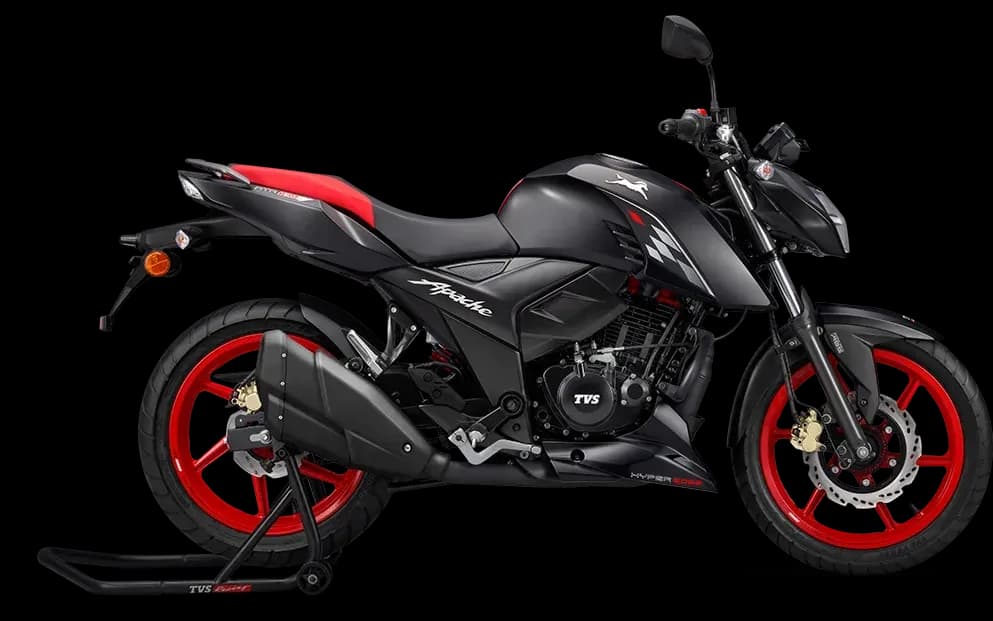
This review focuses on the TVS Apache RTR 160 4V, especially the Special Edition. The TVS Apache RTR 160 2V is discussed separately as the lower-priced alternative. The original September 2026 review compared the 2V BT at Rs 3,13,900 with the 4V ABS RTFI Special Edition at Rs 3,84,900; those are the review's original quoted figures, not a current combined model price. TVS Nepal's distributor listing checked on 17 September 2026 shows the 4V SE at Rs 3,99,900, the 2V ABS at Rs 3,49,900 and the 2V FI at Rs 3,64,900. These are different trims, so the old 2V BT price must not be assigned to the 4V. That is not budget-commuter money. It places the Apache squarely against other performance-leaning 160s and just under the door of the 200cc class, which is exactly the space TVS wants it to occupy. The pitch to a Nepali buyer is straightforward: pay 160cc money, get software and switchgear that most 200s in this price band don't offer. Whether that pitch survives contact with Nepali roads, fuel prices and resale reality is the question worth answering before signing at the showroom.
The two versions discussed here give buyers a real choice between a basic commuter-leaning Apache and a fully loaded one. The September 2026 review's original gap of roughly Rs 71,000 between the 2V BT and the 4V SE needs unpacking, because it is not just about badges.
A Fuel Tank Built To Look Bigger Than 160cc
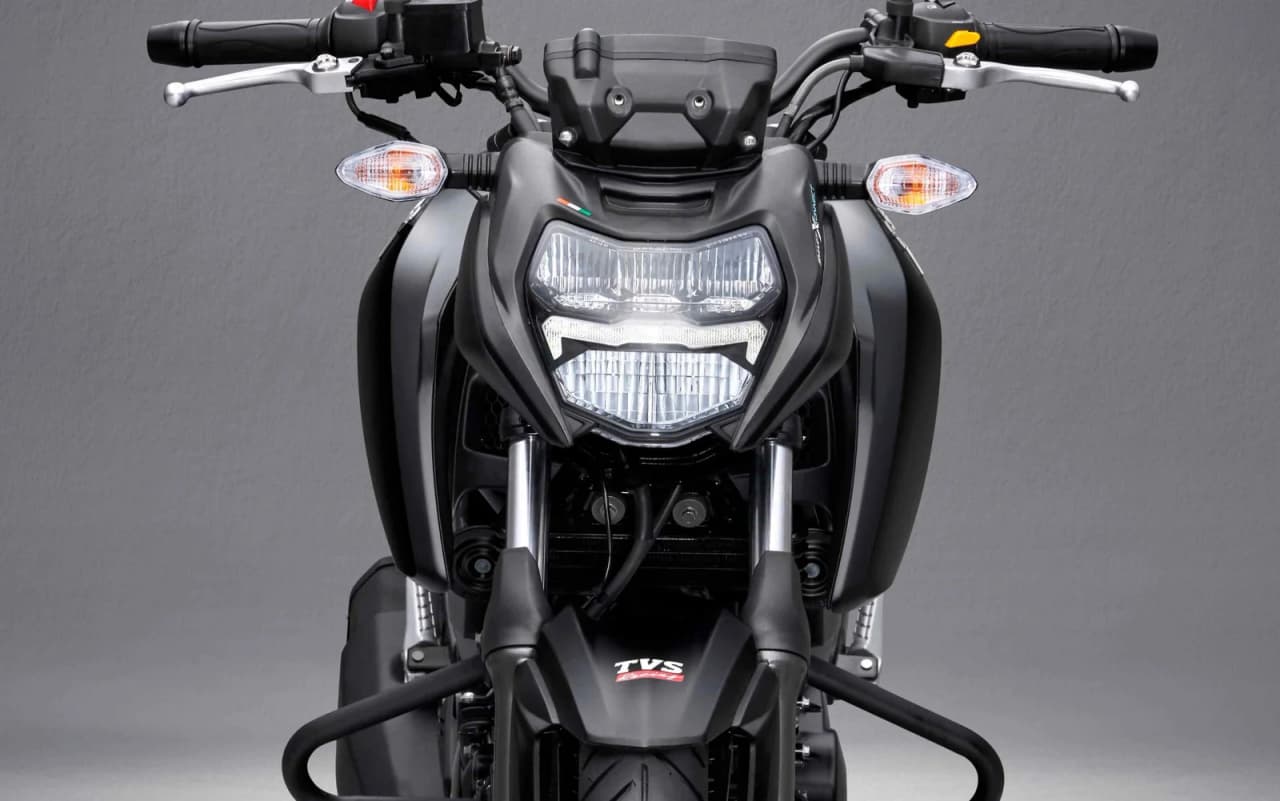
The Apache RTR 160 doesn't try to hide its engine capacity behind a small, apologetic body. The tank is deliberately oversized and shapes the whole silhouette, giving the bike a stance that reads more like a 200 or 220cc machine parked next to it. The facelifted mustache-shaped LED DRLs replace the older eyebrow-style unit, and they sit above a sharply cut headlamp cluster that looks purposeful rather than decorative. A TVS horse logo is worked cleanly into the tank's flank, a small detail but one that photographs well and tells other riders what they're looking at.
At the back, a split-style grab rail and a sharp LED taillight finish the look without cluttering it. Build quality across the panels feels consistent with what TVS has offered in this segment for years: nothing loose, nothing that rattles on inspection, and paint that holds its finish under showroom lighting. At 138 kg kerb weight for the 2V and a touch more for the loaded 4V SE, it doesn't feel flimsy sitting on its side stand, which matters when parking on Kathmandu's uneven roadside gravel.
Read next: TVS Apache RTR 160 4V review · TVS Apache RTR 160 2V review · TVS Apache RTR 160 4V Refresh review: The Performance Benchmark in Nepal
The Matte Black SE Is The One Worth Seeing In Person
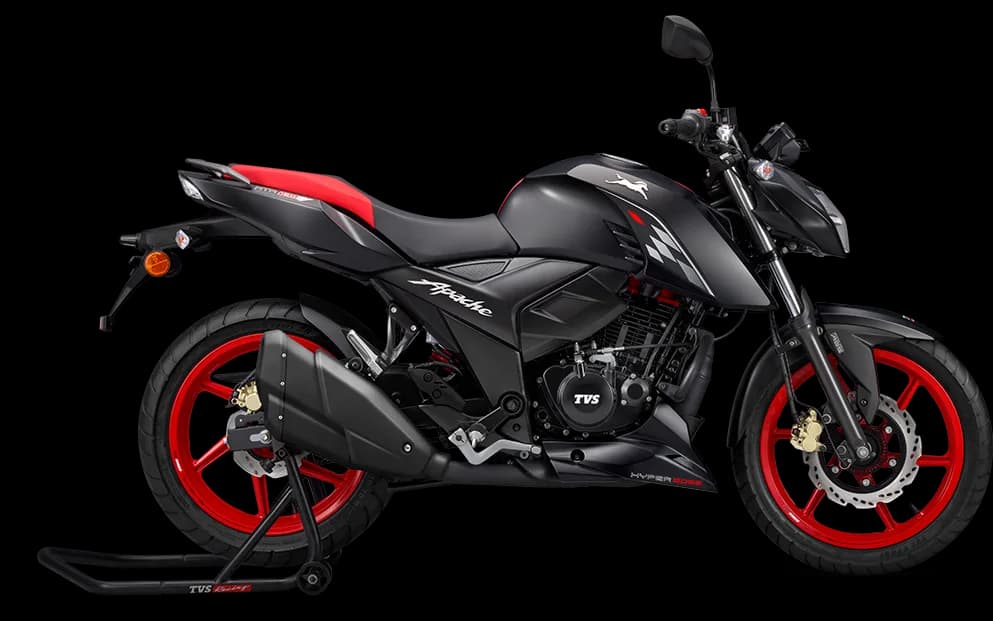
The Special Edition trim gets a premium Matte Black finish lifted with sporty red decals on the tank and red-painted alloy wheels, a combination that looks considerably more expensive than the price tag suggests. Blue and red colourways are also offered across the range for buyers who'd rather not commit to matte black's higher maintenance and visible scratches over time. The red-wheel treatment on the SE is the standout in a showroom line-up and the variant most likely to turn heads on a Kathmandu street, but buyers who want low-fuss upkeep may prefer the standard gloss colours on the 2V.
Switchgear That Punches Above A 160cc Price Tag
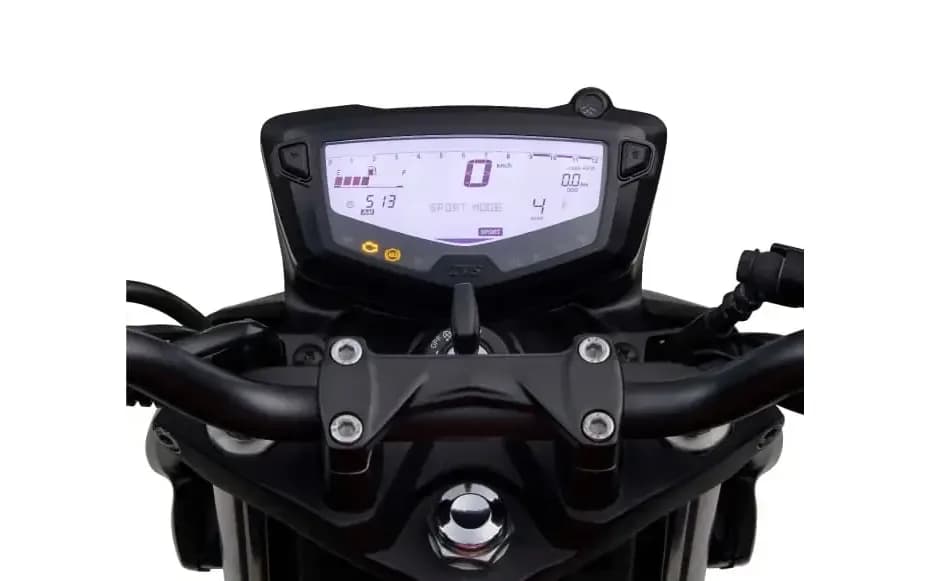
The party piece here is the fully digital instrument cluster, which packs in speed, RPM, gear position indicator, average speed and a lap timer, features that were until recently the preserve of bigger, pricier motorcycles. TVS SmartXonnect Bluetooth connectivity pairs the cluster with a smartphone for turn-by-turn navigation and call or SMS alerts, which is genuinely useful for riders navigating Kathmandu's unmarked lanes rather than a gimmick.
A dedicated Mode button on the handlebar switches between Rain, Urban and Sport riding modes, and this is not a cosmetic toggle. It measurably changes power delivery, throttle response and how aggressively the ABS intervenes, with Rain mode pulling back power and sharpening ABS cut-in for slippery conditions, and Sport mode opening up the top end for a rider who wants it. Glide Through Technology lets the bike crawl at 7-10 km/h in stop-start traffic without any throttle input at all, a small feature that solves a very real Kathmandu ring-road problem: clutch fatigue in gridlock.
A 160cc Engine That Behaves Differently By Mode
The 4V SE uses a 159.7cc, oil-cooled, fuel-injected four-valve engine. TVS Nepal's specification lists 17.55 PS at 9,250 rpm and 14.73 Nm in Sport mode, with power reduced to 15.64 PS in Urban or Rain. These 4V specifications should not be assigned to the separate 2V model. That spread is the real story of this engine. It isn't just a single fixed output chasing a spec-sheet number; it is tuned to feel noticeably different depending on what the rider selects, which is unusual at this price and displacement.
Power reaches the rear wheel through a 5-speed manual gearbox and chain drive, both of which feel appropriately matched to the engine's character: smooth enough for daily commuting, energetic enough in Sport mode to give a genuine sense of punch on an open stretch. The bike is commonly praised for exactly this: quick, confident overtakes on highway stretches where a plain 160 would need a downshift and a run-up.
Ride Quality That Handles Kathmandu's Broken Edges Well
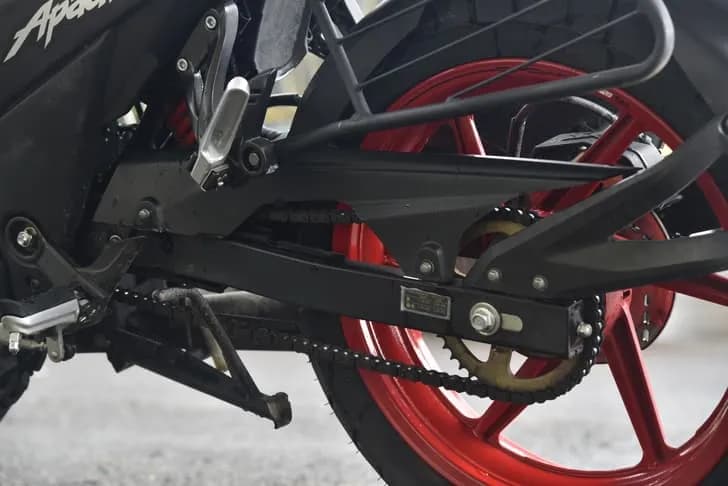
A 180mm ground clearance is generous for this class and pays off directly on Nepali roads, where speed breakers, gravel patches and monsoon potholes are a daily fact of riding rather than an occasional hazard. The 4V SE has telescopic front forks and a rear monoshock; the twin-shock description belongs to the 2V and should not be carried across.
Radial tubeless tyres, with a 130-section unit at the rear, give the bike real grip through corners and under hard braking, and they're a big part of why the Apache is widely regarded as one of the more confidence-inspiring handlers in its class. Stability at speed on the highway is a genuine strength here, not marketing gloss.
Seat Height And Lever Reach Built For Most Nepali Riders
TVS lists an 800mm saddle height for the 4V SE. Its seating position remains approachable for riders of most heights, and the single-piece handlebar keeps the reach upright rather than committing fully to a clip-on sportbike crouch. It is a sporty seating posture without being punishing on a daily commute. The 3-step adjustable clutch and brake levers are a genuinely useful inclusion at this price, letting riders with smaller hands bring the reach in rather than living with a fixed setting.
The pillion seat is the one ergonomic compromise worth flagging honestly. It sits slightly raised and is narrower than ideal, something riders who regularly carry a passenger will notice on longer trips. It is not a dealbreaker, but it is a real one.
Braking That Differs Sharply Between The Two Variants
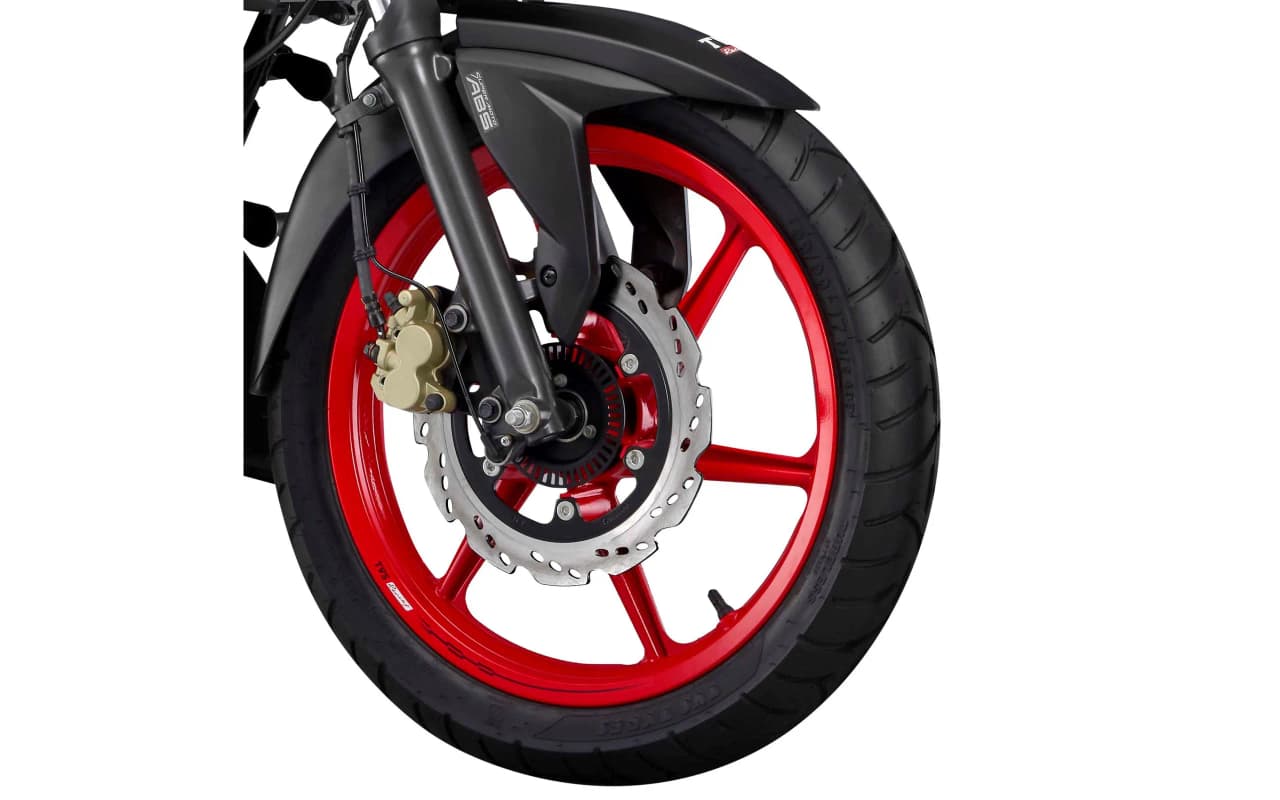
This is where the two variants genuinely diverge, and buyers need to read the spec sheet carefully rather than assume both trims are equal. The 2V BT gets a 270mm front disc paired with a 130mm rear drum. The 4V ABS RTFI SE steps up to disc brakes front and rear, both working with single-channel ABS. Single-channel, not dual-channel, is the one safety-spec criticism that follows this motorcycle consistently across its market. The ABS system's behaviour does shift with the selected riding mode, tightening intervention in Rain mode, which is a genuine safety benefit, but it doesn't replace the reassurance dual-channel ABS gives under heavy front-and-rear braking on wet tarmac.
Fuel Range And Everyday Usability
A 12-litre tank is comfortably sized for this class, giving a workable range for both daily city riding and the occasional trip out to the hills. TVS's own claimed mileage figure sits at 45 kmpl, though this is very much a best-case number achieved in Urban or Rain mode with a gentle right hand.
Real-world conversation among Nepali owners and Indian user reviews puts everyday mileage closer to 35-40 kmpl once Sport mode gets regular use, which is the honest number to budget against rather than the claimed one. For a rider doing a daily Kathmandu commute with occasional highway runs, that gap matters when working out running costs against a plain 160cc commuter.
Running Costs Beyond The Fuel Bill
Fuel economy is the headline running cost, and the mode-dependent swing described above is the main variable buyers should plan around. Riding predominantly in Urban or Rain mode for city traffic and saving Sport for open highway stretches is the practical way to keep the Apache close to its claimed figures.
The other running-cost consideration raised repeatedly in market discussion is resale. The Apache's resale value is perceived by some buyers as softer than direct rivals when it comes time to sell, which is worth weighing for anyone planning to trade in after three or four years rather than keep the bike long-term.
Picking Between The 2V BT And The 4V ABS RTFI SE
At the original September 2026 quoted prices, the Rs 71,000 gap between variants bought a genuine list of upgrades, not a badge. The 4V SE adds the second engine valve pair with its broader mode-dependent power band, a rear disc brake in place of the drum, adjustable levers, and the matte black paint with red wheels and dual-tone seat that make it look distinctly more premium in a showroom line-up. For most buyers who can stretch the budget, the SE is the one we'd point toward: the drum rear brake alone on the 2V BT is a meaningful step down in stopping confidence for a bike capable of the acceleration this engine offers in Sport mode.
The 2V BT still makes sense for a buyer who wants the Apache's looks and highway manners without paying for the full electronics suite, and who is comfortable trading some braking and feature depth for a lower ex-showroom figure.
The Bajaj Pulsar NS160 Is The Direct Value Challenge
The Bajaj Pulsar NS160 remains the most obvious cross-shop in this bracket for Nepali buyers, built around a similar muscular-naked-bike brief and typically priced to undercut the Apache on paper. Where the Apache pulls ahead is the riding-mode system and the adjustable lever set, neither of which the Pulsar NS160 offers in equivalent form. Buyers who prioritise raw spec-sheet value over electronics will still cross-shop the NS160 seriously.
The Honda Hornet 2.0 Trades Attitude For Reliability Reputation
The Honda Hornet 2.0 competes less on outright riding-mode tech and more on Honda's reputation for low running costs and dealer network depth in Nepal. It doesn't match the Apache's mode-switching or its adjustable lever set, but for a buyer whose main priority is minimising long-term ownership fuss over chasing performance features, the Hornet 2.0 remains a serious rival worth a showroom visit.
The Yamaha FZ-S FI Is The Quieter, Simpler Alternative
The Yamaha FZ-S FI sits at a similar price point with a more understated design language and a reputation for smooth, low-drama running. It lacks the Apache's riding modes and digital feature set entirely, but for buyers who find the Apache's sporty, aggressive positioning a bit much for daily commuting, the FZ-S FI is the calmer option worth cross-shopping before deciding.
Verdict
The TVS Apache RTR 160 4V earns its place near the top of Nepal's 160cc shelf on the strength of genuine engineering, not just badge appeal: mode-dependent power and ABS behaviour, a properly useful digital cluster, and ground clearance that respects how Nepali roads actually behave. The 4V ABS RTFI SE, originally quoted in September 2026 at Rs 3.85 lakh and listed by TVS Nepal at Rs 3,99,900 on 17 September 2026, is the version that delivers on the "200cc bike, 160cc price" promise most convincingly, with its disc rear brake and adjustable levers.
The trade-offs are real rather than cosmetic. The single-channel ABS described for this SE is a genuine safety compromise against dual-channel rivals, the base 2V BT's drum rear brake is a step down worth thinking hard about, and claimed 45 kmpl mileage needs a mental discount to 35-40 kmpl for anyone who enjoys Sport mode. Buyers chasing maximum daily-commute fuel efficiency or bulletproof resale should cross-shop the Honda Hornet 2.0 and Bajaj Pulsar NS160 before committing. For riders who want a 160cc motorcycle that looks, sounds and rides like something a class above it, the Apache RTR 160 remains one of the more convincing choices in Nepal's showrooms.
Frequently asked questions
What is the price of the TVS Apache RTR 160 4V in Nepal?
As of September 2026, the TVS Apache RTR 160 4V Special Edition is priced at NPR 3,99,900 in Nepal.
Real buyers, real ownership
What owners are saying
Compiled owner and buyer discussion for each vehicle — likes, complaints and the questions buyers ask.
Explore full specifications, variants & ownership context
Know the product
Key specifications, features & ownership context
Choose a variant to see its recorded specifications and features. Equipment and prices can change across trims.
Latest catalog and directory records supplement the original analysis. Figures may have changed since publication; individual specification and price-check dates appear below.
Rs 4.3 lakh ex-showroom · source checked 30 Oct 2026
Rs 3.65 lakh ex-showroom · source checked 28 Nov 2026
Engine & performance
| Specification / feature | USD | FI |
|---|---|---|
| Engine displacement | 159.7 ccVerified specification · 24 Oct 2026 | 159.7 ccVerified specification · 14 Nov 2026 |
| Max power | 17.55 PSVerified specification · 24 Oct 2026 | 16.04 PSVerified specification · 24 Oct 2026 |
Brakes, tyres & suspension
| Specification / feature | USD | FI |
|---|---|---|
| ABS | ABSVerified specification · 21 Oct 2026 | Single-channel ABSResearched · confirm · 24 Oct 2026 |
Dimensions & weight
| Specification / feature | USD | FI |
|---|---|---|
| Ground clearance | 180 mmVerified specification · 5 Aug 2026 | 180 mmVerified specification · 24 Oct 2026 |
Showroom & service support
Distributor: Jagdamba Motors Pvt. Ltd. (TVS Nepal)
TVS showrooms in Kathmandu (234 showrooms nationwide) · TVS service centers in Kathmandu (57 service locations nationwide)
Listed cities include Attariya, Baglung, Banepa, Bansgadhi, Bardaghat, Bardibas and 99 more.
Brand-wide directory coverage. Confirm that your nearest workshop supports this exact model, powertrain and warranty work; ask about parts availability and booking time.
Market buzz & buyer priorities
Compiled discussion, including buyer reactions and ownership reports; this is not a verified owner survey or a reliability score. Research dated 28 Nov 2026.
What people like
- Class-leading power delivery in the 160cc segment
- Effective Glide Through Technology (GTT) for smooth crawling in traffic
Concerns to investigate
- power feels less in real world
- Minor engine vibrations felt at speeds between 60 km/h and 75 km/h
- Initial stiffness in gear shifting during the engine break-in period
More feedback
- Pillion seat height and comfort considered less ideal for elderly passengers
What buyers ask for
- Real-world fuel economy for daily commuting in cities like Kathmandu
- Ground clearance for navigating unpaved or damaged road sections
- Resale value compared to competitors in the 160cc segment
Nepal ownership context
- High ground clearance of 180mm is frequently cited as a major advantage for Nepali speed breakers
- Jagdamba Motors maintains a wide network of showrooms, making parts and service accessible
- The 160 4V is a popular alternative to the Pulsar NS160 due to its superior technology and riding modes
More feedback
- Knight Black and Matte Black are the most requested colors among Nepali youth
- Nepali buyers commonly compare its purchase price and after-sales confidence with the availability of service centres, spare parts and resale support in their own city.
- Its ground clearance and manageable weight are relevant for Kathmandu traffic, uneven urban roads and occasional rough-road use, but buyers should still confirm the exact Nepal variant before purchase.
Showroom & service support
Distributor: Jagdamba Motors Pvt. Ltd. (TVS Nepal)
TVS showrooms in Kathmandu (234 showrooms nationwide) · TVS service centers in Kathmandu (57 service locations nationwide)
Listed cities include Attariya, Baglung, Banepa, Bansgadhi, Bardaghat, Bardibas and 99 more.
Brand-wide directory coverage. Confirm that your nearest workshop supports this exact model, powertrain and warranty work; ask about parts availability and booking time.
Market buzz & buyer priorities
Compiled discussion, including buyer reactions and ownership reports; this is not a verified owner survey or a reliability score. Research dated 28 Nov 2026.
What people like
- Reliable and punchy initial performance from the 159.7cc air-cooled engine.
- Decent fuel efficiency for the segment, often outperforming the 4V variant in mileage.
- Classic Apache styling remains popular among Nepali youth and daily commuters.
More feedback
- Lightweight kerb weight of approximately 137kg-140kg makes it easy to maneuver in heavy traffic.
Concerns to investigate
- Noticable engine vibrations and noise particularly in the 40-55 km/h speed range.
- Service center quality and wait times are frequently cited as chaotic or inconsistent.
- Issues with handle and frame looseness reported by some owners after riding on rough roads.
More feedback
- Vulnerable braking performance if not maintained, with some users reporting stuck brakes.
- Engine refinement is lower compared to modern fuel-injected competitors from Yamaha or Bajaj.
- The higher variants make the price-sensitive 160cc segment harder to justify for some Nepalese buyers.
What buyers ask for
- Fuel economy (mileage) is a top priority for daily commuters.
- Seat height (790mm) is a major factor for comfort among average-height Nepali riders.
- Low maintenance costs and widespread availability of spare parts through TVS Nepal.
More feedback
- Modern tech additions like digital consoles and Bluetooth connectivity in newer refreshes.
Nepal ownership context
- Authorized distribution and after-sales service are managed by Jagdamba Motors Pvt. Ltd.
- Ground clearance of 165mm is generally sufficient for Kathmandu roads but requires care on steep speedbreakers.
- Resale value remains strong in the second-hand market due to the bike's long-standing reputation in Nepal.
More feedback
- The 2V variant is favored over the 4V by some Nepali buyers specifically for its better fuel economy on long commutes.
- The on-road price is higher than the ex-showroom price because registration, insurance and applicable government charges vary by location and purchase details.
- Nepali buyers commonly compare the motorcycle's ground clearance and suspension suitability with the broken roads, speed breakers and mixed surfaces found outside major cities.
- The Nepal motorcycle uses a petrol combustion powertrain, so ownership depends on petrol availability and regular servicing rather than charging access.
Use these facts alongside the article’s full analysis. Check the final quotation, warranty terms and exact equipment before booking.
Evidence & next steps
Check the details before you buy
Use this guide to build a shortlist. Ask for a written quotation for your chosen variant, including registration, taxes, insurance and finance charges. Confirm the nearest authorised workshop supports that model.
Price sources and dates
These are the recorded distributor-source checks for the selected overview trims. They are separate from the article update and catalog read dates; they do not mean every trim was rechecked today. Confirm the final price with the distributor.
Overview photos come from the corresponding model records; additional article photos carry their own credits. Running costs depend on usage, energy prices, maintenance, insurance and resale value.