Where The Raider Sits In Nepal's Crowded 125cc Shelf
The 125cc commuter segment in Nepal is arguably the most contested price band in the entire two-wheeler market, and the TVS Raider has carved out a distinct identity within it since Jagdamba Motors brought it in back in 2021. At an ex-showroom spread of Rs 2,79,900 for the base FI Drum to Rs 3,15,900 for the top Igo variant, it sits squarely against Nepal's best-selling commuter names, but it doesn't try to compete on conservative appeal. Instead, it leans hard into sporty styling and tech-flavoured features aimed at a younger buyer who wants their first "big bike" to look and feel a notch above the usual 100cc-125cc fare.
That positioning matters in a market where a huge share of 125cc buyers are first-time owners, often students or young professionals, buying largely on financing. The Raider's job is to feel aspirational without pushing the price into 150cc territory, and on the showroom floor, it largely succeeds at that balancing act.
Sharp Creases, Split Seats And A Design That Reads Younger Than Its Segment
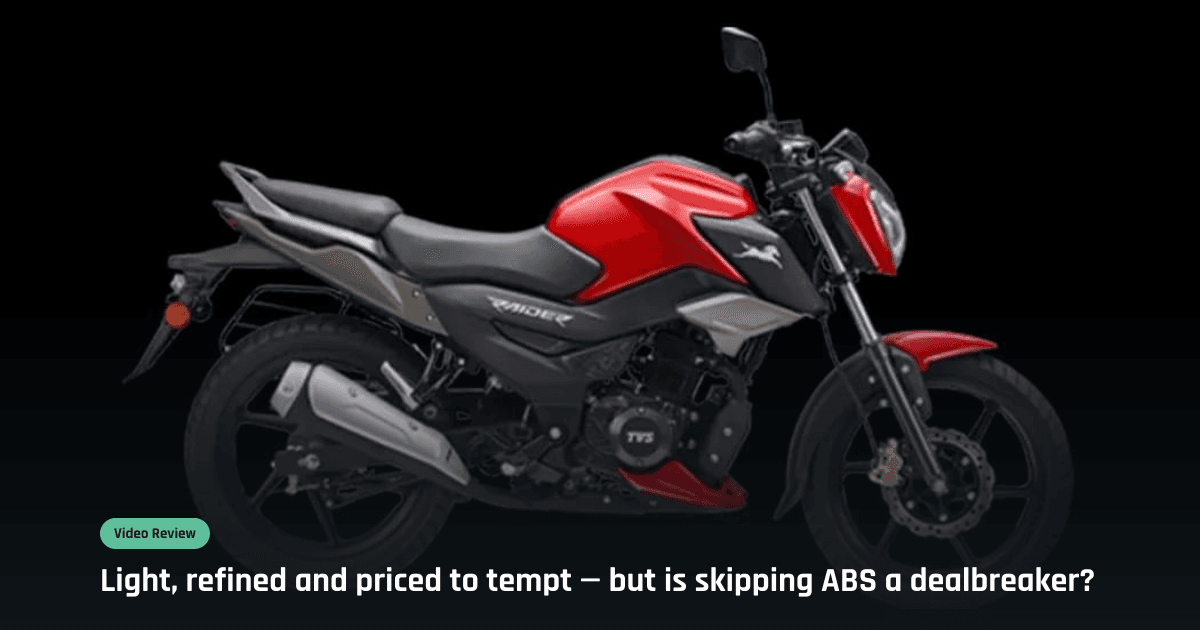
The Raider doesn't try to hide behind understated commuter styling — it leans into sharp tank shrouds, an angular LED headlamp cluster that gives the front an aggressive, almost predatory stance, and body graphics that immediately mark it out from the more conservative bikes parked next to it. The overall silhouette is compact and purposeful, helped by the fact that the bike is genuinely light for its class.
Build quality feels appropriate for the price bracket rather than premium, but nothing about the panel gaps, switchgear or paint finish on showroom units gives cause for concern. The split seat design featured on the FI and Igo variants adds to the sporty look and is a deliberate design choice over the more utilitarian single seat on the base FI Drum. It's a small detail, but it's the kind of thing that Nepali buyers comparing bikes side-by-side on a showroom floor do notice and talk about.
The Colour Choices Do Real Work In Attracting Attention
Colour matters disproportionately in this segment, where buyers are often riding the same bike as three of their friends and want some way to stand apart. TVS understands this with the Raider, offering paint and graphics treatments that range from the more restrained tones on the base variant to bolder, more eye-catching schemes on the higher trims. Darker, more premium-looking finishes paired with contrasting alloy wheel colours consistently draw more attention on the road than the plainer options, and that visual distinctiveness has become part of the Raider's identity in the Nepali market. For buyers who cross-shop purely on looks before they even sit on the bike, the colour and graphics package is often the first thing that pulls them toward the showroom.
A Digital Cluster With iGO Assist, But The TFT Stays Exclusive To The Top Trim
Feature equipment is genuinely one of the Raider's strongest cards against other 125cc commuters. The instrument cluster carries an iGO Assist indicator that lights up under hard acceleration, letting the rider know the torque-boost system has kicked in — a small but satisfying bit of feedback that few rivals at this price bother to offer. The bike also gets a wave-style key, which feels like a genuinely premium touch that's rare to see below the Rs 3 lakh mark in Nepal.
It's worth being clear about what's split across variants here. The Raider FI Drum and Raider Fi run a standard reverse LCD digital screen, while only the range-topping Raider Igo — at Rs 3,15,900 — gets the full TFT display along with the associated on-console notifications, navigation prompts, weather updates and sports score alerts that TVS bundles under its connected features. None of the three variants get ambient sensors, true smartphone connected tech, voice assist or call management, so buyers expecting a fully connected dashboard experience should look at the Igo variant with realistic expectations rather than assuming smartphone-grade functionality. A USB charging port, however, is a consistent inclusion across the lineup and remains one of the more genuinely useful everyday conveniences.
An Engine That Feels More Refined Than Its 124.8cc Displacement Suggests
The heart of the Raider is a 124.8cc air-and-oil-cooled single-cylinder engine producing 8.37 kW at 7,500 rpm and a maximum torque of 11.2 Nm at 6,000 rpm — figures that read modestly on paper but translate into a genuinely likeable riding experience in the metal. What stands out most is refinement: this engine settles into higher speeds with none of the buzziness that plagues many budget 125cc units, staying smooth even as revs climb toward the top of its range.
TVS's Intelligo and iGO Assist technology is the more interesting story here. Under quick throttle inputs, the system adds an extra 0.55 Nm, pushing total torque to a claimed 11.75 Nm and giving the engine a noticeably eager surge exactly when it's needed — pulling away from a traffic light, overtaking a slower vehicle, or powering up a short incline. TVS also claims this system, when paired with Ecothrust FI, can deliver mileage improvements over a standard tune. Low-end pulling power is a particular highlight: the Raider can crawl comfortably in third gear in stop-start traffic without hunting for a lower gear or threatening to stall, which is exactly the kind of real-world usability that matters more to Kathmandu commuters than headline power figures.
The five-speed gearbox uses a conventional 1-N-2-3-4-5 pattern and shifts cleanly, while the multiple ride modes — Eco and Power — give riders a genuine choice between stretching fuel and enjoying a sharper throttle response, a feature set that's unusually generous for this price point.
Telescopic Forks And A 5-Step Monoshock That Cope Well With Bad Roads
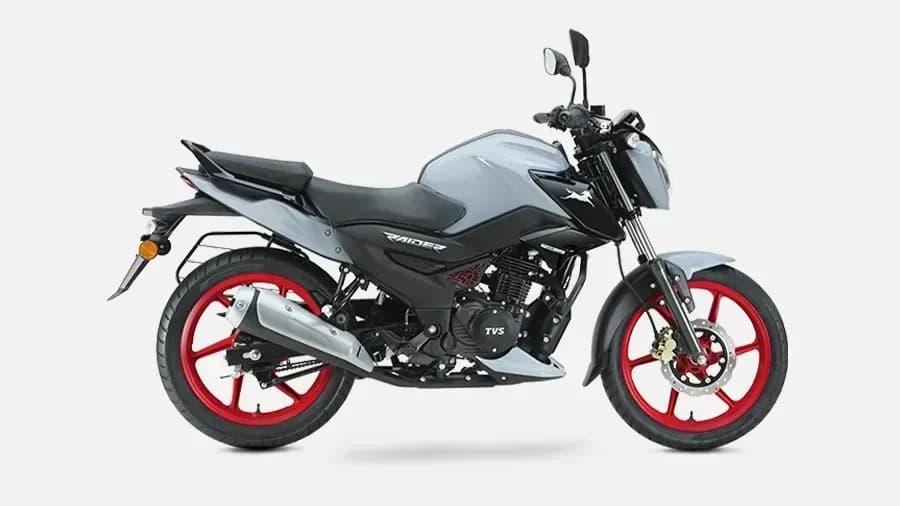
At 123 kg kerb weight, the Raider is noticeably lighter than several of its direct 125cc rivals, and that weight advantage shows up immediately in how effortlessly it changes direction, threads through traffic, and gets flicked into corners. The telescopic front fork and 5-step adjustable, gas-charged monoshock rear suspension combine to soak up potholes and speed breakers with a compliance that feels a step above what the price suggests, and the 180mm of unladen ground clearance means rougher rural stretches and poorly maintained urban roads don't require the usual careful navigation.
The one honest reservation concerns the rubber. The 80/100-17 front and 100/90-17 rear tubeless tyres are on the narrower side for a bike capable of sustained highway speeds, and while they offer adequate grip for city and moderate-speed riding, they don't inspire the same confidence at higher speeds or in wet conditions that a wider footprint would. It's a trade-off buyers should weigh, especially those planning regular highway stretches rather than pure city use.
An Upright Riding Position That Works For Teenagers And Their Fathers Alike
Ergonomics on the Raider are sensibly judged for a wide range of body types and riding experience levels. The handlebar position encourages an upright, relaxed posture rather than anything committed or sporty, which suits both short city hops and longer weekend rides without inducing wrist or shoulder fatigue. The seat height and reach to the footpegs feel proportioned for the kind of shared, multi-rider ownership common in Nepali households, where the same motorcycle might do daily duty for a college-going son and occasional errands for an older family member.
The split seat on the FI and Igo variants adds a touch of visual sportiness without compromising comfort over longer stints, while the single-seat FI Drum keeps things simpler and slightly more utilitarian.
Strong Front Brake Bite, But No ABS Anywhere In The Range
The front disc brake, available on the FI and Igo variants, offers confident bite and progressive stopping power that inspires trust even under harder braking from higher speeds. It's one of the more reassuring components on the bike dynamically.
What holds the safety package back is the complete absence of ABS across all three variants, including the range-topping Igo. This is a widely flagged shortcoming in the 125cc class generally, but it's particularly worth noting on a bike capable of comfortably running at 100 km/h thanks to its light weight and eager engine. Buyers who ride mixed conditions, including wet monsoon roads, should factor this into their decision, since even a single-channel ABS setup would have gone a long way toward closing this gap.
Light Enough For The City, Tall Enough For The Village Roads Beyond It
Daily practicality is where the Raider's lightness and ground clearance pay off together. Weaving through Kathmandu's traffic, parking in tight spaces, and picking through unpaved lanes on the city's outskirts are all made easier by a bike that doesn't feel like a handful at low speeds, and the 180mm clearance means speed breakers and rutted surfaces rarely require a change of line.
Where Fuel Savings And Cheap Servicing Add Up Over Ownership
Running costs are consistently cited as one of the Raider's biggest draws, with the Ecothrust FI and iGO Assist combination contributing to strong real-world fuel efficiency that keeps weekly fuel spend low for daily commuters. TVS's service network through Jagdamba Motors is well established in Nepal, and the Raider is generally regarded as an affordable motorcycle to maintain, with routine servicing costs that stay reasonable over the ownership period — an important consideration for the budget-conscious buyer this bike is aimed at.
Which Of The Three Variants Actually Makes Sense To Buy
The lineup is simple: the Raider FI Drum at Rs 2,79,900 gets a drum rear brake and the standard digital cluster; the Raider Fi at Rs 3,05,900 adds the front disc brake and split seat; and the Raider Igo at Rs 3,15,900 tops things out with the full TFT display, navigation-style connected notifications and the complete iGO Assist experience. For most buyers, the middle Fi variant represents the sensible sweet spot — it brings the front disc brake that meaningfully improves stopping confidence without stretching to the Igo's premium for a screen that, while nice to have, isn't essential. Buyers who want the full tech showcase and don't mind paying the roughly Rs 36,000 premium over the base bike should go straight for the Igo.
The Honda SP 125 Plays It Safer But Feels Older-Fashioned
The Honda SP 125 remains the default choice for buyers who want maximum reliability and the lowest possible drama, and it's a genuinely competent commuter. But next to the Raider, the SP 125 feels visually conservative and mechanically less adventurous — there's no equivalent to the iGO Assist torque boost, no ride modes, and a distinctly older-school design language. Buyers who want something youthful and modern-feeling will find the Raider the more engaging choice.
The Hero Xtreme 125R Brings Wider Tyres But Less Universal Appeal
The Hero Xtreme 125R is the closer sporting rival, running a wider 120-section rear tyre that gives it a stability edge the Raider's slimmer 100-section rear can't quite match at higher speeds. However, the Raider's design tends to appeal across a broader age range, and its refinement and low-end torque delivery hold their own against the Xtreme's more aggressive positioning.
The Bajaj Pulsar 125 Feels Heavier And Less Modern By Comparison
Against the Bajaj Pulsar 125, the Raider's 123kg kerb weight gives it a clear maneuverability advantage, and the feature set — ride modes, iGO Assist, the wave key — makes the Pulsar 125 feel comparatively basic and dated. Riders who prioritise agility and everyday tech over outright brand legacy will lean toward the Raider.
The Verdict: Who Should Actually Buy One
The TVS Raider earns its reputation as one of the most complete packages in Nepal's 125cc segment. It pairs a genuinely refined, torquey engine with class-leading light weight, a suspension setup tuned sensibly for Nepali road conditions, and a features list — iGO Assist, ride modes, the wave key, and the TFT screen on the Igo — that punches above its price bracket. The narrower tyres and the lack of ABS across the range are legitimate compromises, and highway-focused riders or safety-conscious buyers should weigh them seriously.
For college students and young first-time riders wanting something stylish, light and cheap to run, and for families who want one motorcycle that suits riders of different ages and experience levels, the Raider remains an easy recommendation — provided buyers go in with clear eyes about what the price doesn't include.
Writes on vehicle pricing, taxation and the Nepali auto market from ongoing tracking of distributor price lists. Editorial policy.