Where This Fits In Nepal's Naked Bike Pecking Order
Nepal's 150-160cc segment is crowded with commuter-sport crossovers, but very few of them are true streetfighters built around a track-derived chassis. The MT-15 V2 is one of the rare ones. Distributed by MAW Rides Pvt. Ltd. as Yamaha Nepal's flagship small-capacity naked, it sits at Rs 5,49,900 for the standard BS6 variant and Rs 5,76,900 for the fully-loaded MT-15 V2, positioning it above most 150-160cc commuters and squarely as an aspirational buy for riders who want R15 handling DNA without the fairing. This is not a bike aimed at practicality-first buyers — it's aimed at someone who wants to feel the difference every time they tip it into a corner.
The 2024 update to the Nepali market brought two changes that matter more than any cosmetic tweak: dual-channel ABS and a traction control system, both now standard. For a bike in this price band, that's a meaningful safety upgrade, and it's the single biggest reason the MT-15 V2 has moved from "good-looking naked" to "genuinely well-equipped naked" in our assessment of the segment.
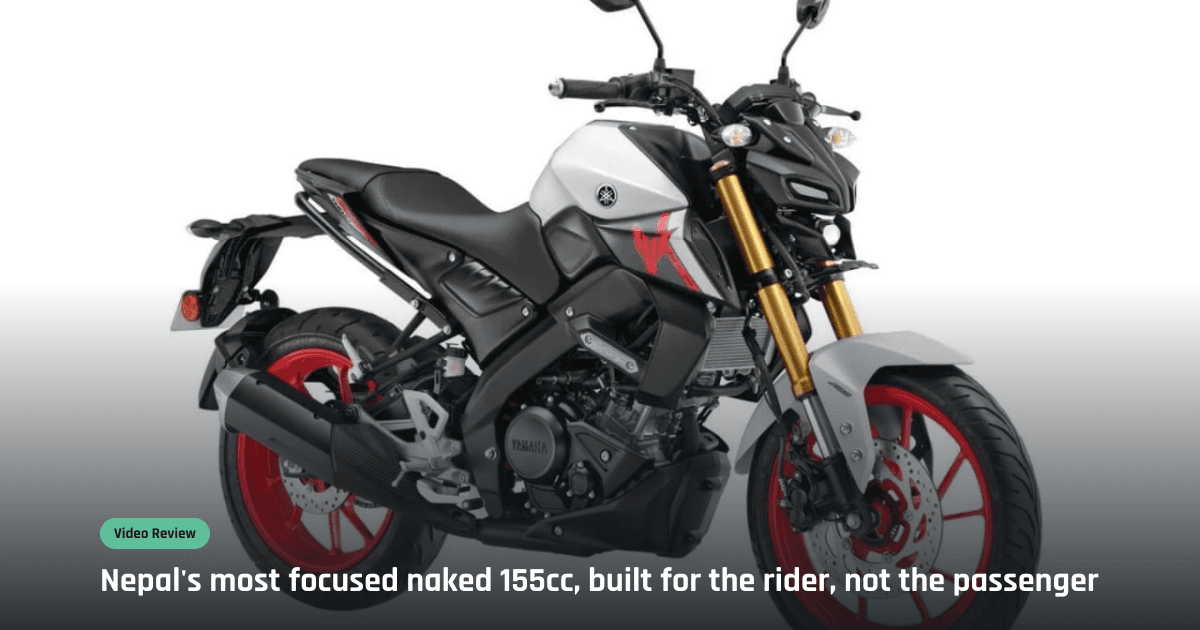
An Aggressive, Slightly Robotic Face That Actually Suits the Metallic Black Colourway
The MT-15 V2's design language hasn't softened with age — if anything the sharp, faceted headlight cowl and twin LED auxiliary lights flanking the bi-functional LED projector unit still look like nothing else in this price bracket. It's a deliberately robotic, insectoid front end, and it photographs better in person than in spec sheets.
The Metallic Black variant we've spent the most time looking over at showroom level is the one that best sells this design. It mixes matte black tank panels with glossy black elsewhere, and Yamaha has thrown in orange/red alloy wheels that pop hard against the dark bodywork. The golden-finished USD front forks add another splash of contrast up front and genuinely lift the perceived quality of the bike — this doesn't look like a Rs 5.5 lakh motorcycle when it's parked next to cheaper naked competition. Around the back, the sharp LED tail lamp and chunky tyre hugger keep the rear end visually tidy, though the compact tail does foreshadow the pillion accommodation problem we'll get to shortly.
Build quality at the panel gaps and switchgear level holds up well under showroom scrutiny — nothing rattles, nothing feels like it was value-engineered down to hit a price point.
Four Colours, One Special Edition That's No Longer Around
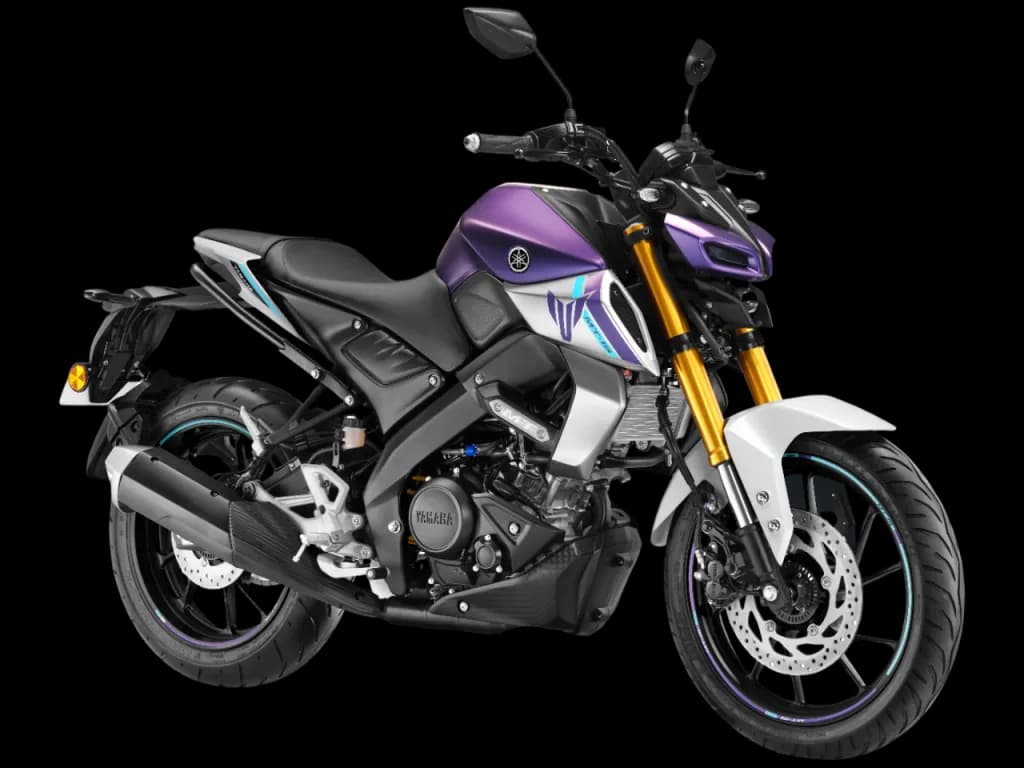
Buyers in Nepal can currently choose between Cyan Storm, Ice Fluo Vermillion, Racing Blue and Metallic Black. All four lean into the aggressive-naked theme rather than offering a subdued option — there's no black-on-black stealth trim here, which suits a bike built to be noticed. A Monster Energy-inspired special edition livery has been sold in the past but isn't part of the current lineup, so buyers hoping to track one down should treat it as unavailable rather than a special order.
A Cluster That Talks to Your Phone, and Actually Says Something Useful
The fully digital LCD instrument cluster is one of the MT-15 V2's genuine value propositions. It bundles a tachometer, speedometer, fuel gauge, gear position indicator, VVA status and TCS indicator into one legible display, and pairs with a phone via the Yamaha Y-Connect app to unlock a surprisingly deep feature set: call alerts, SMS and email notifications, phone battery level, last-parked-location, a fuel consumption tracker, a maintenance reminder system, and even a malfunction notification and ranking feature. Few 155cc streetfighters sold in Nepal offer this level of connected functionality standard.
Switchgear quality matches the cluster's ambition — the left switch cube integrates the pass light and high/low beam toggle cleanly, and the right side houses the engine kill/start switch with a positive, tactile action. LED turn signals are now standard across the range, replacing the older bulb-type units and giving the bike a more premium look at the extremities, not just at the headlight.
The VVA Kick Above 7,400rpm Is the Engine's Party Trick
The 155cc liquid-cooled, SOHC, 4-valve engine shares its fundamental architecture with the R15, and it shows in how willingly it revs. With 18.6PS at 10,000rpm and 14.1Nm of torque at 7,500rpm, it's not the most powerful engine in its capacity class on paper, but the way it delivers that power is the story. Yamaha's Variable Valve Actuation kicks in above 7,400rpm and gives a distinct, noticeable surge in the top end — the kind of thing that makes short shifting feel like the wrong move and holding a gear to redline feel like the right one.
The wet, multiple-disc clutch pairs with a 6-speed constant-mesh gearbox, and the light clutch pull makes stop-start city riding far less tiring than the bike's sporty intent might suggest. The exhaust note backs up the performance character with a bassy grunt at idle that turns raspy under load — it doesn't sound like a generic commuter engine, and that matters to the buyer this bike is chasing. Compression ratio sits at 11.6:1, and the fuel-injected setup means cold starts and throttle response stay consistent regardless of altitude, a real consideration on Nepal's hill roads.
The Deltabox Frame Is Why It Corners Like It Costs More
This is where the MT-15 V2 separates itself from nearly everything else in its price range in Nepal. The Deltabox frame — the same design philosophy underpinning Yamaha's R-series — gives the chassis a rigidity that translates directly into cornering confidence. Paired with 37mm USD front forks and a well-tuned rear monoshock, the bike holds its line through direction changes with a planted feel that heavier, softer-framed commuters in this segment simply can't match.
The 140-section rear radial tyre does its part too, offering strong grip that lets the chassis's composure actually be exploited rather than wasted. At 141kg kerb weight with a 1,325mm wheelbase, the bike strikes a balance between stability at speed and the agility needed to flick through Kathmandu's traffic gaps. Ground clearance of 170mm is adequate for Nepali road conditions without feeling like the bike sacrifices low-slung sportiness to get there.
A Seat Built for One, With the Pillion as an Afterthought
At an 810mm seat height, most riders from around 5'4" upward will find the reach to the ground manageable, and the seat cushioning itself is comfortable enough for the rider over a normal commute. But the seat's footprint is genuinely compact, and that compactness becomes a real limitation the moment a second person climbs on.
The pillion seat is narrow to the point of being a token gesture rather than a usable perch, and Yamaha has fitted a single grab strap rather than proper grab rails — there's simply nothing substantial for a passenger to hold onto on a bumpy road. This is consistent with buyer and press feedback on the bike, and it's not a minor quibble: anyone who regularly rides two-up should treat this as a genuine deal-breaker rather than a small compromise, because the ergonomics here are built entirely around the solo rider experience.
Dual-Channel ABS and Traction Control Finally Arrive Where They Matter
The most consequential update to the MT-15 V2 is safety hardware, not styling. Dual-channel ABS now backs up the 282mm front disc and complements the rear setup, giving both wheels independent anti-lock protection rather than the single-channel arrangement of earlier versions. On a bike capable of the kind of cornering speeds this chassis enables, that upgrade is not cosmetic — it's a genuine reduction in risk on Nepal's mixed-surface roads.
The Traction Control System adds a second layer of protection, cutting in to prevent rear-wheel slip on wet tarmac, gravel patches, or the kind of monsoon-slicked roads that are a fact of life for much of the year in Nepal. A side stand engine cut-off sensor rounds out the safety package, a small but sensible inclusion that prevents riders from pulling away with the stand still down.
No Main Stand Means Chain Care Takes More Effort
Practicality here is a mixed picture. The 10-litre fuel tank is a reasonable size for a bike this compact, giving it decent range for city use and short weekend rides without feeling undersized. The light 141kg kerb weight and tight dimensions make it an easy bike to filter through traffic and park in tight showroom-adjacent alleys, which counts for a lot in Kathmandu and Pokhara's denser areas.
The absence of a main stand is a genuine practical shortfall, though. Chain lubrication and adjustment — routine maintenance on any chain-driven motorcycle — become noticeably more fiddly without one, and it's an odd omission on a bike that otherwise tries hard to feel complete.
What Riders Can Realistically Expect at the Pump
Real-world mileage in the region of 45 km/l is achievable when ridden sensibly in the 60-70 km/h band, which is a solid, believable number for a 155cc performance-oriented engine rather than a pure commuter unit. Riders who spend more time exploiting the VVA's top-end character should expect that figure to drop accordingly — this is a bike that rewards spirited riding with noise and pace, not with frugality.
Which Variant to Buy, and Why the Price Gap Matters
The two variants sold in Nepal — the MT-15 V2 BS6 at Rs 5,49,900 and the MT-15 V2 at Rs 5,76,900 — bracket a gap of just under Rs 27,000. Given that the higher trim is where buyers get the fuller expression of the model's current specification, and given how central the safety package and connected features are to this bike's value proposition, we'd steer most buyers toward stretching to the top variant rather than saving on the base trim. This is a bike bought as much for what it represents — technology, handling, safety tech — as for basic transportation, and skimping on the trim level undercuts that whole pitch.
The KTM Duke 125 Undercuts It in Displacement, Not in Overall Package
The KTM Duke 125 is the most obvious cross-shop for buyers eyeing the MT-15 V2 in Nepal's naked bike space. The Duke 125 counters with a wider stance — a 110-section front tyre and 150-section rear against the MT-15's 100-section front and 140-section rear — and larger brake discs, running a 300mm front and 230mm rear versus the MT-15's 282mm/220mm setup. On paper, that sounds like an edge for the KTM.
In practice, the MT-15 V2 answers back with more displacement, more usable power, and technology the Duke 125 doesn't offer at this price — VVA and a traction control system chief among them. For most Nepali buyers cross-shopping this pair, the Yamaha represents the stronger overall value proposition: more performance, more safety tech, for less money than one might expect given the equipment on offer.
The TVS Apache RTR 160 4V Is Cheaper, But Gives Up the Chassis Advantage
The TVS Apache RTR 160 4V is the more budget-conscious alternative in this conversation, and it undercuts the MT-15 V2 on price. What it can't match is the technical depth Yamaha has built in: the MT-15 gets liquid cooling where the Apache relies on air/oil cooling, VVA for that top-end surge, a Deltabox frame instead of a conventional frame design, USD forks instead of conventional telescopic units, and a traction control system the Apache doesn't offer.
For buyers whose primary concern is initial outlay, the Apache RTR 160 4V remains a sensible, credible choice. But anyone cross-shopping the two with handling and outright technology as priorities will find the MT-15 V2's extra spend translates into a tangibly more sophisticated motorcycle underneath them.
Our Verdict: Buy It to Ride Alone, Buy It to Ride Well
The Yamaha MT-15 V2 remains, in our assessment, the most technically accomplished 155cc naked available in Nepal at this price point. The combination of a Deltabox frame, USD front forks, VVA-equipped engine, dual-channel ABS and traction control is not matched feature-for-feature by anything else in this bracket, and the connected instrument cluster adds genuine daily usefulness rather than gimmick value.
The trade-offs are clear and consistent: a pillion experience that's an afterthought at best, no main stand for easy maintenance, and a price that sits above much of the direct competition. If you ride solo or with only occasional, short-distance pillion duty, and you value chassis composure and safety tech over outright practicality, the MT-15 V2 is an easy recommendation. If two-up touring comfort is a real requirement, look elsewhere — no amount of Deltabox rigidity fixes a seat that was never designed with a passenger in mind.
Writes on vehicle pricing, taxation and the Nepali auto market from ongoing tracking of distributor price lists. Editorial policy.