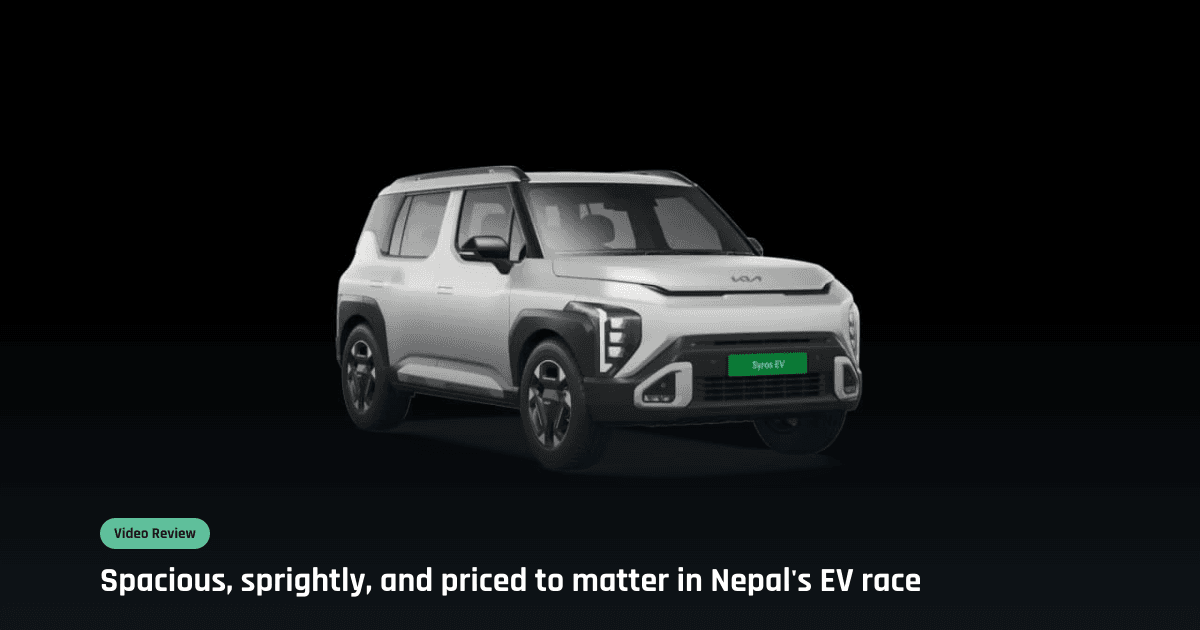
Where The Syros EV Fits Into Nepal's Electric Shift
Kia Nepal, through Continental Trading Enterprises, has priced the Syros EV at Rs 37.9 lakh ex-showroom for its single variant on offer in the Nepali market, positioning it squarely as a compact electric crossover built for city use rather than long highway hauls. This is a car aimed at buyers who have already decided an EV makes sense for their daily commute and want something more spacious and better equipped than the compact electric hatchbacks and SUVs currently dominating showroom floors in Kathmandu. Kia's own global lineup for the Syros EV includes multiple trims and two battery options, but for now Nepali buyers are looking at a single, well-specified offering rather than a sprawling trim ladder — which, if anything, simplifies the decision considerably.
The broader electric SUV segment in Nepal has grown crowded very quickly, and the Syros EV enters at a moment when buyers are comparing everything from small city-focused EVs to larger crossovers with bigger batteries. What immediately sets it apart on paper is cabin space and features-per-rupee, two things Nepali buyers have historically had to sacrifice when choosing a compact EV. Whether that translates into showroom success will depend heavily on how well Kia Nepal can communicate the ownership proposition alongside the price tag.
A Familiar Silhouette With Just Enough EV Identity
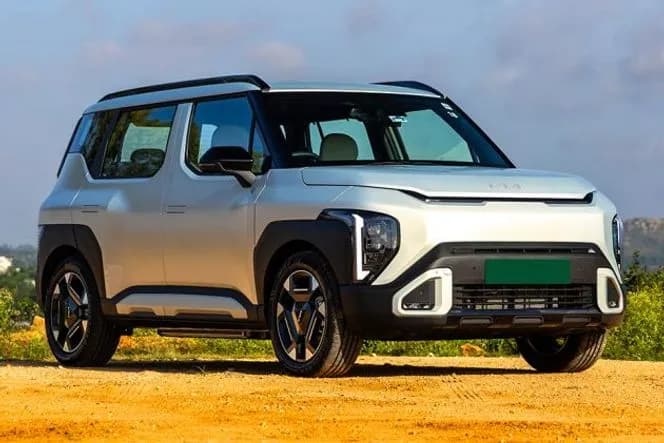
The Syros EV doesn't try to reinvent its own shape, and that is both its strength and its most debated trait. The clearest giveaway that you're looking at the electric version is the green number plate mandated for EVs in Nepal, but Kia has also made a handful of deliberate visual tweaks. The front bumper is slightly revised with a slimmer cooling slot positioned above the number plate, and the triangular pods that house the LED fog lamps have received minor detailing changes compared to the ICE Syros. The charging port sits on the front left fender rather than where a fuel filler cap would normally be, a small detail that still trips up first-time EV owners reaching for the wrong side of the car out of habit.
Underneath, the battery pack does protrude slightly and is visible if you crouch down beside the car, though the integration is tidy enough that it doesn't look like an afterthought. Ground clearance actually improves slightly on the EV, coming in at 197mm — 7mm higher than the ICE version, a welcome detail for Nepali roads where speed bumps and unpaved patches are unavoidable even in cities. The tri-spoke alloy wheel design is exclusive to the EV and is one of the more effective ways Kia has differentiated the car without going overboard. At the rear, changes are limited to an EV badge, so from behind, most people won't clock the difference at all.
Where opinion genuinely splits is the overall face of the car. The squat stance works well and gives the Syros EV a planted, purposeful look, but the rounded nose, low-set headlamps and heavy cladding combine into a design that reads as unusually quirky rather than conventionally handsome. This won't bother buyers who want their EV to look distinct from regular traffic, but those hoping for a more mainstream SUV silhouette may need to see it in person before committing.
Interior Colour Themes Worth Knowing Before You Choose
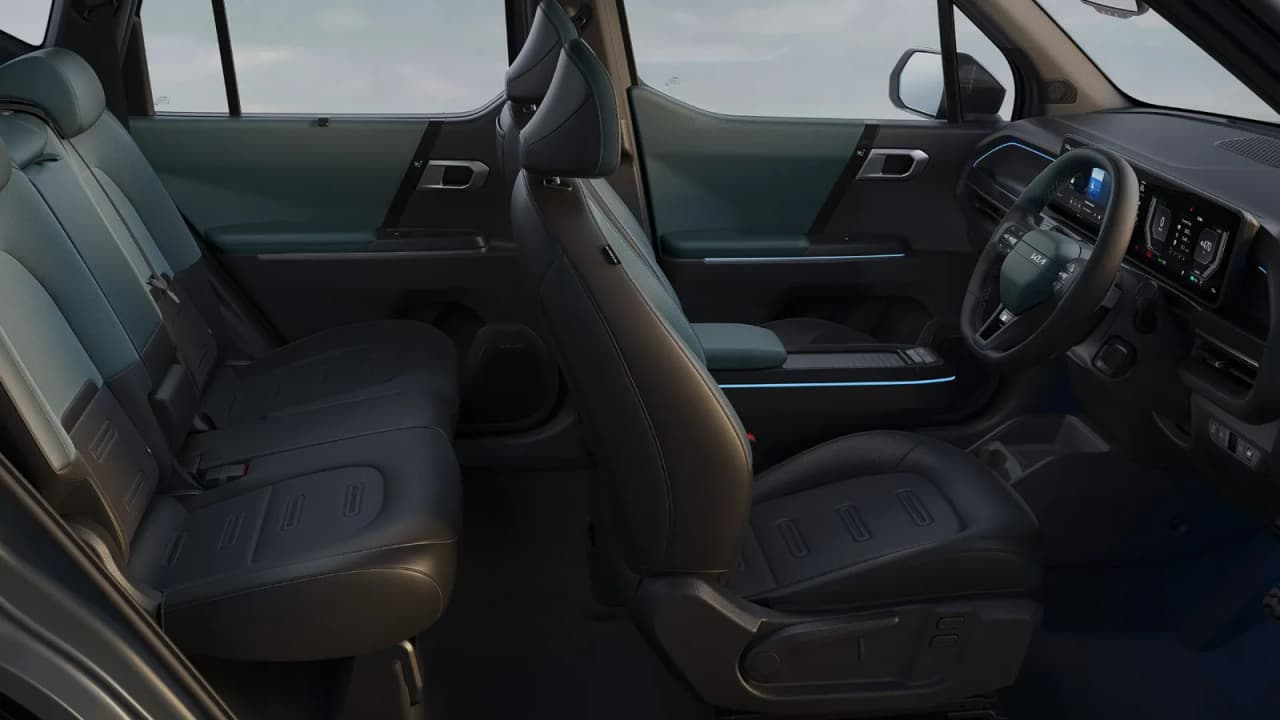
Kia offers a genuinely varied palette on the Syros EV's cabin, and it's worth understanding before you walk into a showroom. The higher X-Line trim gets an Onyx green and black interior theme that feels the most distinctly "EV" of the lot, while the HTX+ trim goes for a warmer cream and black combination that lifts the cabin ambience considerably. Other trims in the range come with a cloud blue and grey tone that leans more neutral. Exterior colour choices seen on test cars include a matte grey-greenish shade that suits the car's futuristic styling intentions well, though buyers should check current colour availability with Continental Trading Enterprises directly, as EV launch colours can vary by shipment.
The Cabin's Party Trick Is What It Doesn't Have
The single biggest change inside the Syros EV, compared to both its own ICE sibling and most rivals in this segment, is the redesigned center console. Because there's no transmission tunnel or gear selector to package, Kia has created a floating console section with genuinely useful storage space underneath it — a shelf that swallows phones, bags, and loose items that would otherwise clutter the front seats. It's a small engineering decision that pays off constantly in daily use.
The drive mode selector has moved to a stalk mounted behind the steering wheel, which also houses the start/stop switch, freeing up the console further. On higher trims, the steering wheel itself is borrowed from the Kia Seltos and carries controls for the ADAS suite, audio, and drive modes, though it's worth flagging that it only gets tilt adjustment with no reach adjustment — taller drivers may need a few extra minutes to find their ideal position, and some will never quite get there.
Dual 12.3-inch screens handle instrumentation and infotainment, backed by a separate 5-inch climate control display, and the infotainment system includes a dedicated EV-specific screen that shows battery status, nearby charging points, and energy consumption patterns — a genuinely useful inclusion rather than a gimmick. Wireless Android Auto and Apple CarPlay come standard, removing the annoyance of cables. The top-spec X-Line trim bundles in a crisp 360-degree camera alongside the ADAS suite. Ambient lighting now stretches to 64 colours and extends into the footwells, which sounds like a minor flourish until you're driving at night and appreciate the subtle glow. Front seats get ventilation and partial power adjustment for fore/aft movement and recline, while connected car features cover remote start, remote cooling, phone-as-key, scheduled charging, and remote battery preconditioning — all features that matter more in daily EV ownership than they might sound on a spec sheet.
Power Delivery That Rewards Confident Driving
Under the skin, the Syros EV uses a permanent magnet synchronous motor driving the front wheels, with the standard range version producing 135hp and the extended range variant stepping up to 171hp — both delivering 255Nm of torque. The claimed 0-100kph figure for the extended range version stands at 8.1 seconds, quick enough to make overtaking on the Prithvi Highway or navigating Kathmandu's chaotic traffic gaps feel genuinely stress-free rather than nerve-wracking.
Power delivery has been tuned thoughtfully. Even in Sport mode, where the motor feels most alert and responsive, there's no sudden jerkiness that can catch passengers off guard — a criticism often levelled at EVs tuned purely for peak acceleration numbers. Eco and Normal modes dial things back appropriately for stop-start traffic. What stands out most, though, is refinement: the motor is impressively quiet, and combined with good sound insulation, the cabin stays remarkably calm even under hard acceleration.
Suspension Reworked To Carry The Extra Weight, And It Shows
Anyone who has driven the ICE Kia Syros will know its low-speed ride can feel jiggly over Nepal's patchwork road surfaces. The EV version is a clear step up. Kia has reworked the suspension to cope with the roughly 200kg the battery pack adds, and the result is a noticeably more absorbent, settled ride quality that deals with potholes and speed breakers with far more composure. Suspension noise is also well contained, so you don't get the same clattering intrusion into the cabin that lesser-sorted EVs suffer from when their heavier underpinnings meet rough tarmac.
Steering is light and requires minimal effort, making the Syros EV easy to place in tight city lanes and multi-storey parking, while a large glasshouse gives excellent all-round visibility — genuinely useful given how many Kathmandu intersections demand quick judgment calls about oncoming traffic and pedestrians.
Rear Seat Space That Beats Cars Above Its Price
This is where the Syros EV makes its strongest case. The rear cabin offers impressive knee room and headroom, comfortably accommodating a passenger over six feet tall — a rarity in this segment. The seats slide forward and backward, letting owners choose between maximising legroom or prioritising boot space depending on the day's needs, and the fully flat rear floor means the middle passenger isn't forced to straddle an awkward transmission hump.
That said, the battery pack does raise the floor slightly, resulting in a knees-up seating posture that some passengers will notice on longer journeys, even if it never becomes actively uncomfortable. The cabin's width is the other limiting factor — three adults across the back seat is a genuine squeeze, not helped by the absence of a rear centre headrest. Front seats are comfortable and well-shaped but could stand to be slightly larger for bigger-framed occupants.
Stopping Power And A Safety Suite Ahead Of Its Price Point
All four wheels get disc brakes, and stopping power feels strong and consistent. The regenerative braking system offers four levels (0 to 3), controlled via paddle shifters behind the steering wheel, and a long press on the left paddle activates one-pedal driving mode, which can bring the car to a complete halt using regen alone — a feature EV owners in stop-start city traffic will use constantly once they get used to it.
On the safety front, the top X-Line trim brings Level 2 ADAS with auto emergency braking, lane keep assist, high beam assist, adaptive cruise control, parking collision avoidance, and leading vehicle departure alerts. Adaptive cruise and lane keep assist operate smoothly without abrupt corrections, and the system does a commendable job distinguishing cars, two-wheelers, and pedestrians on the instrument display — a genuinely reassuring feature given Nepal's mixed traffic conditions. Even without ADAS, standard safety kit includes 6 airbags, ESC, hill start assist, a tyre pressure monitor, and ISOFIX child seat mounts. There's no official crash test rating published yet, though a strong result is expected once tested, based on how the ICE Syros has performed.
Storage That Extends Beyond The Boot
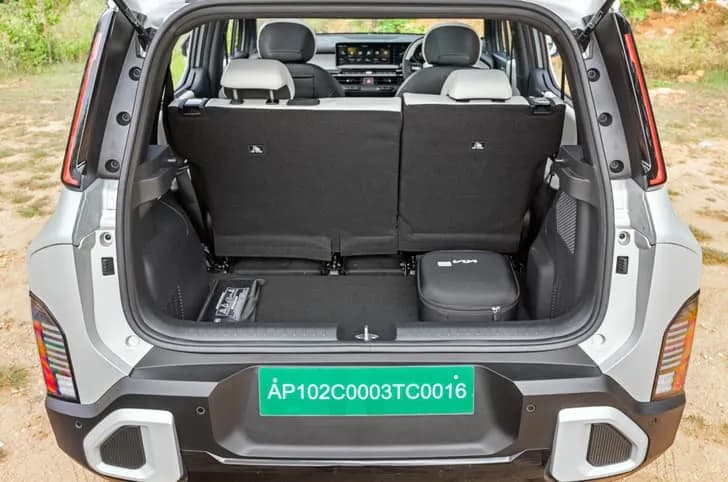
Practicality runs deeper than just rear seat space. Cabin storage includes a large glovebox, a dashboard shelf, and generously sized door pockets, while the redesigned centre console adds two adjustable cup holders plus a storage box beneath the armrest. Boot space ranges from 390 litres with the rear seats slid fully back to 465 litres with them slid forward — a useful bit of flexibility for owners who occasionally need extra cargo room. A space-saver spare tyre sits under the boot floor, and there's also a 16-litre frunk under the bonnet, useful for charging cables or smaller items you don't want rattling around the main boot.
Charging Times And What They Mean For A Kathmandu Commute
The Syros EV's global range figures include a 42kWh battery certified for 443km and a 51.4kWh battery certified for 526km, though real-world figures are more realistically expected around 300-320km and 400km respectively, accounting for Nepal's hilly terrain and traffic conditions. Charging times scale accordingly: a 7.4kW AC charger takes about 6 hours for the standard battery and 7 hours 15 minutes for the extended version, while an 11kW AC setup cuts that to roughly 4 hours and 4 hours 50 minutes. For anyone with access to a 100kW DC fast charger, a 10-80% top-up takes just 39 minutes on either battery — genuinely quick for a mid-trip charge on a highway journey.
Ownership costs are backed by an unusually strong package for the Nepali market: a 15-year or unlimited kilometre battery warranty for the first owner, and an assured buyback value of up to 80% after three years. Kia also offers a Battery-as-a-Service scheme, letting buyers rent the battery separately at Rs 3.3 per km to bring down the upfront purchase price — a scheme that could make electric mobility accessible to buyers who'd otherwise be priced out entirely.
What Rs 37.9 Lakh Actually Buys In Nepal
In Nepal, the Syros EV is currently offered as a single, fully-loaded variant at Rs 37.9 lakh ex-showroom through Continental Trading Enterprises. This straightforward one-variant approach removes the usual trim-level guesswork Nepali buyers face with other EVs, though it also means there's no lower-cost entry point into the model here the way there might eventually be with a Battery-as-a-Service style scheme, should Kia Nepal choose to introduce one locally. For now, the price is the price, and buyers are getting the top-tier feature set as standard — ventilated front seats, sliding rear seats, the dual 12.3-inch screen setup, and the full ADAS suite among them.
The Tata Nexon EV Undercuts It But Feels Smaller Inside
The Tata Nexon EV remains one of the most established electric options in Nepal and continues to be cross-shopped by anyone considering the Syros EV. Where the Nexon EV holds its ground is familiarity and a longer service history in the Nepali market, giving buyers more confidence about parts availability and technician experience. However, the Syros EV's rear cabin space, sliding seat function, and features list — particularly the rear-seat ventilation and 16-amp plug — put it a clear step ahead in outright practicality and everyday convenience, even before factoring in the strength of Kia's battery warranty and buyback terms.
The Mahindra XUV 3XO EV Is The Closer Match On Size
The Mahindra XUV 3XO EV sits in a similar compact SUV bracket and is arguably the more natural rival in terms of footprint and intended use case. Both cars target city-first buyers who want SUV styling without committing to a larger, pricier EV. The Syros EV's advantage lies in its genuinely spacious, flat-floored rear cabin and its longer feature list even before stepping up trims, while the XUV 3XO EV will appeal to buyers who prioritise a more conventional SUV stance over the Syros EV's quirkier styling.
Our Verdict: A Smart Buy For City Life, If The Looks Work For You
The Kia Syros EV is a deeply thought-through product wrapped in styling that will divide opinion. For city-based buyers who spend most of their time navigating Kathmandu Valley traffic, occasionally venturing out to the Terai or nearby hill stations, it offers genuine everyday usefulness: excellent rear space, a comfortable and quiet ride, strong performance for overtaking, and an ownership package — the 15-year battery warranty and 80% buyback assurance in particular — that meaningfully lowers the anxiety around buying an EV in a market still building out its charging infrastructure.
Where it asks buyers to compromise is styling that leans quirky rather than universally appealing, a steering wheel without reach adjustment, and a rear bench that's better for two adults than three. At Rs 37.9 lakh, the Syros EV is a considered purchase rather than an impulse one, and it suits buyers who value space, features, and ownership peace of mind over outright badge appeal or the most conventional SUV looks on the road.
Writes on vehicle pricing, taxation and the Nepali auto market from ongoing tracking of distributor price lists. Editorial policy.