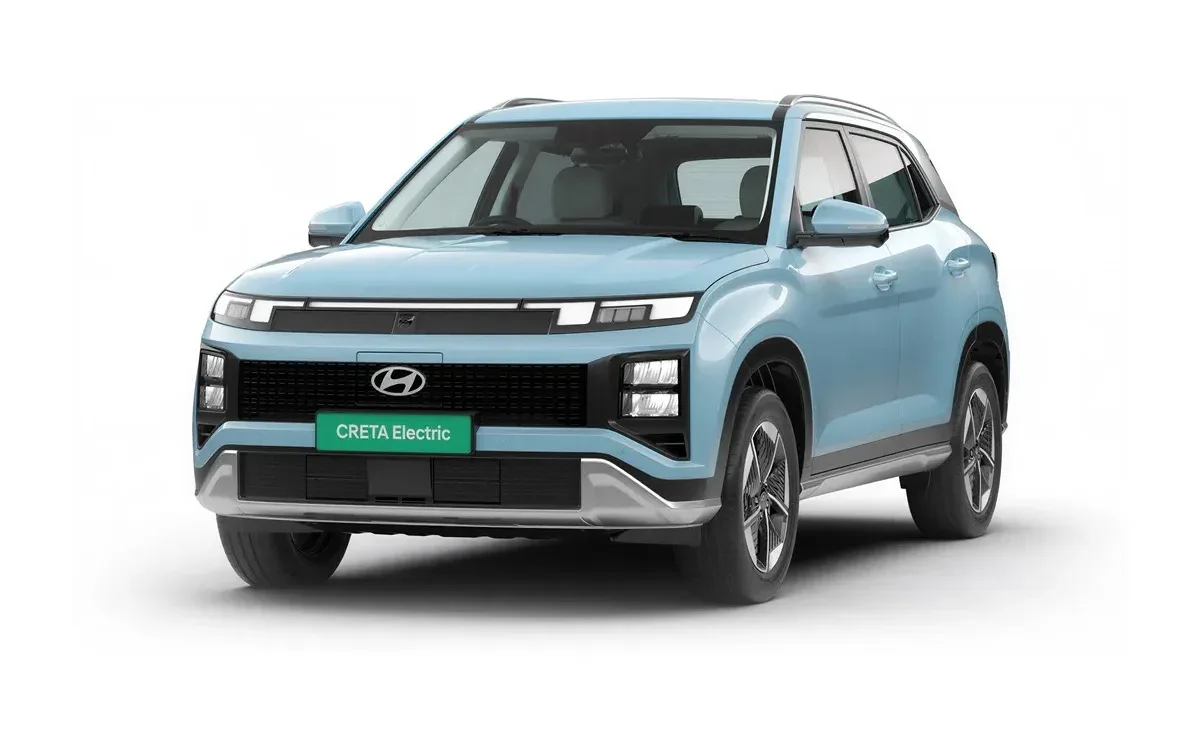
Start with the numbers
Compare at a glance
Catalog prices in Nepalese rupees. Compare the exact variant before choosing.
| At a glance | Hyundai Creta EV |
|---|---|
| Ex-showroom price | Rs 51.96–76.96 lakh |
| Fuel | Electric |
| Engine / motor | 126 kW motor |
Ex-showroom prices exclude registration, road tax and insurance. Specifications can vary by trim. See individual source-check dates ↓
Know the product
Key specifications, features & ownership context
Choose a variant to see its recorded specifications and features. Equipment and prices can change across trims.
Latest catalog and directory records supplement the original analysis. Figures may have changed since publication; individual specification and price-check dates appear below.
Rs 51.96 lakh ex-showroom · source checked 23 Aug 2026
Battery & charging
| Specification / feature | Executive |
|---|---|
| Battery | 42 kWhVerified specification · 17 Jul 2026 |
| Claimed range | 390 km (MIDC)Verified specification · 17 Jul 2026 |
| 10–80% DC charge | 39 minResearched · confirm · 1 Sept 2026 |
Safety & driver assistance
| Specification / feature | Executive |
|---|---|
| Airbags | 6 airbagsVerified specification · 17 Jul 2026 |
| 360° camera | YesResearched · confirm · 1 Sept 2026 |
| ADAS | ADASResearched · confirm · 1 Sept 2026 |
Dimensions & weight
| Specification / feature | Executive |
|---|---|
| Ground clearance | 200 mmResearched · confirm · 31 Aug 2026 |
| Boot space | 433 LResearched · confirm · 31 Aug 2026 |
| Seating | 5 seatsResearched · confirm · 31 Aug 2026 |
Drivetrain & transmission
| Specification / feature | Executive |
|---|---|
| Transmission | AutomaticResearched · confirm · 1 Sept 2026 |
| Drivetrain | FWDResearched · confirm · 1 Sept 2026 |
Comfort & convenience
| Specification / feature | Executive |
|---|---|
| Touchscreen | 12.3 inResearched · confirm · 1 Sept 2026 |
| Sunroof | ElectricResearched · confirm · 1 Sept 2026 |
Engine & performance
| Specification / feature | Executive |
|---|---|
| Max power | 135 PSVerified specification · 17 Jul 2026 |
Claimed range uses the stated test cycle. Different cycles are not a like-for-like range comparison; actual range depends on roads, load, speed and weather.
Showroom & service support
Distributor: Laxmi Intercontinental Pvt. Ltd.
70 listed brand showrooms · 35 listed brand service locations
Listed cities include Bhairahawa, Bhaktapur, Bharatpur, Biratnagar, Birgunj, Birtamode and 12 more.
Brand-wide directory coverage. Confirm that your nearest workshop supports this exact model, powertrain and warranty work; ask about parts availability and booking time.
Market buzz & buyer priorities
Compiled discussion, including buyer reactions and ownership reports; this is not a verified owner survey or a reliability score. Research dated 5 Sept 2026.
What people like
- Strong performance and smooth ride quality on rough Nepali roads, with ground clearance considered sufficient for typical highway and hilly routes
- Familiar Creta design and interior make the transition to EV easy for existing Hyundai users in Nepal
- Real-world range of the 42 kWh battery around 250–270 km in city use is seen as acceptable for daily commuting
More feedback
- Comfortable cabin, good features and refined driving experience are appreciated compared to earlier mass‑market EVs
- Brand trust in Hyundai and positive history of Kona EV in Nepal gives buyers more confidence in reliability
- Good ride quality and cabin build are appreciated
Concerns to investigate
- Price is perceived as on the expensive side for a compact SUV EV, with some buyers wishing it was significantly cheaper
- Charging infrastructure outside major cities remains a concern for long‑distance use, especially in hilly and rural areas
- Infotainment glitches and camera/sensor performance are noted as needing improvement for a modern EV
More feedback
- Boot space and practicality are considered adequate but not class‑leading compared to some rival EV SUVs
What buyers ask for
- Real usable range on Nepali highways and city traffic rather than just ARAI/MIDC figures
- Ground clearance and suspension toughness for hills, broken roads and speed bumps
- Upfront price versus perceived value compared to other EV SUVs like BYD Atto 3 and existing Kona EV
More feedback
- Service network strength, reliability history and availability of EV‑specific parts in Nepal
Nepal ownership context
- Buyers frequently compare Creta EV with BYD Atto 3, citing Creta’s better ground clearance for Nepali roads but Atto 3 as stronger on features and range at similar or higher price
- Discussion in Nepali EV communities links Creta EV’s prospects to Hyundai’s existing service network and the good reliability track record of the Kona EV
- Real‑range expectations in Kathmandu and major cities hover around 250–270 km for the 42 kWh pack, which users feel suits typical daily and inter‑city travel between nearby hubs
More feedback
- Enthusiast reviewers emphasise that the suspension and ground clearance are well suited to broken tarmac, speed bumps and light off‑road common on Nepali highways
- Ground clearance seen as adequate (≈190-200 mm) for many roads, yet doubts remain for very rugged terrain
- Official real-world range claims are around 390 km for the 42 kWh variant, buyers expect less on hilly, hot or highway settings
- Charging network improving but long-distance charging infrastructure remains spotty outside major centres
Use these facts alongside the article’s full analysis. Check the final quotation, warranty terms and exact equipment before booking.
Price & variants
The Hyundai Creta EV is the pricier and broader lineup, with an ex-showroom range of Rs 51.96 lakh to Rs 76.96 lakh across 6 variants in Nepal, while the Haval / GWM Ora 5 EV starts lower at Rs 46.99 lakh and goes to Rs 52 lakh across 2 variants. For a buyer comparing entry points, the Ora 5 EV is the more affordable way into this matchup, while the Creta EV stretches much higher if you want more equipment and trim choice.
| Model | Price range | Variants | Authorized distributor | Showrooms | Service centers |
|---|---|---|---|---|---|
| Hyundai Creta EV | Rs 51.96 lakh–Rs 76.96 lakh | 6 | Laxmi Intercontinental Pvt. Ltd. | 35 | 42 |
| Haval / GWM Ora 5 EV | Rs 46.99 lakh–Rs 52 lakh | 2 | V.G. Impex Pvt. Ltd. | 15 | 16 |
Key differences
The biggest hardware difference is that the Creta EV offers a 42 kWh standard-range battery in Nepal, with a planned 51.4 kWh long-range version in the lineup, while the Ora 5 EV uses a 58.3 kWh LFP battery in both variants. The Ora 5 EV also has the stronger range claim on paper, at 520 km on the NEDC figure, while the Nepal market also shows a WLTP claim of about 435 km; the Creta EV’s standard-range versions are quoted around 300–320 km in real-world or India-spec context, and the LR version is expected around 400 km.
Both are compact SUVs, but the Creta EV is the more fully documented product in Nepal: it has a 2670 mm wheelbase, about 190 mm ground clearance, and familiar compact-SUV dimensions of roughly 4325 mm long, 1790 mm wide, and 1630 mm high. The Ora 5 EV is also a compact SUV with a 2700 mm wheelbase, but its exact length, width, height, boot volume, and ground clearance are not officially disclosed in searchable Nepal sources.
Hardware and driving character
| Item | Hyundai Creta EV | Haval / GWM Ora 5 EV |
|---|---|---|
| Battery | 42 kWh standard range; 51.4 kWh LR planned | 58.3 kWh LFP |
| Claimed range | Around 300–320 km for standard-range; around 400 km expected for LR | 520 km NEDC; about 435 km WLTP |
| Motor | About 99 kW standard-range; about 126 kW on LR | 100 kW, 200 Nm |
| Drivetrain | Rear-wheel drive | Front-wheel drive |
| Wheelbase | About 2670 mm | 2700 mm |
For Nepali buyers, this means the Ora 5 EV is the better paper-range product, while the Creta EV LR is the more familiar SUV package if you want Hyundai’s support network and rear-wheel-drive layout. The standard-range Creta EV is clearly the shorter-legged option, but it also stays lighter on the wallet than the LR.
Cabin, features, and practicality
The Creta EV is the more clearly defined car in Nepal when it comes to equipment. Even the Executive trim gets a 10.25-inch touchscreen, a digital instrument cluster, and EV-specific displays, while higher trims add more comfort and convenience features such as upgraded upholstery, connected-car tech, and likely premium touches like a panoramic sunroof and a powered driver seat on the Premium+ grade. It also keeps a useful boot, with rear cargo space around 400–430L and 60:40 split-folding rear seats.
The Ora 5 EV is more difficult to judge on features because official Nepal trim-wise equipment details are not fully published in searchable sources. That makes it harder to compare cabin value with the same confidence. What is clear is that the car is positioned as a compact electric SUV with a strong battery-and-motor package, but buyers cannot yet verify its boot capacity, ground clearance, or detailed safety and convenience specification from the Nepal data set.
Ownership in Nepal
This is where the Creta EV has a major practical advantage. Hyundai’s Nepal network for this model is much larger, with 35 showrooms and 42 service centers, compared with 15 showrooms and 16 service centers for the Ora 5 EV through V.G. Impex. For a vehicle meant to be owned for years, that wider footprint matters for routine servicing, parts access, and confidence outside the Kathmandu Valley.
The Creta EV also benefits from a more established consumer understanding of the Creta nameplate, which can matter at resale time even if exact future values cannot be predicted. By contrast, the Ora 5 EV’s ownership case depends more heavily on whether you are comfortable buying on the strength of its range-and-price proposition rather than its aftersales reach.
Which suits whom
- Choose the Hyundai Creta EV if you want the safer ownership bet, the widest dealer-and-service coverage, and a compact SUV that is easier to understand and compare trim by trim.
- Choose the Creta EV Premium+ if you want the most complete Hyundai package in this comparison and are willing to pay for it.
- Choose the Creta EV Smart (O) LR if you want a better balance of range and equipment and can justify the jump over standard-range trims.
- Choose the Haval / GWM Ora 5 EV Mid if your priority is maximum range value at the lowest price in this matchup.
- Choose the Ora 5 EV High only if the extra money buys you a feature set you personally want, because the Nepal trim split is not fully disclosed.
Verdict
For most Nepali buyers, the Hyundai Creta EV wins overall because it combines broader aftersales support, more transparent variant structure, and a more practical ownership footprint in Nepal. The Haval / GWM Ora 5 EV wins on price-and-range appeal, especially for buyers who want a lower entry price and a larger battery on paper.
If you are buying with your head, the Creta EV is the more balanced long-term purchase. If you are buying for the strongest range-to-price story, the Ora 5 EV is the sharper value play.
Current prices on Nepal AutoMart
- Hyundai Creta EV price in Nepal: Rs 51.96 lakh – Rs 76.96 lakh ex-showroom, 6 variants
- Haval / GWM Ora 5 EV price in Nepal: Rs 46.99 lakh – Rs 52 lakh ex-showroom, 2 variants
Compare Hyundai Creta EV vs Haval / GWM Ora 5 EV variant by variant
Evidence & next steps
Check the details before you buy
Use this guide to build a shortlist. Ask for a written quotation for your chosen variant, including registration, taxes, insurance, finance charges and any charger installation. Confirm the nearest authorised workshop supports that model.
Price sources and dates
These are the latest recorded distributor-source checks for a variant of each model. They are separate from the article update and catalog read dates; they do not mean every trim was rechecked today. Confirm the final price with the distributor.
Overview photos come from the corresponding model records; additional article photos carry their own credits. Running costs depend on usage, energy prices, maintenance, insurance and resale value. Read the article’s assumptions before making cost comparisons.