Where This Sits In Nepal's Electric SUV Story
Hyundai's Creta has been one of the best-selling names in Nepal's petrol and diesel SUV segment for years, and the arrival of a fully electric version through Laxmi Intercontinental Pvt. Ltd. in 2025 is a significant moment — not because it reinvents the Creta, but because it doesn't. The Creta EV takes a formula Nepali buyers already trust and re-engineers it around a 42 kWh or 51.4-kWh-class battery and an electric motor, without touching the basic recipe that made the ICE Creta popular in the first place.
That positioning cuts both ways. On one hand, buyers get a familiar, well-proportioned mid-size SUV with none of the styling experimentation that some electric-only models indulge in. On the other, at an ex-showroom range of Rs 51.96 lakh to Rs 76.96 lakh across six variants, the Creta EV sits at a price point in Nepal that puts it well above several established electric SUVs already on our roads. This is not a budget EV, and it is not trying to be one — it is a premium, feature-rich family SUV that happens to run on a battery, and it needs to be judged on those terms.
A Familiar Silhouette With Tell-Tale Electric Details
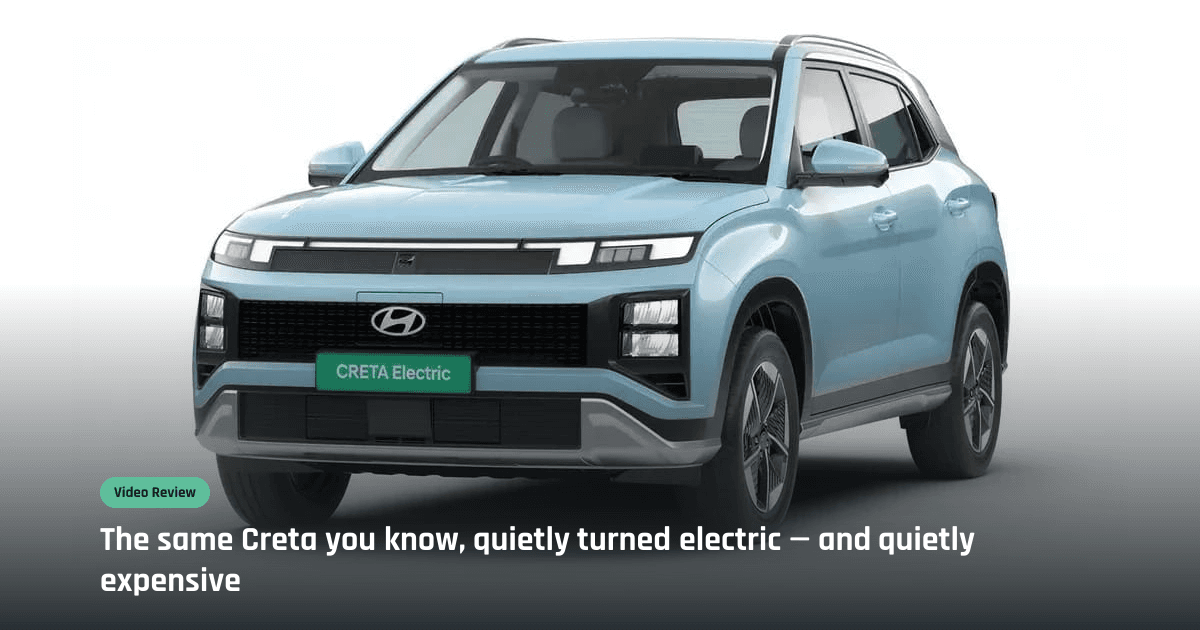
Park the Creta EV next to its combustion sibling and most people on the street won't immediately clock the difference. That is the most honest criticism to make of its design: this is very recognisably a Creta, and for a car commanding this kind of price in the EV space, some buyers will feel it doesn't look expensive enough to justify the tag. Hyundai's changes are deliberate rather than dramatic — a blanked-off front grille housing an LED light bar in place of the usual air intake, and aerodynamically styled alloy wheels designed to trim drag rather than turn heads.
Look closer at the side profile and the giveaway is the battery pack, which sits low in the floorpan and is visible as a slight bulge below the door sills. It is not intrusive, and it hasn't caused any real-world ground clearance complaints given the Creta EV's 200mm clearance figure, but it is there if you go looking, and it is the one detail that visually separates this from the standard car. Build quality itself feels solid and consistent with what Hyundai buyers in Nepal have come to expect — tight panel gaps, a reassuring door-shut sound, and nothing that feels cut-price about the way it's assembled.
Colours On Offer
Nepali showroom units have been seen in a light blue-grey dual-tone scheme finished with a contrasting black roof, a combination that suits the Creta's more restrained, mature design language and helps it look a shade more premium than a single-tone paint job would. It's a scheme that photographs well in daylight and doesn't scream for attention, which fits the character of the car generally — this isn't an SUV built to be loud.
The Cabin Tech That Works, And The One Control That Doesn't
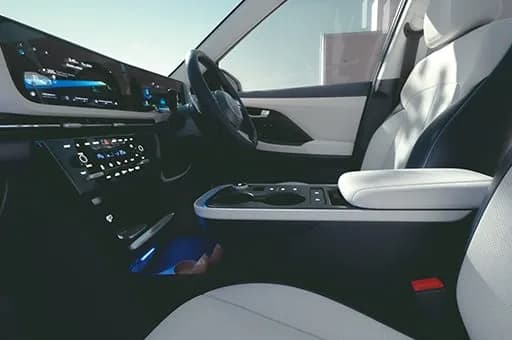
Step inside and the Creta EV's twin 10.25-inch displays — one for the driver's instrument cluster, one for the central touchscreen — form the visual centrepiece of the dashboard. What stands out in day-to-day use is less the size of these screens and more how dependable they are: the software runs smoothly, responds quickly to inputs, and is laid out in a logical way that doesn't force drivers to dig through nested menus to find basic functions. That sounds like faint praise until you consider how many electric SUVs in this price bracket still ship with laggy, unpolished infotainment — the Creta EV's system simply behaves the way a Rs 50-plus lakh car's system should.
The one interface decision that draws consistent criticism is the climate control panel, finished in glossy black and operated entirely by touch rather than physical switches. It looks smart when the cabin lighting catches it, but it picks up fingerprints quickly and is genuinely harder to adjust accurately while driving compared to a simple rotary dial or button. It's a small thing, but it's the kind of small thing that buyers notice on the two-hundredth commute, not the first.
Advanced driver assistance features, including Lane Following Assist and Leading Vehicle Departure Alert, are also on board and calibrated sensibly — they intervene when useful without constantly fighting the driver for control, which has not always been the case with ADAS suites fitted to SUVs at this price point.
Power Delivery That Suits Drivers New To EVs
The Creta EV's line-up splits into two motor outputs: a 99 kW (135 PS) IPMSM motor paired with a 42 kWh battery on the Executive, Smart (O), Premium+ and Executive Tech (AT) variants, and a stronger 126 kW motor fitted to the Smart (O) LR and Premium+ LR 126 kW trims, with a single-speed automatic gearbox and front-wheel drive throughout. What stands out about how this power reaches the road is the manner of its delivery — quick, but smooth and linear, without the sharp head-jerk that can make some EVs feel unrefined the moment you touch the accelerator.
Even switched into a sportier drive mode, the response stays manageable rather than aggressive, which is a deliberate and sensible calibration choice for a market where a large proportion of buyers are stepping into an EV for the first time, straight out of a petrol or diesel Creta. Refinement is a genuine strength — cabin noise stays low, and the transition from standstill to cruising speed happens with none of the driveline harshness that betrays a hastily converted combustion platform.
Why The Ride Quality Might Be The Best Reason To Buy One
If there is a single mechanical upgrade that justifies the Creta EV's existence beyond the drivetrain swap, it's the ride. To cope with the added weight of the battery pack, the suspension has been stiffened, and rather than making the car feel harsh, this has actually improved how it manages Nepal's often patchy road surfaces. At highway speeds it feels stable and planted, with vertical body movement kept impressively in check, and on broken tarmac and potholes it absorbs impacts rather than transmitting them into the cabin.
This composure is arguably the most immediately noticeable difference to anyone who has driven the standard Creta — it feels like the more mature, settled version of the car, and for buyers who spend real time on Kathmandu Valley's uneven roads or highway stretches outside the valley, that alone is worth serious consideration.
Space That Rewards Rear-Seat Passengers Specifically
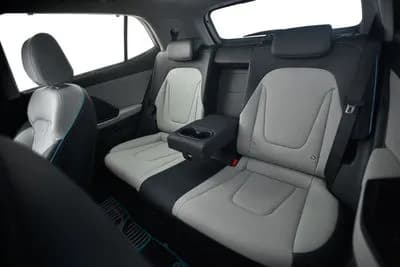
Cabin dimensions built on a 2,610mm wheelbase translate directly into rear-seat space that stands out even by segment standards. Legroom and headroom are both generous, the backrest angle is comfortable rather than upright, and — critically for an EV — the floor has not been raised to accommodate the battery in a way that forces rear passengers into a knees-up position. That's a detail that trips up several electric SUVs and one the Creta EV gets right.
Front seats get electric adjustment and ventilation on higher trims, along with height-adjustable driver seating across the range, and a fold-out tray table behind the front passenger seat adds a genuinely useful touch for rear occupants on longer journeys. The panoramic sunroof, standard branding aside, does real work here too — it makes the cabin feel noticeably airier than the glasshouse alone would suggest.
Regenerative Braking You Can Actually Tune To Your Driving
Braking feel is one of the more thoughtfully engineered aspects of the car. Regeneration is adjustable through steering-wheel paddles across multiple levels — 0 through 3, plus an i-Pedal single-pedal mode and an Auto setting that adapts to traffic and road conditions. Level 1 in particular feels close to natural engine braking, which will be reassuring for drivers transitioning from a conventional Creta and unsure what to expect from one-pedal driving.
Safety equipment is comprehensive across the range: 6 airbags, ABS with EBD, ESC with Vehicle Stability Management, Hill-start Assist Control and Hill Descent Control, and TPMS Highline are all part of the package, backed by Level 2 ADAS on relevant trims. For a family SUV built around long-distance comfort, this is a safety spec sheet that matches the ambition of the price tag.
Running Costs That Actually Change The Ownership Maths
This is where the Creta EV makes its strongest financial case. Charging at home works out to roughly Rs 1.01 per kilometre, assuming a domestic tariff of around Rs 8 per unit, while relying on public DC fast charging pushes that to approximately Rs 3.2 per kilometre at a typical Rs 26 per unit rate. Either way, that compares dramatically with the running cost of a comparable petrol Creta Turbo DCT, which works out to something in the region of Rs 7.8 per kilometre.
For high-mileage owners — company fleets, ride-hailing operators, or families doing frequent intercity trips — that gap compounds quickly over a year of ownership and materially changes the total cost of running the vehicle, even accounting for the higher upfront price.
Six Variants, Two Battery Sizes, And Where The Value Sits
Nepal's line-up runs from the Executive at Rs 51.96 lakh through the Smart (O) at Rs 56.96 lakh, Premium+ at Rs 59.96 lakh and Executive Tech (AT) at Rs 60.96 lakh, all built around the 99 kW motor and 42 kWh battery good for a claimed 390 km MIDC range. Above these sit the long-range models — the Smart (O) LR at Rs 69.96 lakh and the Premium+ LR 126 kW at Rs 76.96 lakh — stepping up to the stronger 126 kW motor.
For most buyers, the Executive Tech (AT) at Rs 60.96 lakh looks like the sensible middle ground: it carries the "Tech" badge that suggests a fuller ADAS and equipment set over the base Executive, without the extra outlay for the long-range battery that many Nepali daily-use cases may not fully need given the standard car's already-substantial 390 km range. Buyers who regularly cover longer intercity distances, or who simply want the added performance margin from the 126 kW motor, are the ones who'll get genuine value from stepping up to the LR trims.
The BYD Atto 3 Undercuts It Significantly On Price
The BYD Atto 3 remains one of the most obvious cross-shops for anyone considering the Creta EV in Nepal, and the comparison is mostly about money. The Atto 3 arrives at a noticeably lower price point while still offering a well-equipped, comfortably sized electric SUV cabin. What it doesn't match is the Creta EV's rear-seat space and the sheer familiarity of the Hyundai ownership experience through an established distributor network — but for buyers prioritising value over badge familiarity, the Atto 3 is the car that will pull at the Creta EV's price advantage hardest.
The MG ZS EV Offers A Simpler, Cheaper Alternative
The MG ZS EV is the other name buyers will inevitably weigh against the Creta EV, largely because it has been in the Nepali market longer and has built a track record among early EV adopters here. It doesn't match the Creta EV's cabin refinement or its composed ride quality, and its infotainment experience has historically felt less polished, but its lower entry price makes it a legitimate alternative for buyers who want an electric SUV without stretching into the Creta EV's higher trims.
The Verdict: A Confident, Composed EV For Buyers Who Value Substance Over Statement
The Hyundai Creta EV succeeds by refusing to reinvent what already worked. It rides better than the standard Creta, seats rear passengers more comfortably than most rivals in its class, runs on genuinely stable software, and costs a fraction of a petrol Creta to run day to day. Its real-world range figures around the 390 km mark for the standard battery give it enough breathing room for most Nepali use cases without constant range anxiety.
Where it asks for compromise is in the areas that matter to a specific type of buyer: those wanting an EV that visually announces itself will find the Creta EV too familiar, the touch climate panel will frustrate anyone who prefers physical switches, and the price will simply be out of reach for buyers comparing it against cheaper electric SUVs already established in Nepal. For the buyer it is built for — a family that wants Creta-level practicality, lower running costs, and a genuinely comfortable rear seat, and who is prepared to pay a premium for Hyundai's build quality and dealer network — this is one of the most complete electric SUVs money can currently buy in Nepal.
Writes on vehicle pricing, taxation and the Nepali auto market from ongoing tracking of distributor price lists. Editorial policy.