A Pickup That Doesn't Feel Like Nepal's Usual Idea Of One
Nepal's pickup buyers have long had a narrow set of choices — diesel double-cabs built for work sites, farms and rough tracks, chosen more for toughness than comfort. The eTerron 9, brought in by Himalaya Motrox Pvt. Ltd. under the Himalaya Organization umbrella, arrives in 2026 with a different pitch. It is an electric double-cab meant to be driven and lived in like a premium SUV, not just worked in. That makes it one of the more interesting launches in the segment this year.
At Rs 88 lakh for the Comfort variant and up to Rs 1.28 crore for the range-topping Premium, this is not a truck aimed at the traditional pickup buyer counting rupees per kilometre against a diesel rival. It sits between executive SUV money and a commercial-vehicle body style. That positioning will shape who actually buys one in Nepal — likely urban businesses, adventure operators and early EV adopters rather than contractors chasing maximum payload per rupee.
Design Language That Borrows From SUVs, Not Farm Trucks
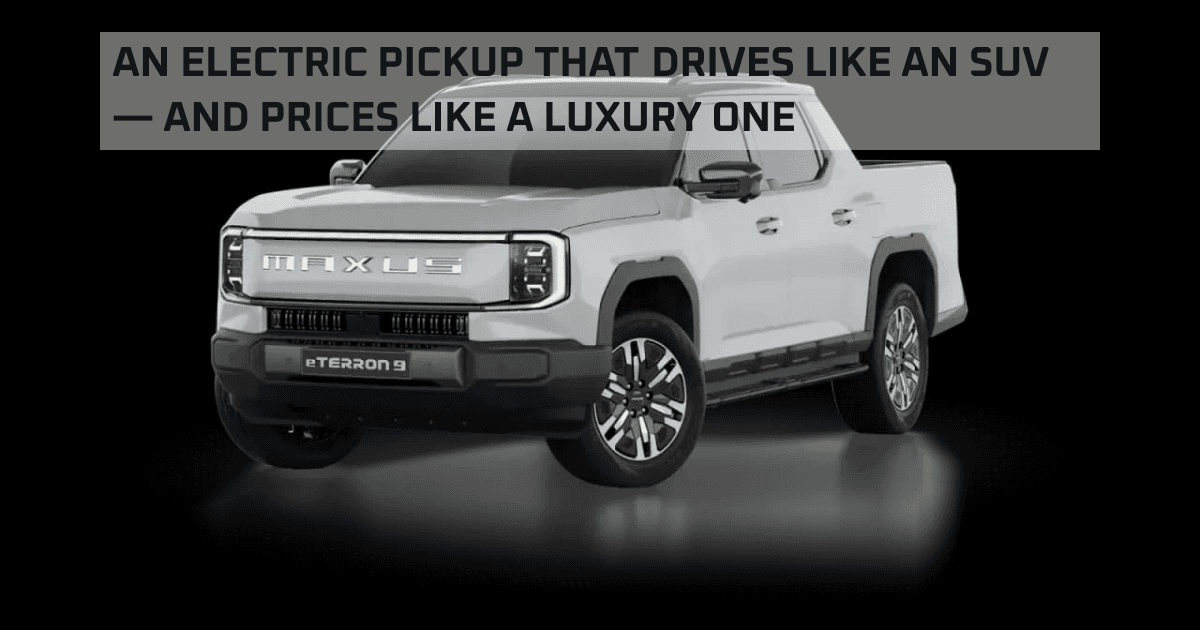
The eTerron 9's exterior does not try to look like a workhorse. The front end carries a full-width "MAXUS" branding strip with a wrap-around LED light signature and vertical LED headlamps, giving it a face that reads more lifestyle SUV than construction-site pickup. Around the back, a similar full-width running light bar pairs with vertical tail lamps and an integrated rear bumper step for bed access.
The side profile is where the design stands out most. Angular surfacing, flat panel work and a long flatbed give it a distinctly modern, almost Rivian-like silhouette rather than the boxy, utilitarian stance Nepali buyers associate with double-cabs. Gloss black detailing on the mirror caps and body trim, along with 20-inch alloy wheels, finishes a look that is trying hard to move away from the pickup stereotype.
On colours, the eTerron 9 has been shown in a light grey/silver metallic finish. It suits the truck's SUV-leaning design. It should be the safer, more popular choice for buyers who want it to look premium rather than purely functional.
The Cabin Is Where This Truck Argues Its Price
Step inside and the eTerron 9 makes its strongest case. The dashboard is built around a large dual-screen layout combining infotainment and a digital instrument cluster, with integrated sat-nav, Apple CarPlay and Android Auto. A voice-recognition assistant handles hands-free control, and the centre console includes wireless phone charging plus a deep armrest storage bin.
Dual-zone climate control is operated through a row of physical quick-access buttons beneath the main screen. That is a small but welcome detail for anyone who has struggled with touchscreen-only climate menus while driving. In the truck bed, two electronic power outlets and twin overhead LED spot lamps mean the eTerron 9 can also work as a mobile workstation or campsite base.
Across the variant line-up, exact feature parity is not fully clear. The Comfort trim appears to be the value-focused 4x4 entry point, while Premium is pitched as the more fully loaded, luxury-leaning option. Interior specifics — seat materials, exact climate control setup, screen sizes — are not officially detailed for every trim, so buyers comparing Comfort against Premium in the showroom should ask pointed questions rather than assume shared equipment.
700 Nm, Full-Time 4WD, And No Diesel Clatter
The eTerron 9's mechanical case is strong on paper. Torque stands at 700 Nm across the line-up, sent through a proper 4WD system rather than a part-time setup. That torque figure alone tells you this truck should never feel breathless. The usual diesel pickup complaint of lag and strain under load is not part of the electric pickup's vocabulary.
Most variants — Exclusive, 4WD, Comfort — are rated at 325 kW, a serious output for this segment. The Premium variant, curiously, is rated at only 125 kW despite sitting at the top of the price ladder at Rs 1.28 crore. Buyers assuming "Premium" means "most powerful" would be wrong here and should verify this carefully at the dealership before signing.
What stays consistent across the electric powertrain is the absence of diesel engine noise or vibration. Power delivery is silent, refined and immediate. That is a clear point of difference from every diesel double-cab Nepali buyers have driven before.
Claimed 560 km Range Eases The Biggest EV Pickup Worry
Range anxiety is the biggest psychological barrier to any electric commercial vehicle, and the eTerron 9's claimed 560 km range is a reassuring number on paper. It should cover most intercity Nepali routes without a mid-journey charge, assuming real-world figures stay close to the claim. Ground clearance sits at 230mm on the Exclusive variant and 260mm as listed for pricing purposes elsewhere in the range. That is comfortably suited to Nepal's unsealed roads and monsoon-battered tracks, though a firm wheelbase figure has not been officially disclosed.
Ride Comfort That Reads More SUV Than Truck
Handling and ride quality are consistently flagged as one of the eTerron 9's strongest traits. The emerging consensus is worth taking seriously. It has a surprisingly tight turning circle for a vehicle of this size, and a ride quality that stays smooth and composed over rough surfaces. That is a real departure from the typically stiff, load-tuned suspension of diesel pickups.
Multiple drive modes, including Eco, Standard, Sport and dedicated off-road settings for mud and snow, give it range across use cases. It can handle daily city driving and genuine backcountry work.
Comfort That Extends Properly Into The Back Seat
One of the more consistently praised aspects of trucks like this is how well the rear cabin is treated. There is generous legroom and headroom, heated seats, and a flat rear floor without a transmission tunnel, which makes carrying three across workable rather than a squeeze. For Nepali buyers who use their double-cab as a family vehicle as often as a work truck, that matters more than most spec sheets capture.
Safety Equipment Still Needs Firming Up At The Dealership
The eTerron 9 shares its structural safety characteristics across the range, and Himalaya Motrox's positioning references a Euro NCAP 5-star-rated lineup context for the platform. A full trim-by-trim breakdown of safety equipment is not officially detailed for every variant in Nepal yet. Buyers should ask dealerships directly what is fitted on the specific trim they are considering rather than assuming top-spec safety kit carries down the range.
Where Rs 88 Lakh Buys You In, And Where It Doesn't
Five variants span the eTerron 9 range: Comfort at Rs 88 lakh, Exclusive at Rs 99.99 lakh, Luxury at Rs 1.10 crore, 4WD at Rs 1.18 crore, and Premium topping out at Rs 1.28 crore. For most buyers, the Comfort or Exclusive trims deserve the closest look. Both carry the full 325 kW output and 4WD hardware, without paying the premium that Luxury and 4WD command for what appear to be comfort and equipment upgrades rather than mechanical ones.
The Premium trim is harder to justify given its 125 kW rating despite the highest price point. Unless the extra luxury equipment genuinely explains nearly Rs 40 lakh over the Comfort variant, buyers chasing outright capability should look elsewhere in the range. The 4WD variant, at Rs 1.18 crore, looks like the sensible middle ground for anyone wanting the full power output plus whatever additional off-road hardware or trim its name implies.
The Maxus T60 Max Is The Obvious In-House Alternative
For buyers who like the Maxus badge and pickup format but are not ready to commit to an electric drivetrain, Himalaya Motrox's own Maxus T60 Max remains the logical diesel alternative in Nepal. The T60 Max offers the traditional pickup ownership experience — proven diesel running costs, established payload expectations, and a familiar fuel-and-service ecosystem that the eTerron 9 simply cannot match yet given how thin fast-charging infrastructure remains outside the Kathmandu Valley. Buyers who need to haul heavy, predictable loads daily without range planning will likely still find the T60 Max the more practical near-term choice.
Our Verdict: A Genuinely Impressive Truck, Priced For A Narrow Buyer
The eTerron 9 is a genuinely impressive vehicle to drive and sit in. It is refined, quick, comfortable, and fitted with details like the frunk, the power outlets in the bed, and the dual-screen cabin that no diesel rival in Nepal currently matches. It feels like a premium SUV wearing a pickup body.
But the price range — Rs 88 lakh to Rs 1.28 crore — puts it well beyond traditional pickup money in Nepal, and several key details, from exact dimensions to full safety equipment lists per trim, remain undisclosed at launch. This is best suited to businesses wanting a striking, low-running-cost fleet vehicle, adventure operators needing genuine off-road ability without the diesel compromise, and early EV adopters with the budget to match their enthusiasm. It is not built for the traditional payload-first pickup buyer this segment has served until now.
Writes on vehicle pricing, taxation and the Nepali auto market from ongoing tracking of distributor price lists. Editorial policy.