Where The NS200 Sits In Nepal's Crowded 200cc Shelf
Bajaj and HH Bajaj have brought the Pulsar NS200 back into the Nepali lineup for 2026 as a five-variant spread, starting at Rs 3,98,900 for the base ABS trim and topping out at Rs 4,68,900 for the FI Dual ABS BS6 version. In between sit the SC and DC USD variants at Rs 4,24,900 apiece and the FI ABS trim at Rs 4,51,900. That's a meaningful jump from what buyers may remember the NS200 costing in earlier generations, and it places the bike firmly in premium 200cc territory — a segment where riders are now weighing it against Bajaj's own larger NS400 and the more affordable N250 from the same showroom floor.
What hasn't changed is the fundamental character of the machine. This is still the compact, aggressive, liquid-cooled naked bike that built its reputation on being quicker-witted than anything else its size. For Nepali buyers who ride mostly in dense urban traffic with occasional highway stretches to Pokhara or the Terai, that character matters more than outright numbers, and it's why the NS200 continues to hold a distinct identity even as Bajaj's own NS400 crowds the space above it.
A Streetfighter Face That Still Looks The Part
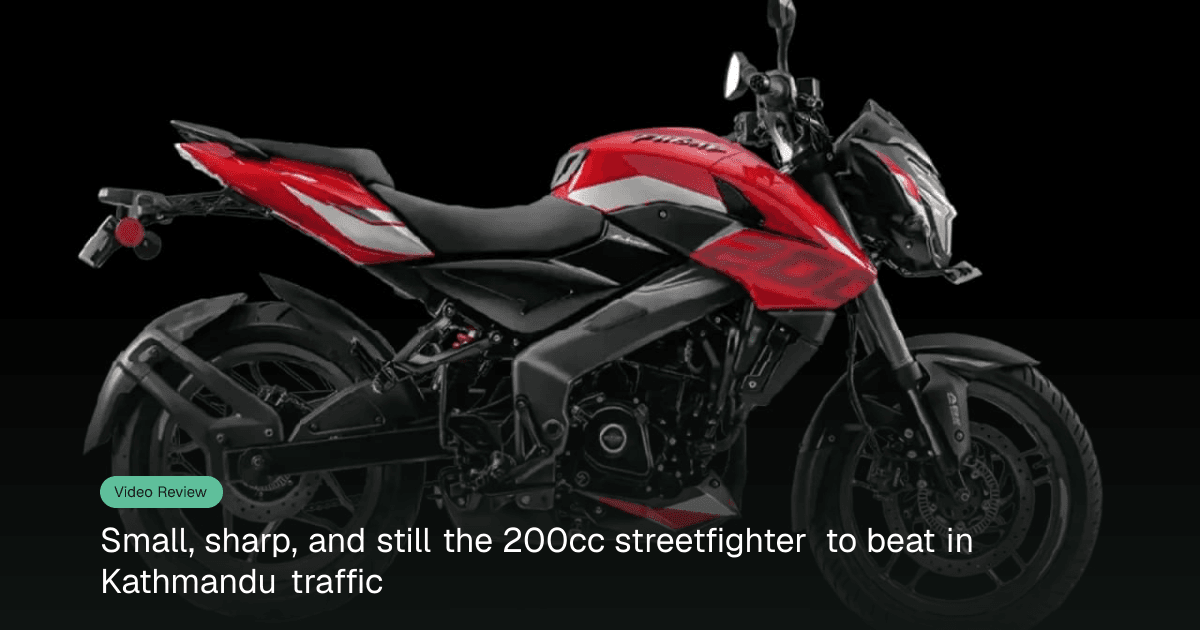
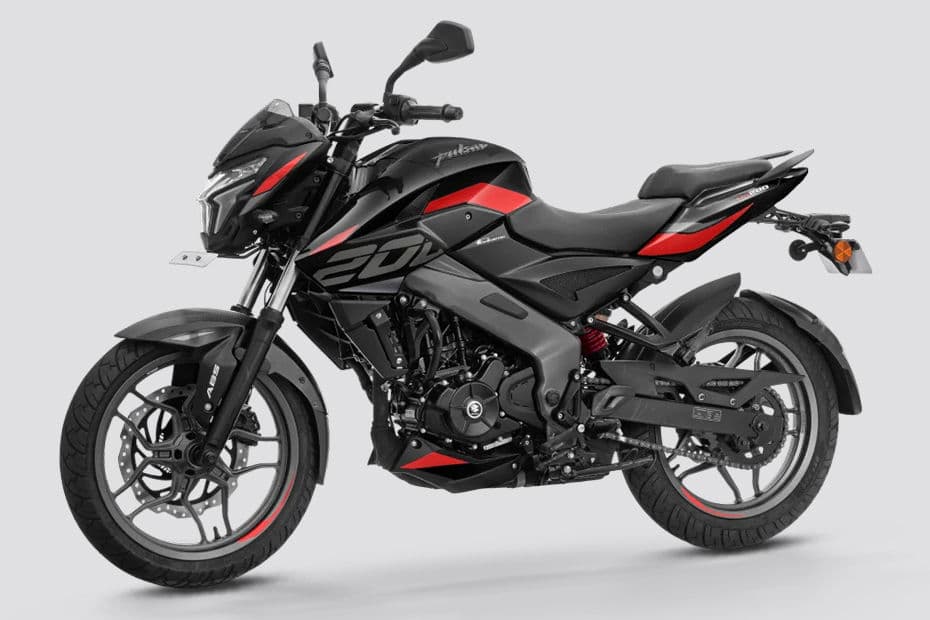
The design language hasn't softened one bit. The NS200 carries a sharp, aggressive stance with a LED headlight shaped like a thunderbolt — genuinely one of the more distinctive front-end designs in this price band, giving the bike a modern, slightly mean look head-on. The perimeter frame is left exposed rather than hidden behind bodywork, which reinforces the naked-bike aesthetic and lets you see the engineering rather than just the plastic around it.
The underbelly exhaust is a small but effective touch — it keeps the tail section clean and compact instead of letting a bulky muffler dominate the rear three-quarter view, which is part of why the bike photographs and parks so much smaller than its NS400 sibling. Build quality at this price point holds up to scrutiny at the showroom: panel gaps are tight, the frame welds are neat, and the overall fit feels considered rather than cost-cut, even on the base-spec ABS variant.
The White, Black And Red Scheme Does The Design Justice
The dual-tone white and black paint scheme with red accents is the standout colour option and does real justice to the aggressive lines of the bike. The white bodywork contrasts sharply against the dark engine casing and black frame components, which actually highlights the exposed perimeter frame rather than competing with it. It's a scheme that photographs well in showroom lighting and still looks sharp after a few weeks of daily riding, since the darker components hide road grime better than a full white finish would.
What You Actually Get On The Dash And Switchgear
Equipment levels are where the NS200 makes its strongest case for the money. The fully digital instrument console displays speed, tachometer, odometer, gear position and fuel trip data in one clean layout, and — crucially for this segment — includes Bluetooth connectivity with turn-by-turn navigation support, a feature that's still missing on several rivals at this price. A USB charging port sits conveniently next to the display, letting riders top up a phone mid-commute without fumbling for a separate socket.
The switchgear itself is functional and well laid out, though it's worth flagging one gap: there's no dedicated hazard light switch, an odd omission for a bike launched in 2026 with otherwise modern electronics. LED lighting extends across the headlight, taillight and turn signals, which is now close to standard expectation in this class but still adds a premium look after dark. The digital console setup does the job an analogue dial simply can't in 2026, and it's one of the clearest upgrades buyers get for choosing the NS200 over an older or more basic 200cc machine.
The 199.5cc Engine That Still Loves To Rev
At the heart of the NS200 is Bajaj's 199.5cc, liquid-cooled, single-cylinder FI DTS-i engine producing 18 kW (24.5 PS) at 9,750 rpm and 18.74 Nm of torque at 8,000 rpm, driven through a 6-speed gearbox with chain final drive. On paper these numbers haven't shifted from what long-time Pulsar buyers will recognise, but the way the engine delivers them remains the bike's signature strength — it's rev-happy, responsive, and clearly happiest when spinning towards the top of its range rather than lugging along at low revs.
The exhaust note deserves particular mention: it has a genuinely sporty, refined character that adds to the sense of occasion every time you crack the throttle, and it's consistently one of the most-praised aspects of riding this machine. Acceleration is strong enough that clearing 100 km/h is well within easy reach, and the 6-speed gearbox shifts cleanly enough that extracting the engine's full potential doesn't feel like a chore. This remains a liquid-cooled motor in a segment where several direct competitors still rely on air- or oil-cooling, and that difference shows up in sustained performance during longer, harder riding rather than just in showroom spec sheets.
USD Forks And A Chassis That Rewards Aggressive Riding
The ride and handling package is built around upside-down front forks paired with a rear mono-shock, and together they deliver a ride quality that's sporty without being punishing. At a kerb weight of just 158 kg and a wheelbase of 1,363 mm, the NS200 feels noticeably lighter and more flickable through corners than bulkier rivals in adjacent segments, and that agility is arguably the single biggest reason to choose this bike over something larger.
The tyre setup — 100-section front and 130-section rear, both tubeless — offers good grip in everyday riding, though it's worth noting these are bias-ply tyres rather than radials, a genuine and fair criticism given how sporty the rest of the package feels. Radials would sharpen the cornering confidence further, and it's the one area where the chassis promises more than the rubber currently delivers. Ground clearance of 168 mm is comfortable for Nepali road conditions, coping well with speed bumps and moderately broken surfaces without scraping.
Sporty Ergonomics That Ask A Little Of Your Lower Back
Riding position on the NS200 is sporty but still usable for daily commuting — the reach to the clip-on handlebars is comfortable and gives good control over the front end without tipping into full sportbike aggression. Seat height sits at 805 mm, which most riders will find manageable at traffic stops.
The split-type seat, however, is where the NS200 shows a genuine compromise: cushioning feels noticeably firmer than what you'd find on the larger NS400, and riders doing longer stints on the highway may feel that firmness after an hour or more in the saddle. It's not uncomfortable for city commuting or short rides, but buyers planning frequent long-distance trips should factor this in rather than assume all-day plushness.
Grimeca Brakes That Bite Softly But Confidently
Braking hardware consists of a 300 mm front disc and 230 mm rear disc, paired with dual-channel ABS as standard — a genuinely reassuring safety spec at this price point, and one that isn't universal across the 200cc segment in Nepal. The brake lever feel is on the softer side rather than sharp and grabby, but the actual bite is progressive and easy to modulate, which builds confidence quickly rather than catching new riders off guard.
For a bike capable of the kind of acceleration the NS200 offers, having dual-channel ABS as a baseline safety net rather than an optional extra is exactly the right call, and it's one of the clearer reasons the more affordable trims still feel like sound purchases rather than stripped-down compromises.
Small Footprint, Genuine Daily Usability
Where the NS200 earns its keep day to day is in how easily it slots into Nepali traffic conditions. The compact dimensions — 2,017 mm long and 804 mm wide — combined with that 158 kg kerb weight make it noticeably easier to filter through congested Kathmandu streets than bulkier alternatives. This is a bike that feels genuinely sized for narrow lanes and stop-start traffic rather than one that merely tolerates it.
A small but meaningful practical touch is the inclusion of a center stand, which makes routine maintenance like chain lubrication significantly easier — and it's worth noting this is something the larger, pricier NS400 actually goes without. The 12-litre fuel tank supports E20 fuel, which is a forward-looking touch as Nepal's fuel blend policies evolve, and it should offer decent range for the typical daily commute even though Bajaj has not officially disclosed a mileage figure for this Nepal-spec model.
What Servicing And Fuel Costs Will Actually Look Like
Running cost data remains somewhat incomplete at an official level — HH Bajaj has not published a mileage figure for this Nepal-market bike, so buyers should treat any number floating around as unverified rather than a promise. The instrument cluster does at least display real-time and average fuel economy readouts, which gives owners a way to track their own consumption pattern rather than relying on guesswork.
One cost consideration worth flagging for service budgeting: the engine uses a triple spark plug configuration, which can make routine servicing marginally more involved and may nudge up spark plug replacement costs during major services compared to single-plug rivals. It's a minor point in the context of overall ownership costs, but it's the kind of detail that adds up over several years of ownership and is worth asking your service centre about upfront.
Picking Between The Five Variants On Offer
With five variants spanning Rs 3,98,900 to Rs 4,68,900, the trim decision genuinely matters here. The base Pulsar NS200 ABS at Rs 3,98,900 gets you the core package — the same 199.5cc liquid-cooled engine, 6-speed gearbox and dual-channel ABS braking — without some of the higher-spec electronics. Stepping up to the Pulsar NS200 FI ABS at Rs 4,51,900 or the SC and DC USD variants at Rs 4,24,900 brings additional finish and equipment differences worth comparing side by side at the showroom before committing.
The range-topping FI Dual ABS BS6 variant at Rs 4,68,900 represents the fullest expression of the package and will suit buyers who want every available feature without compromise. For most riders prioritising value, though, the case is strongest at either end of the range: the base ABS trim for those who want the essential NS200 experience at the lowest entry cost, or the top FI Dual ABS BS6 for those unwilling to leave any equipment on the table. The middle variants make sense mainly for buyers with a specific preference for the DC USD fork setup or SC finish.
The Bajaj Pulsar NS400 Costs More And Weighs More
Bajaj's own Pulsar NS400 sits above the NS200 in the lineup at around Rs 2.37 lakh more on an on-road basis, and the two machines are aimed at genuinely different riders despite sharing a family name. The NS400 is bulkier, heavier and more powerful, but that added heft comes at the cost of the NS200's defining trait: its light, flickable, city-friendly agility. The NS400 also swaps in radial tyres, addressing the one tyre-related criticism levelled at the NS200.
Riders chasing outright power and a more substantial highway presence will lean towards the NS400. Those who value compactness, a lower purchase price and easier daily manageability in tight traffic should stick with the NS200 — it remains the sleeker, lighter, more accessible machine of the two, and for a majority of Nepali riders navigating urban commutes, that trade-off works in the NS200's favour.
The Bajaj Pulsar N250 Undercuts It But Drops The Liquid Cooling
The other internal rival worth naming is the Bajaj Pulsar N250, priced around Rs 1.89 lakh on an on-road basis — a considerably cheaper proposition. The key mechanical difference is cooling and gearing: the N250 relies on an oil-cooled engine rather than the NS200's liquid-cooled unit, and it doesn't match the NS200's 6-speed gearbox or general performance ceiling.
For buyers on a tighter budget who still want the Pulsar naked-bike look and everyday usability, the N250 is a sensible step-down. But anyone cross-shopping performance, sustained high-rev running, or the sportier riding experience will find the NS200's liquid cooling and extra gear genuinely worth the price difference, particularly for riders who do a fair amount of highway running where sustained engine temperatures matter more.
Our Take: A Sharper Choice For The Committed Rider
The Pulsar NS200 remains one of the most complete, characterful options in Nepal's 200cc naked bike segment. Its liquid-cooled engine, 6-speed gearbox, dual-channel ABS and genuinely engaging chassis add up to a motorcycle that rewards a rider who wants to be involved rather than one looking for a purely relaxed commute. The firmer seat, bias-ply tyres and missing hazard switch are real, specific compromises rather than deal-breakers, but they're worth knowing before you sign the papers.
This is a bike best suited to younger riders and enthusiasts who want a sporty, agile, quick-revving 200cc machine for city riding with occasional highway stretches — the kind of buyer who'll appreciate the exhaust note and the flickable handling more than outright plushness. Riders who want more highway presence, a bulkier stance or outright power should look upward to the NS400 within Bajaj's own range; those on a tighter budget who can live without liquid cooling have the N250 as a genuine, sensible alternative from the same showroom.
Current prices on Nepal AutoMart
- Bajaj Pulsar NS200 price in Nepal: Rs 3.99 lakh – Rs 4.69 lakh ex-showroom, 5 variants
- Bajaj Pulsar N250 price in Nepal: Rs 4.58 lakh – Rs 5.2 lakh ex-showroom, 4 variants
Writes on vehicle pricing, taxation and the Nepali auto market from ongoing tracking of distributor price lists. Editorial policy.