Where This Fits In Nepal's Thinning EV Middle Ground
Nepal's EV market has split into two clear camps: budget Chinese hatchbacks fighting for attention under Rs 25 lakh, and a growing crowd of premium SUVs well north of Rs 40 lakh. The Proton e.MAS 5 EV, arriving through Jagdamba Motors in 2026, sits squarely in the gap between them, priced from Rs 29.84 lakh for the Prime and Rs 34.84 lakh for the Premium. That puts it above the cheapest EV hatchbacks but comfortably below premium electric SUVs. It is a genuine C-segment hatchback-crossover, not a stripped-down city runabout. In a market where most buyers cross-shop EVs against established petrol sedans and hatchbacks, that positioning matters more than the badge.
This is Proton's first EV, built on Geely's architecture and tuned with Malaysian input. It reaches Nepal at a time when buyers are more informed and more skeptical of unproven EV brands than they were even two years ago. The e.MAS 5 stays away from headline-grabbing range figures or big power claims and leans on space, comfort and everyday usability. That becomes important once the first rush of EV ownership fades.
A Design With No Awkward Angles
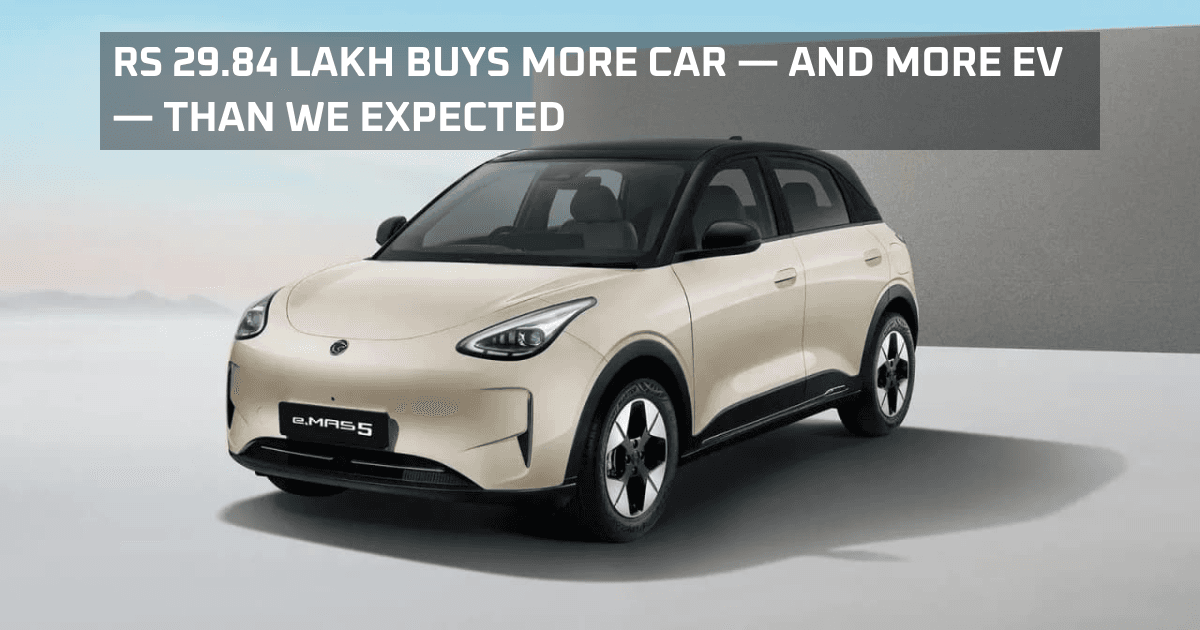
The e.MAS 5 carries a clean, contemporary silhouette that avoids the fussy character lines many electric cars use to signal their EV status. Full LED headlights and LED taillights bookend the body, and the test-spec car we've seen in cream/white with a black roof looks more premium than its price bracket would suggest. Sixteen-inch wheels fill the arches well without looking undersized. The dual-tone paint gives it enough showroom presence next to petrol hatchbacks in the same price zone.
Panel gaps and door feel point to solid build quality rather than flash. This isn't a car trying too hard to look expensive. At 4,135 mm long, 1,805 mm wide and 1,580 mm tall, with a 2,650 mm wheelbase, it reads as compact from the outside, but the proportions are clearly tuned toward cabin space. You notice that the moment you sit inside.
Cream, White, And Two Interior Trims Worth Knowing About
Exterior colour choices lean toward the clean end of the spectrum, with the cream/white and black-roof combination the most eye-catching in showrooms. Inside, buyers get a choice between white leatherette and Flint Grey. The white cabin photographs beautifully and lifts the sense of space. It is also the one we'd flag as a practical risk, since light-coloured leatherette in Nepali conditions tends to show stains and scuffs sooner than the grey alternative. For anyone planning to keep the car for the long haul or protect resale value, Flint Grey is the more sensible pick.
The 14.6-Inch Screen Doesn't Forget The Physical Buttons
Both variants get a digital instrument cluster, an 8.8-inch LCD unit, paired with a large 14.6-inch centre touchscreen running at 1080p resolution. It feels responsive, and wireless Apple CarPlay and Android Auto come standard. That removes one of the more common daily annoyances in budget EVs, where phone mirroring is often wired-only or laggy. 4G and Wi-Fi connectivity plus online navigation round out the tech package.
What stands out more than the screen itself is what Proton chose not to digitise. Air-conditioning controls, hazard lights and other frequently used functions stay as physical buttons on the centre console instead of being buried inside touchscreen menus. In a segment where manufacturers increasingly move everything into the screen to look modern, this is a small but useful decision for anyone driving in Kathmandu traffic. The Premium gets 6 speakers against the Prime's 4, and the Prime is limited to a single USB-A and USB-C port. Modest, but sufficient for a car at this price.
Two Power Outputs, One Clear Winner For Real Use
The Prime runs a 58 kW motor producing 130 Nm of torque, with a claimed 0–50 km/h time of 4.4 seconds. The Premium steps up to 85 kW and 150 Nm, cutting that sprint to 3.9 seconds. Both use an 11-in-1 integrated motor unit driving the rear wheels. That layout is still uncommon at this price point in Nepal, where most affordable EVs are front-driven.
On the road, the difference between the two is less about outright speed and more about how effortless the car feels in ordinary use. The rear-mounted motor is smooth and near-silent, and refinement is a real highlight. Road roar and wind noise stay well out of the cabin. That is not something we can say about most EVs in this bracket. The Premium's extra power is noticeable in overtaking and highway merges, where the Prime's 58 kW output feels adequate rather than confident.
Rear-Wheel Drive Makes The Steering Feel Alive
Rear-wheel drive changes the character of this car more than the spec sheet suggests. With the front wheels freed from driving duty, the steering feels light, quick to respond and more agile than the front-driven hatchbacks it will be cross-shopped against. Turn-in is sharp without feeling nervous. The car also holds its line through faster corners with more composure than its size and price would predict.
The multi-link rear suspension is the standout mechanical decision here. Compared with the torsion-beam setups common in this segment, it keeps the rear wheels more controlled over broken surfaces and absorbs bumps instead of sending them into the cabin. Over Kathmandu's patchwork roads and the potholed stretches on the way out of the valley, that translates into a ride that stays settled where cheaper rivals start to crash and bounce. It is the single biggest engineering advantage this car has over its price bracket.
Room For A Six-Footer, Front And Back
Space is where the e.MAS 5 makes its strongest case. Rear seat passengers get genuine legroom and headroom, with seat cushions mounted high enough that taller occupants are not left in the knees-up posture common in small EVs. A 6-foot adult sits comfortably in the back with room to spare. Rear passengers also get dedicated dual rear air vents, and many rivals at this price skip that detail entirely.
Ergonomically, the steering wheel is comfortable, the driving position is easy to settle into, and the mix of digital displays with retained physical switchgear keeps daily operation intuitive. No menu-diving needed.
Stability Under Pressure, Not Just On Paper
Braking hardware pairs ventilated discs at the front with solid discs at the rear, along with an electric parking brake on both variants. It is a sensible, proven setup rather than anything exotic. What matters more in daily use is how the chassis behaves during sudden manoeuvres. The same multi-link rear suspension that smooths out bumps also keeps tyre contact more consistent during quick lane changes or emergency braking, giving the car a settled, predictable feel. Both variants carry a full suite of safety systems as standard.
A Boot That Grows To 1,320 Litres, Plus A Frunk
Practicality is one of the strongest arguments for buying this car over a petrol equivalent. The boot holds 375 litres with the rear seats up, expanding to 1,320 litres with them folded flat. That is enough for furniture-moving duty, not just weekend bags. On top of that, the electric motor's rear-mounted layout frees up a 70-litre frunk under the bonnet, useful for shoes, wet gear, or anything you'd rather keep separate from the main cabin. A 28-litre under-seat storage compartment in the rear adds more everyday utility that petrol hatchbacks simply can't offer. The turning radius is tight enough to make U-turns and tight Kathmandu parking manoeuvres genuinely easy.
What The Range And Charging Numbers Mean Day To Day
The Prime's 30.12 kWh battery delivers a WLTP range of 225 km and 280 km NEDC, while the Premium's larger 40.16 kWh pack stretches that to 325 km WLTP and 395 km NEDC. In real-world terms, a near-full charge on the Premium should comfortably cover a week of typical city commuting for most Kathmandu-based owners without needing a daily top-up.
Charging speed is where the two variants diverge more sharply than the range figures suggest. The Prime supports DC fast charging at up to 53 kW, taking 21 minutes to go from 30–80%. The Premium bumps DC input to 71 kW, which cuts downtime on longer trips. AC charging is capped at 6.6 kW across both variants, so a 10–100% top-up from a home or office AC charger takes 4.9 hours on the Prime and 5.9 hours on the Premium. That is slower than some rivals now offering higher AC rates. For owners relying mainly on home charging overnight, this is not a dealbreaker, but it does need planning. Both variants carry an 8-year/160,000 km warranty on the high-voltage battery and components, and both include Vehicle-to-Load capability, letting the car power external devices. That is useful for outdoor use or backup power during load-shedding.
Rs 34.84 Lakh Is Where The Real Value Sits
The Prime, at Rs 29,84,499, gets you into e.MAS 5 ownership with the 58 kW motor, 30.12 kWh battery and 225 km WLTP range. It is a reasonable entry point, but it feels like the compromise variant once you've driven the Premium. The Premium, at Rs 34,84,499, adds the 85 kW motor, the larger 40.16 kWh battery, faster DC charging and two additional speakers.
For an extra Rs 5 lakh, the Premium's range jumps by 100 km WLTP and its DC charging power climbs from 53 kW to 71 kW. That is a real-world upgrade, not a badge exercise. Unless budget is the absolute deciding factor, the Premium is the variant we'd point buyers toward. The extra outlay buys useful range and speed, not just cosmetic extras.
The Toyota Vios Wins On Reputation, Not On Space Or Ride
The Toyota Vios remains the default cross-shop for buyers in this price bracket, largely on the strength of Toyota's resale value and service network in Nepal. The comparison flatters the Vios less than its reputation suggests once you look at the hardware. Its torsion-beam rear suspension cannot match the e.MAS 5's multi-link setup for ride comfort over broken roads, and its cabin does not offer the same rear legroom or storage flexibility. Running costs tilt heavily toward the e.MAS 5 once fuel is taken out of the equation entirely.
The Honda City Feels Cramped By Comparison
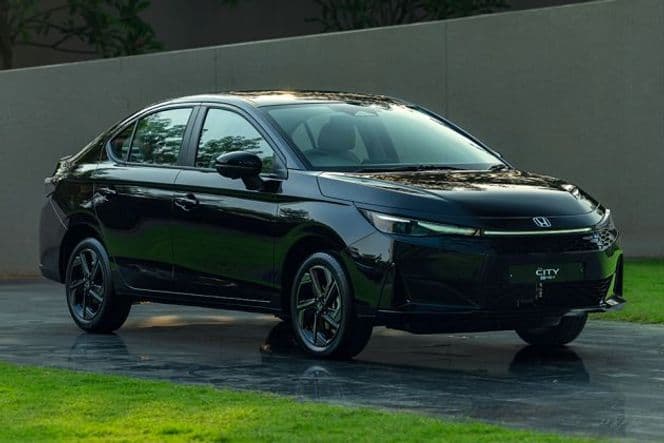
The Honda City has long been the space-and-comfort benchmark in this segment, but the e.MAS 5 quietly outdoes it on cabin room, especially in the rear seat and boot flexibility. The City's petrol engine and established dealer network remain real advantages for buyers wary of EV ownership. Even so, anyone cross-shopping on interior space and everyday practicality will find the Proton pulls ahead, with the frunk adding storage the City has no equivalent for.
The Hyundai Creta EV Plays In A Different League On Price
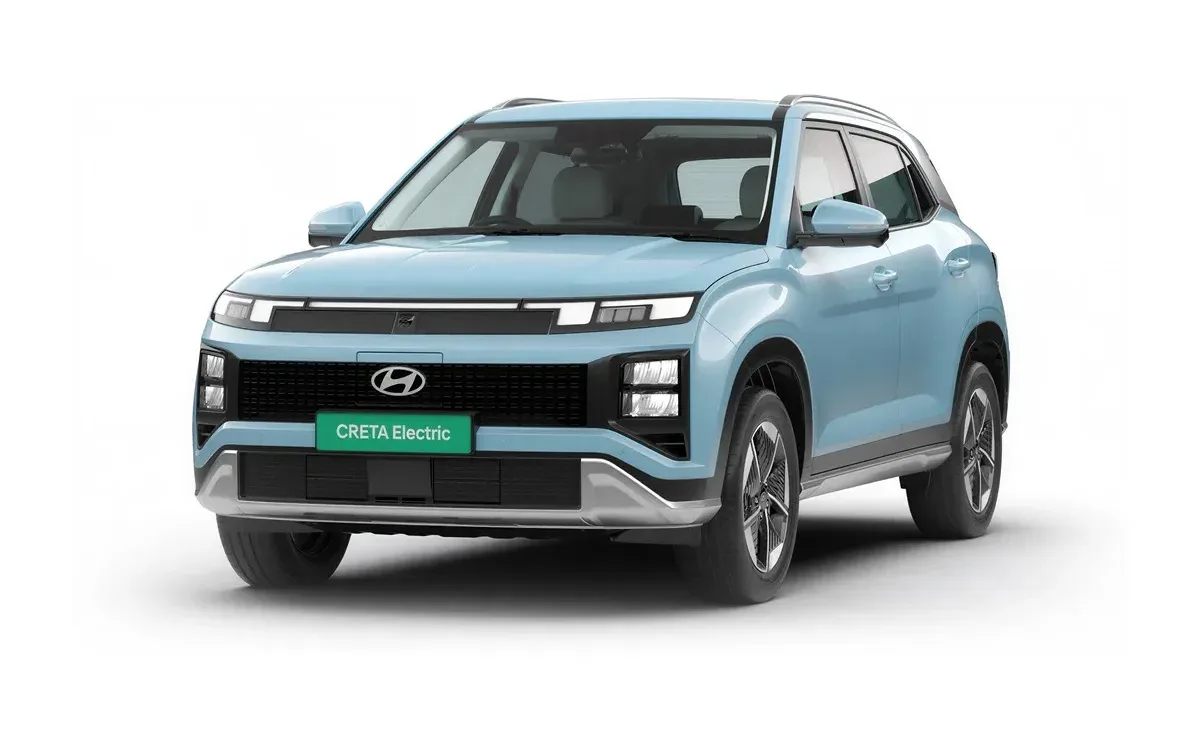
The Hyundai Creta EV sits above the e.MAS 5 in both size and price, and buyers considering it are usually working with a larger budget and a preference for SUV proportions. It is not a direct like-for-like rival. It is the natural next step up for anyone who test-drives the e.MAS 5 Premium and wants more ground clearance and a bigger footprint, at a correspondingly higher cost that pushes well past what the e.MAS 5 asks.
Who Should Actually Buy This
The Proton e.MAS 5 EV is best suited to city-based buyers taking their first step into electric ownership. It suits people who want a car that is comfortable to live with day to day rather than one built around headline performance numbers. Its combination of space, ride comfort, quiet refinement and real practicality, from the frunk to the expandable boot and under-seat storage, makes it easy to recommend over petrol equivalents at a similar price, provided home or workplace AC charging is available given the modest 6.6 kW ceiling.
The Premium variant is the one we'd steer most buyers toward, given the meaningful jump in range and charging speed for a manageable price difference. For anyone cross-shopping the Toyota Vios or Honda City purely out of habit, the e.MAS 5 deserves a serious look before the decision is made. It is rare to find this much cabin space, ride comfort and daily usability bundled together at this price in Nepal's EV market.
Writes on vehicle pricing, taxation and the Nepali auto market from ongoing tracking of distributor price lists. Editorial policy.