Where Each EV Sits in the Nepali Market
For compact EV buyers in Nepal, the **Tata Tiago EV and Proton e.MAS 5** now sit right on top of each other in pricing, but they approach the segment very differently.
- Tata Tiago EV (LR XT and LR XZ+ Tech Lux) is positioned as a budget-friendly, small long‑range hatchback. Its ex‑showroom prices run from Rs 27.49 lakh (LR XT) to Rs 29.99 lakh (LR XZ+ Tech Lux), making it one of the most affordable long‑range EVs from a mainstream brand.
- Proton e.MAS 5 (Prime and Premium) is pitched as a larger, more advanced compact EV. Its ex‑showroom pricing ranges from about Rs 29.84 lakh (Prime) to Rs 34.84 lakh (Premium), with introductory launch prices undercutting later list prices.
The Tiago EV plays the value and network card: it is backed by Sipradi Trading, with 58 showrooms and 37 service centres across Nepal. The e.MAS 5 comes through Jagdamba Motors, currently with 4 showrooms and 1 service centre, leaning on product appeal and safety tech more than sheer coverage.
For many buyers outside the Valley, the Tiago’s broader footprint is a major practical advantage. Inside the Valley and other major cities, the Proton’s extra space, battery options and safety kit make it a serious step‑up alternative.
Design, Size and Road Presence
Tata Tiago EV
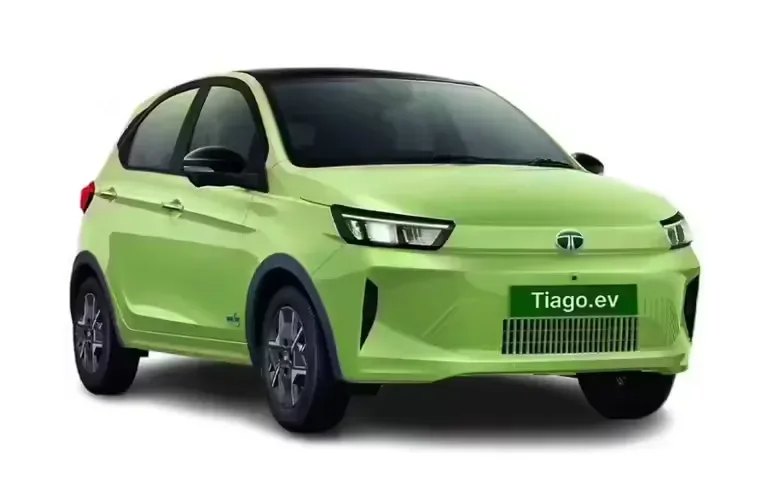
The Tiago EV is a familiar 5‑seater hatchback with EV‑specific touches.
- Dimensions: 3781 mm (L) × 1677 mm (W) × 1536 mm (H).
- Ground clearance: 166 mm, respectable for small‑car EV use on Nepal’s mixed roads.
- Styling: The facelifted Tiago.ev gets refreshed bumpers, EV‑themed detailing and new colours like Chill Lime and Arizona Blue. It remains a compact city car in visual terms.
On the road, it looks and feels like a small, friendly hatchback. The EV cues are there, but it is not trying to be an SUV or a crossover.
Proton e.MAS 5
The e.MAS 5 is clearly larger and has a more grown‑up stance.
- Dimensions: 4135 mm (L) × 1805 mm (W) × 1580 mm (H), with a 2650 mm wheelbase.
- Body style: A compact family hatchback with more height and width than the Tiago EV.
- Prime variant: 15‑inch wheels, halogen headlamps, follow‑me‑home lights.
- Premium variant: 16‑inch wheels, full LED headlamps, auto headlamps, front fog lights, powered tailgate.
Overall, the Proton feels closer to a compact crossover hatch in size and presence. It will fill out a parking space more than the Tiago EV and look more substantial on highway runs and family trips.
Design verdict: - If you want a small city hatchback that is easy to park and thread through tight streets, the Tiago EV fits better. - If you want a roomy, modern‑looking family EV with stronger showroom presence, the e.MAS 5, especially in Premium, clearly has the edge.
Features and Equipment
Cabin and Comfort
Tiago EV LR XT
- Fabric upholstery with a simple 5‑seat layout.
- Automatic climate control is available even on the XT Long Range.
- Height‑adjustable driver seat is not officially confirmed for Nepal.
Tiago EV LR XZ+ Tech Lux
- Premium interior trim and better seat and cabin materials than XT.
- Automatic climate control as standard.
The Tiago’s cabin is straightforward, focused more on essential comfort than luxury. The Tech Lux variant lifts the ambience, but this is still a small‑car interior.
Proton e.MAS 5 Prime and Premium
Both variants offer a more upmarket baseline:
- Leatherette seats and a two‑tone leatherette steering wheel.
- Power windows with anti‑trap.
- Smart convenience touches like 28L rear under‑seat storage compartments.
- Intelligent keyless entry and start.
Interior colour choices such as Alabaster White and Flint Grey add a more contemporary feel. In terms of material richness and clever storage, the e.MAS 5 feels like a class above the Tiago EV.
Infotainment and Connectivity
Tiago EV
- Both LR variants get an advanced digital instrument cluster.
- The XZ+ Tech Lux adds a 10.2‑inch touchscreen infotainment system with modern connectivity and convenience tech.
- The XT’s touchscreen and detailed feature list for Nepal are not fully disclosed, but it is positioned as the more basic long‑range trim.
Proton e.MAS 5
- 8.8‑inch LCD instrument cluster on both Prime and Premium.
- Prime: 4 speakers, 1 Type‑A + 1 Type‑C USB.
- Premium: 6 speakers, 2 Type‑A + 1 Type‑C USB.
- Both: Apple CarPlay / Android Auto, 4G and Wi‑Fi connectivity, and online navigation.
In infotainment terms, the Tiago’s Tech Lux wins on sheer screen size, while the Proton wins on smartphone integration and connected features. For buyers who live in Google Maps and music streaming, the e.MAS 5’s built‑in online navigation and connectivity ecosystem are compelling.
Safety and Driver Assistance
This is one of the clearest differentiators.
Tiago EV (Nepal spec)
- Regenerative braking across the EV range.
- Reverse parking sensors are standard.
- Airbag count, ESC and advanced safety features are not transparently disclosed in the Nepal documentation as of mid‑2026.
The Tiago EV has a safety reputation in India, but in Nepal the official variant‑wise safety list is not clearly laid out. For a buyer wanting a specific count of airbags and active safety systems, this lack of clarity is a drawback.
Proton e.MAS 5 Prime
- 6 airbags: front, front side, and side curtains.
- Electronic Stability Control (ESC).
- G‑Traction Control System (GTCS), ABS, EBD, TPMS.
- Auto Hold, Hill Descent Control, rear parking sensors, auto door lock.
Proton e.MAS 5 Premium adds a full ADAS suite:
- Adaptive Cruise Control (ACC).
- Autonomous Emergency Braking (AEB) and Forward Collision Warning (FCW).
- Lane Departure Warning (LDW) and Lane Keep Assist.
- Blind Spot Detection (BSD), Rear Cross Traffic Alert (RCTA), Rear Collision Warning (RCW), Door Opening Warning (DOW).
- 360° camera with 3D display.
Safety verdict: For buyers prioritising transparent safety equipment and modern driver‑assist tech, the Proton e.MAS 5, especially Premium, is far ahead of the Tiago EV.
Motor, Battery and Performance
Tata Tiago EV
Both long‑range variants share the same core hardware:
- Battery: 24 kWh lithium‑ion.
- Claimed range: around 250–291 km per charge.
- Real‑world range: around 205 km in typical mixed use.
- Motor: 48 kW Permanent Magnet Synchronous Motor, about 65.3 PS.
- Torque: 114 Nm, front‑wheel drive.
- Transmission: single‑speed automatic.
This makes the Tiago EV a modest but adequate performer. It is tuned for city efficiency and everyday use rather than outright acceleration. Real‑world range around 200 km is enough for most urban and peri‑urban commutes, with occasional inter‑city trips if planned around charging.
Proton e.MAS 5
Prime
- Battery: 30.12 kWh CATL LFP.
- Range: 225 km WLTP, 280 km NEDC.
- Motor: 58 kW, 130 Nm, rear‑wheel drive.
- 0–50 km/h: 4.4 seconds.
Premium
- Battery: 40.16 kWh CATL LFP.
- Range: 325 km WLTP, 395 km NEDC.
- Motor: 85 kW, 150 Nm, rear‑wheel drive.
- 0–50 km/h: 3.9 seconds.
Both variants share:
- 11‑in‑1 integrated motor design.
- MacPherson strut front / multi‑link rear suspension.
- Electric power steering.
- Regenerative braking, Vehicle‑to‑Load (V2L) capability.
- Fast charging: DC 30–80% in about 21 minutes; AC 10–100% in 4.9 hours (Prime) and 5.9 hours (Premium) at 6.6 kW.
Performance‑wise, the rear‑wheel‑drive layout and stronger motors make the Proton feel livelier, especially in Premium. The longer range of the 40.16 kWh battery is a genuine upgrade for buyers who regularly undertake longer drives beyond the Valley.
Performance verdict:
- For pure city commuting, the Tiago EV’s performance is sufficient and its smaller battery helps keep costs down.
- For range and brisk acceleration, the e.MAS 5 Premium is the clear performance pick; even the Prime offers more battery than the Tiago EV and a RWD character that enthusiasts will appreciate.
Ride, Handling and Comfort (Likely Character)
Neither model has been instrument‑tested back‑to‑back locally, but we can reasonably infer character from layout and hardware.
- The Tiago EV’s shorter wheelbase, FWD layout and 166 mm ground clearance point to a car optimised for tight urban manoeuvring and rough‑road clearance, with predictable small‑hatch dynamics.
- The e.MAS 5’s 2650 mm wheelbase, multi‑link rear suspension and RWD suggest better straight‑line stability, a more composed ride over broken surfaces, and a more planted feel at speed.
In practice, a family of four will likely feel less cramped and less jostled in the Proton, especially on highways and longer trips, while solo and couple commuters in cramped city cores may find the Tiago easier to thread through traffic and park.
Practicality and Running Costs
Space and Cargo
Tiago EV
- Boot: 240 litres.
- Rear seats fold for extra luggage space.
This suffices for city shopping and light luggage but is tight for heavy family travel.
Proton e.MAS 5
- Rear luggage (min): 375 litres; max (with seats folded): 1320 litres.
- Front luggage (frunk): 70 litres.
The Proton offers significantly more usable cargo space, both in normal use and with seats folded. For families carrying bags, strollers or gear, it is in a different league.
Charging, Warranty and Ownership
Both cars support regenerative braking. The Proton’s published charging details are more complete and reassuring:
- e.MAS 5: clearly specified DC fast‑charging times and AC charging durations, plus V2L for powering external devices.
- Tiago EV: fast‑charging specs are not fully detailed in the provided Nepal data, though it supports DC fast charging in other markets.
On battery assurance:
- Proton e.MAS 5 includes an 8‑year / 160,000 km warranty on the high‑voltage battery and components.
- The Tiago EV’s exact Nepal battery warranty structure is not specified in the given dataset; buyers should confirm with Sipradi.
When it comes to after‑sales convenience:
- Tiago EV is backed by 58 showrooms and 37 service centres.
- e.MAS 5 is backed by 4 showrooms and 1 service centre.
For buyers outside major cities, this difference is substantial. Routine service, parts availability and peace of mind all favour the Tata infrastructure at present.
Running costs for both will be low compared to petrol cars, but insurance, tyres and potential bodywork are likely to be cheaper for the smaller Tiago EV simply because it’s a smaller, lower‑value car. The Proton’s more complex ADAS hardware and larger body may lead to higher repair costs if damaged.
Price and Variants: Side‑by‑Side
Ex‑showroom Pricing in Nepal
| Model & Variant | Battery (kWh) | Claimed Range | Drivetrain | Price (Rs lakh) |
|---|---|---|---|---|
| Tiago EV LR XT | 24 | 250–291 km (claimed), ~205 km real | FWD | 27.49 |
| Tiago EV LR XZ+ Tech Lux | 24 | 250–291 km (claimed), ~205 km real | FWD | 29.99 |
| e.MAS 5 Prime | 30.12 | 225 km WLTP | RWD | 29.84 (approx) |
| e.MAS 5 Premium | 40.16 | 325 km WLTP | RWD | 34.84 (approx) |
Proton has also used introductory launch prices for the first batch of customers (around Rs 29.99 lakh Prime and Rs 34.99 lakh Premium), which sharpen the value temporarily. The Tiago EV’s pricing is already aggressive and more stable.
Which EV Suits Which Buyer?
Choose Tata Tiago EV if:
- You want to enter EV ownership under Rs 30 lakh with a mainstream brand.
- You live outside Kathmandu or major hubs and want strong sales and service coverage.
- Your daily use is mostly city commuting, with occasional short highway trips where ~205 km real‑world range suffices.
- You prioritise lower purchase cost over cabin space, power or advanced safety tech.
Between the two Tiago variants:
- LR XT (Rs 27.49 lakh) makes sense for buyers watching every lakh and willing to compromise on features.
- LR XZ+ Tech Lux (Rs 29.99 lakh) suits urban buyers who want a richer interior and a proper infotainment experience while staying in the Tiago footprint.
Choose Proton e.MAS 5 if:
- You want a larger, more comfortable family EV with much more boot space and interior room.
- You care deeply about safety, including multiple airbags, ESC and ADAS such as ACC, AEB and lane‑keeping (Premium).
- Your use case includes regular longer highway runs, where the Premium’s 325 km WLTP range and faster acceleration add real comfort.
- You value connected features like built‑in online navigation, CarPlay/Android Auto and 4G/Wi‑Fi.
Between the two Proton variants:
- Prime (around Rs 29.84 lakh) is compelling if you want more space and RWD character at Tiago‑adjacent pricing, and can live without the bigger battery and full ADAS suite.
- Premium (around Rs 34.84 lakh) is the sweet spot for range, performance and safety, provided your budget stretches beyond Rs 30 lakh and you accept a leaner service network.
Editorial Verdict
Viewed purely as hardware, Proton e.MAS 5 Premium is the stronger product: more space, more range, more performance and a safety package that frankly embarrasses most small EVs at this price level. For a Kathmandu‑based family that will keep the car for years and regularly travel beyond the Valley, it is the more future‑proof choice.
However, the Tata Tiago EV remains the more sensible mass‑market buy for a large part of Nepal. It’s cheaper to buy, cheaper to insure and supported by a far deeper nationwide network. For first‑time EV buyers who simply want a reliable, compact electric hatchback with decent real‑world range, the Tiago LR XT and LR XZ+ Tech Lux are hard to argue against.
In simple terms:
- Budget‑conscious, network‑focused buyers: choose Tata Tiago EV, especially LR XZ+ Tech Lux if you can stretch a bit.
- Space‑and‑safety‑focused buyers with higher budgets: choose Proton e.MAS 5 Premium.
- Enthusiasts or city‑based families wanting a bigger feel without going to an SUV: Proton e.MAS 5 Prime hits a sweet spot between price, space and rear‑drive character.
Both cars are strong additions to Nepal’s EV landscape, but they answer different questions. Knowing which question you are asking – budget and support, or space, tech and safety – will lead you to the right key.
Compare Tata Tiago EV vs Proton e.MAS 5 EV variant by variant
Writes on vehicle pricing, taxation and the Nepali auto market from ongoing tracking of distributor price lists. Every price in this piece is read live from the Nepal AutoMart catalog — how we verify prices.