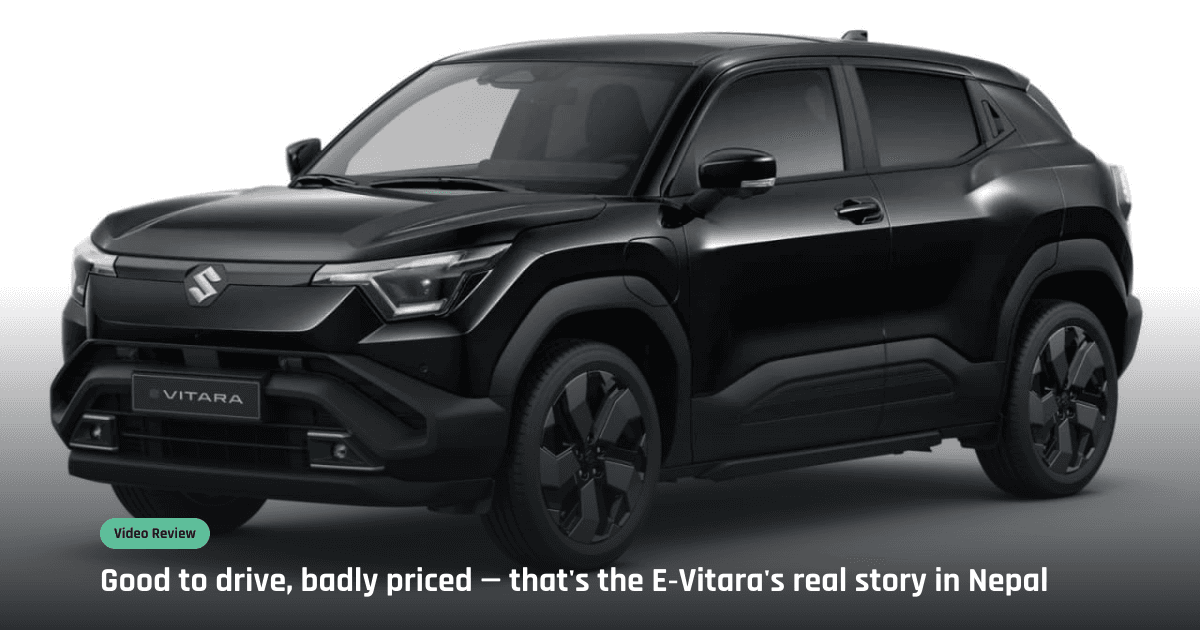
Where Suzuki's First Electric SUV Lands In Nepal's Market
Suzuki has never been a brand Nepali buyers associate with premium price tags, which makes the E-Vitara's arrival through CG MotoCorp (Suzuki Cars Nepal) something of a departure. At Rs 51.99 lakh for the entry Delta and Rs 63.49 lakh for the fully loaded Alpha DT, this is not a budget EV chasing scooter-replacement buyers — it's a considered, mid-size electric SUV aimed at families who'd otherwise be cross-shopping Korean and Chinese electric crossovers. It arrives in Nepal for the 2026 model year carrying Suzuki's long-earned reputation for reliability and after-sales reach into a segment where that reputation counts for very little unless the product itself stacks up on range, charging and cabin space. On paper and in showroom impressions, it mostly does — with a few notable exceptions we'll get to.
The four-variant spread — Delta, Zeta, Alpha and Alpha DT — gives buyers a genuine ladder to climb rather than a token base trim nobody buys. That's sensible in a market where financing costs bite hard on anything above Rs 55 lakh, and where the difference between variants needs to be felt, not just read off a spec sheet.
Sharp Creases, A Fake Light Bar, And A Face That Doesn't Apologise
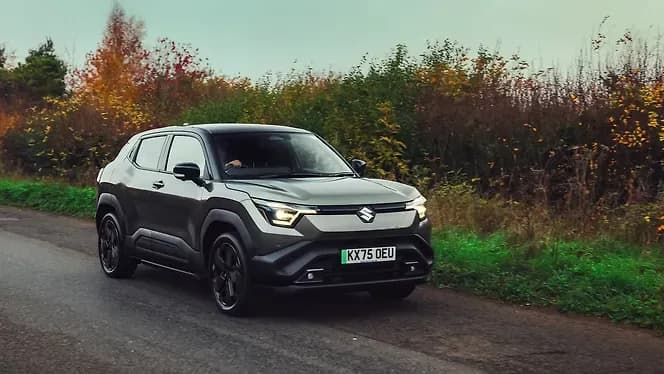
The E-Vitara doesn't look like a badge-engineered hatchback wearing an SUV costume, which is more than can be said for some rivals in this price band. It has a rugged, chunky stance with sharp body lines running its length, and the LED headlight signature at the front is genuinely one of the sharper designs in this class — bold, angular, and paired with a grille treatment that gives the nose real presence rather than the blank-faced look common to many EVs. Buyers walking into a CG MotoCorp showroom for the first time consistently react to the front end before anything else.
The rear is a more mixed story. Suzuki has fitted a light bar across the tailgate that doesn't actually illuminate as a single connected strip — it's a styling cue rather than a functioning bar — and the overall rear three-quarter view draws inevitable comparisons to the Mahindra 3XO, a resemblance that will either read as "on-trend" or "derivative" depending on the buyer. One detail that photographs don't always catch: the rear door handles are hidden, tucked into the C-pillar rather than sitting on the door itself, which cleans up the side profile nicely and is the kind of touch usually reserved for cars well above this price point.
The Khaki Green Test Car Sets The Tone
Showroom units and press cars have been shown in a rugged khaki green that suits the E-Vitara's SUV pretensions far better than a conventional white or silver would. It's a deliberately outdoorsy colour choice, leaning into the "adventure-ready" positioning rather than the city-runabout look most electric crossovers default to. We'd expect Suzuki Nepal to offer a broader palette as deliveries scale up, but on the evidence so far, the green is the one that does most for the design.
A Dual-Screen Cabin That Still Keeps Its Buttons
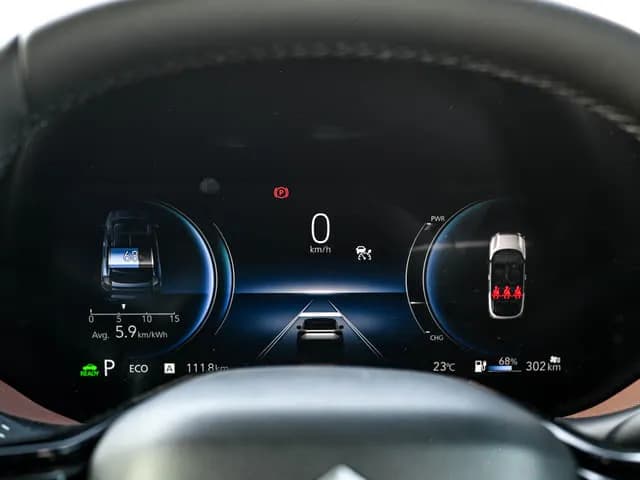
Every variant from the Zeta upward gets Suzuki's dual-screen layout — a 10.25-inch infotainment display paired with a 10.1-inch digital driver's screen — and importantly, Suzuki hasn't gone the route of burying climate control inside a touchscreen menu. There are physical toggle switches for the air conditioning, and that alone will matter to Nepali buyers used to fiddling with fan speed while driving on the Ring Road. The infotainment system supports wireless Apple CarPlay and Android Auto, so there's no fumbling for a USB cable every time you get in.
Where the equipment list gets more selective: a wireless phone charger is fitted on the Zeta and Alpha but not the base Delta, and ventilated front seats are reserved for the range-topping Alpha alone. One genuine ergonomic gripe carries over into daily use — heated seat functions, where fitted, are buried a few menu layers deep in the touchscreen rather than accessible via a direct button, which feels like an odd oversight on a car that otherwise gets its physical controls right.
Two Power Outputs, One Front-Wheel-Drive Layout For Nepal
Suzuki's global E-Vitara line includes both a single-motor front-wheel-drive layout and a dual-motor all-wheel-drive version, but the line-up confirmed for Nepal runs on a single-speed electric transmission driving the front wheels only. Power varies by variant: the Delta manages 105.8 kW, while the Zeta, Alpha and Alpha DT step up to 128 kW, with 193 Nm of torque across the range. That's a meaningful jump from entry to mid-spec, and in practice the added power removes any sense of the car straining under load — Suzuki has tuned the delivery to be smooth rather than aggressive, and there's no torque steer tugging at the wheel even under a firm right foot, a trait front-wheel-drive EVs don't always manage cleanly.
Kerb weights climb from 1725 kg on the Delta to 1815 kg on the Alpha DT, and the extra mass is felt more in ride composure than in outright pace — this isn't a car chasing a 0-100 kph number, it's tuned for confident, controlled progress.
Suspension That Doesn't Crash, Steering That Doesn't Wander
The MacPherson strut front and multi-link rear suspension combination is the right call for this segment, and it shows. Ride quality is well-balanced, quiet over bumps, and notably free of the bouncy, unsettled feel that afflicts rivals still running a simpler torsion-beam rear axle. On broken tarmac the E-Vitara holds its composure rather than transmitting every ridge into the cabin, and that alone puts it ahead of a chunk of its price bracket.
Steering is sharp and direct, and the car corners flat with genuine confidence — there's little of the body roll that afflicts taller electric SUVs carrying heavy battery packs low in the chassis. Suzuki has also built in a Trail mode that uses brake-based torque vectoring — effectively simulating a limited-slip differential electronically — to help tuck the nose into corners and improve traction off-road. It's a clever way of delivering SUV-like capability without the cost and complexity of a second motor, though the trade-off is that frequent brake intervention during off-road use will likely accelerate pad wear over time, and the low-slung battery pack has been reported to scrape on mild off-road terrain — worth bearing in mind for anyone eyeing this as a genuine gravel-road companion rather than a tarmac-and-occasional-dirt-track SUV.
Rear Seats Built For Real Passengers, Minus The Vents
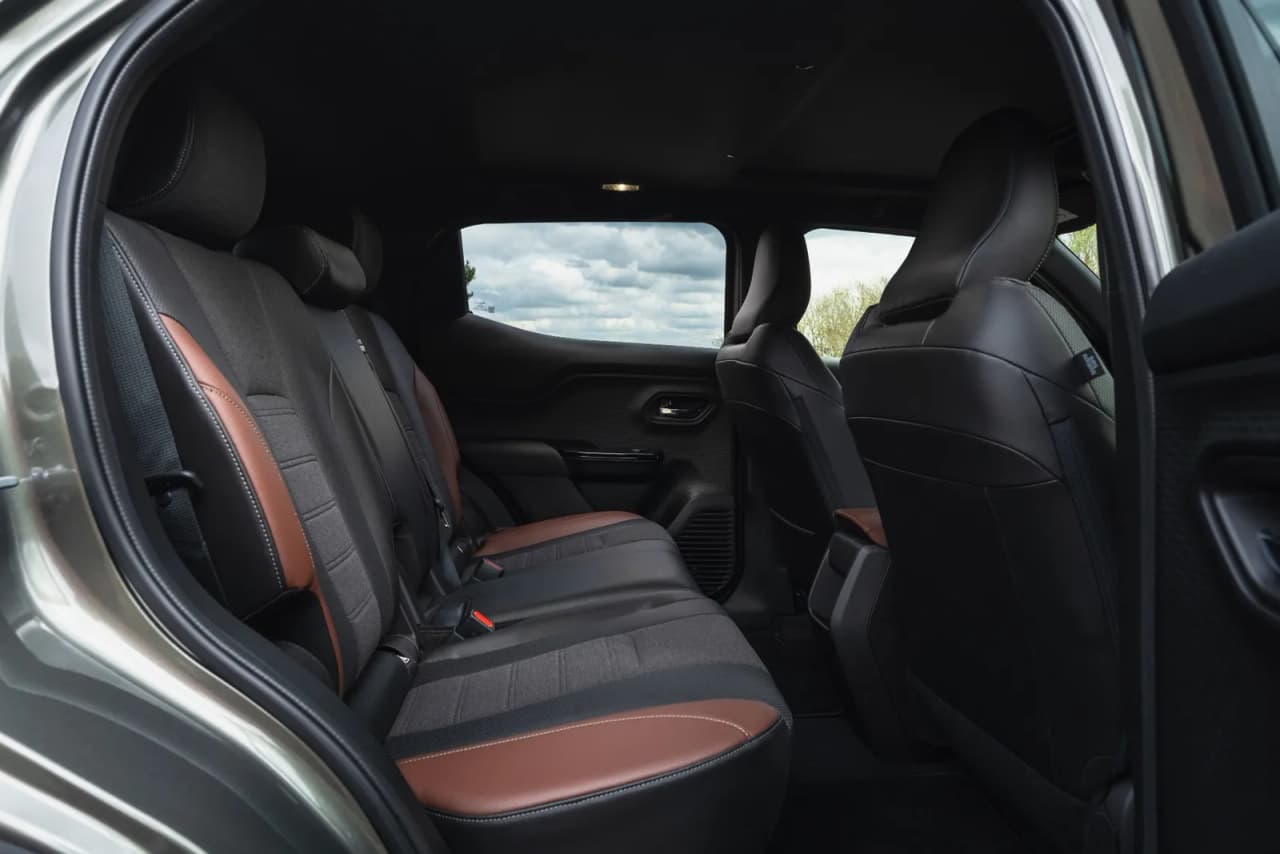
This is where the E-Vitara quietly does its best work. Front seats are well-shaped and genuinely supportive over longer drives, and rear seat space is generous — a passenger of around 5'11" gets good headroom and legroom, helped by the 2700 mm wheelbase, one of the longer ones in this class. The rear seatback also reclines in two stages, a small but genuinely useful touch on longer highway runs where fixed-angle rear benches start to wear on passengers after an hour or two.
The one real ergonomic miss is the absence of rear air vents. In Kathmandu traffic or on a Tarai afternoon, that's a comfort compromise rear passengers will notice quickly, and it's an odd omission on a car that gets so much else about the rear seat right.
Seven Airbags And A Turning Circle Built For Narrow Lanes
Suzuki has equipped the E-Vitara generously on safety, with seven airbags including a knee airbag, front and rear parking sensors, and tyre pressure monitoring across the range. Braking is via discs all round with an electronic parking brake, and the brake-based torque vectoring doubles as both a handling and a safety feature by keeping the car stable through corners. A 5.2 m turning radius is respectable rather than exceptional for the class, and will matter to buyers navigating Kathmandu's tighter residential lanes.
A Boot That Doesn't Match The Rest Of The Car
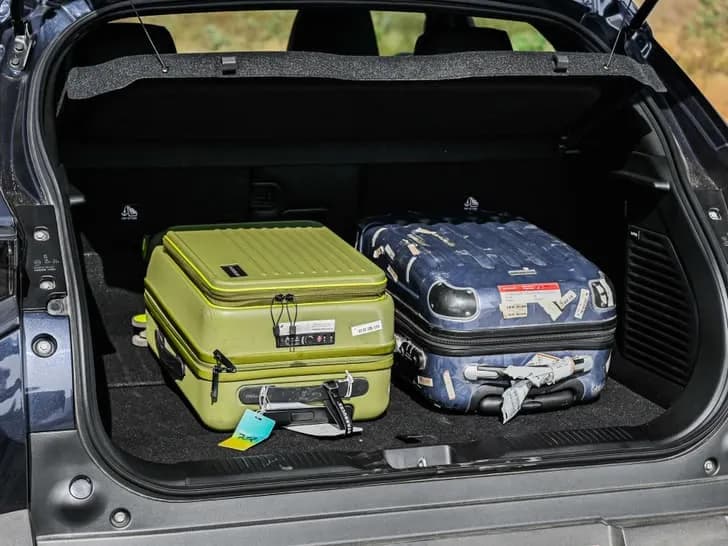
Practicality is the E-Vitara's clearest weak point. Boot space is limited, the loading floor sits high, and there's only a small amount of underfloor storage with no spare wheel provided — a genuine consideration on Nepali roads where a puncture kit alone doesn't always cut it. Cabin storage fares better, with decent door bins and a proper central armrest box, but for a car this size, the boot shortfall is the one practicality complaint that will resurface every time a buyer tries to load luggage for a family trip to Pokhara or Chitwan.
Charging Times That Demand Patience On The Highway
All variants use a Lithium Ferrophosphate (LFP) battery pack, with capacity rising from 48.8 kWh on the Delta to 61.1 kWh on the Zeta, Alpha and Alpha DT. AC charging from 10-100% takes roughly 6.5 hours on the Delta and around 9 hours on the higher-capacity variants using a 7.4 kW charger, while DC fast charging from 10-80% takes 45 minutes. That DC figure is on the slower side for this class, and it's the running-cost trade-off buyers need to weigh seriously if they plan long highway runs between Kathmandu and the Tarai rather than sticking to city and home charging. The upside is a genuinely reassuring 8-year/160,000 km battery warranty, among the stronger guarantees available on any EV sold in Nepal today.
Picking A Variant: Why The Zeta Looks Like The Sweet Spot
At Rs 51.99 lakh, the Delta gets you into the E-Vitara range but with the smaller 48.8 kWh battery and 105.8 kW motor — adequate, but noticeably behind its siblings. The Zeta, at Rs 56,99,000, jumps to 128 kW and the larger 61.1 kWh battery, plus the wireless charger, making it the variant that delivers the most meaningful upgrade per rupee spent. The Alpha at Rs 62,99,000 adds ventilated seats, and the Alpha DT tops the range at Rs 63,49,000. Unless the ventilated seats are a firm requirement, the Zeta reads as the value pick of the range — it carries the same drivetrain upgrade as the flagship without the last two trims' price premium.
The Kia EV3 Undercuts It On Range And Charging Confidence
The Kia EV3 is the rival every E-Vitara buyer will inevitably cross-shop, and it's a legitimate threat on the numbers that matter most to EV ownership — range confidence and charging speed. Where the E-Vitara's DC charging tops out slower and its boot is genuinely tight, the Kia EV3 has built its reputation on being a more complete package for buyers whose priority is stress-free long-distance use rather than back-road handling. The E-Vitara claws back ground on ride quality and steering feel, but buyers prioritising road-trip usability will want to sit in both before deciding.
The BYD Atto 2 Plays The Value Card Hard
The BYD Atto 2 is the more overtly value-focused rival in this bracket, and it's worth cross-shopping specifically because pricing is the E-Vitara's most exposed flank. Where Suzuki leans on driving dynamics and interior ergonomics to justify its ask, the BYD Atto 2 tends to compete on straightforward cost-per-feature, which matters enormously to Nepali buyers financing a Rs 55-60 lakh purchase. Anyone drawn to the E-Vitara's design should still get an Atto 2 quote before signing.
The Verdict: A Suzuki Loyalist's EV, If The Price Doesn't Deter Them
The Suzuki E-Vitara is a genuinely well-engineered electric SUV wrapped in a striking design, and the driving experience — quiet ride, flat cornering, direct steering — is a real step ahead of what the segment often delivers. But the small boot, missing rear vents, slower DC charging and the sheer size of the Rs 51.99-63.49 lakh price spread mean this is a car that has to be judged variant by variant rather than as a blanket recommendation. It suits Suzuki loyalists who want a well-built, traditionally reassuring EV and are willing to trade some practicality and charging convenience for driving manners and cabin comfort — buyers whose priority is maximum range or the biggest boot in the segment should look elsewhere first.
Writes on vehicle pricing, taxation and the Nepali auto market from ongoing tracking of distributor price lists. Editorial policy.