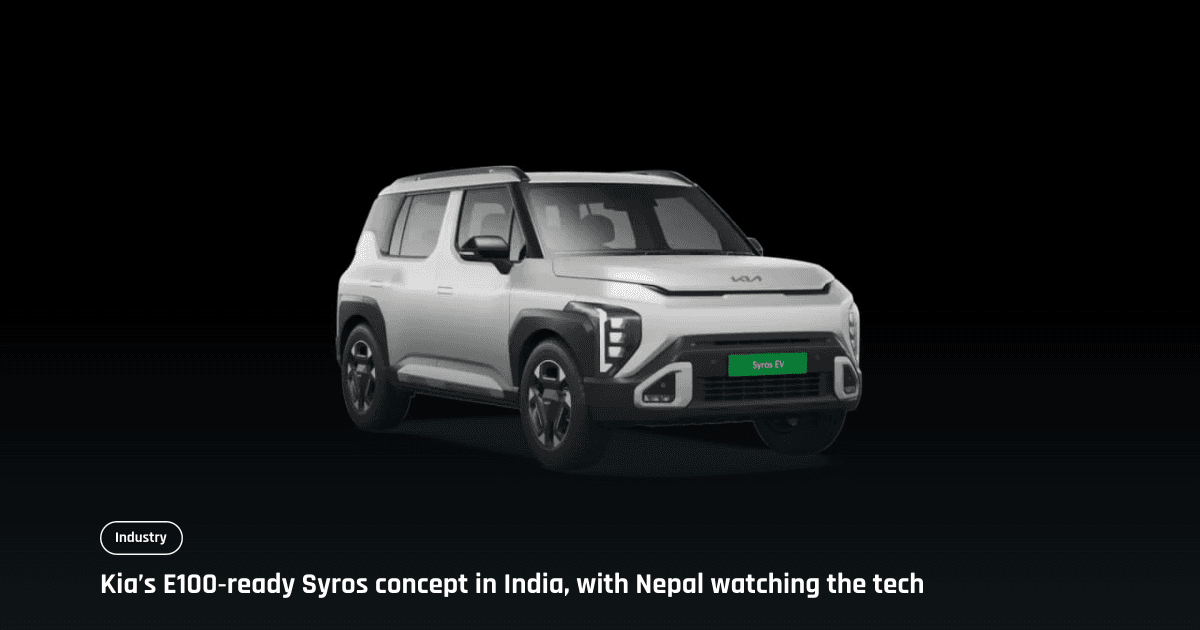
Kia has revealed a Syros Flex Fuel Vehicle (FFV) Concept in India, showcasing a compact SUV powertrain that can run on pure petrol, pure ethanol or blends up to E100. The car pairs a 1.0‑litre three‑cylinder direct‑injection turbo‑petrol engine with a 6‑speed torque‑converter automatic gearbox instead of the regular Syros’ 7‑speed dual‑clutch unit, with revisions to the ECU, TCU and fuel system to handle varying ethanol content. A future Syros flex‑fuel variant, if ever adapted for Nepal, would likely sit around the Syros EV and Sonet in positioning, but no Nepali pricing or launch plan has been announced.
India’s flex-fuel push vs Nepal’s fuel reality

The Syros FFV appears as India formalises regulations for higher ethanol blends and E100‑compatible vehicles, a move aimed at reducing crude oil imports and encouraging domestic ethanol use. The concept signals how Kia can respond to such rules by re‑engineering its small turbo‑petrol engines for multi‑fuel operation.
Nepal, however, currently relies on imported conventional petrol and diesel with no clear roadmap for high‑ethanol blends or flex‑fuel certification. That means a Syros FFV powertrain is not a near‑term option for Nepali buyers, and there is no confirmation that this specific flex‑fuel model will be produced even for India, let alone exported.
Why Nepali buyers should still pay attention
For Nepali customers who track Indian and Chinese developments because most vehicles here are imported from those markets, the Syros FFV matters as a pointer to Kia’s broader engine strategy. If India eventually shifts a large part of its line‑up to flex‑fuel‑ready turbo‑petrol engines, future Sonet, Seltos or Carens iterations sold in Nepal could inherit similar hardware, even if they run mainly on standard petrol here.

This could influence maintenance costs, performance tuning and future pricing, but until Nepal adopts any ethanol‑blend policy or Kia’s Nepali distributor confirms a flex‑fuel model, the Syros FFV remains a technology showcase abroad, not a buying choice in Nepal.
Our own record on this
Each is a dated change we applied to a published ex-showroom price after checking it. A logged change may be a distributor's revision or our own correction coming into line with the official figure — the log says which way each one moved, and when, not why.
See the full price-change log →- Kia Sonet: kia.com.np — checked 2026-10-20
- Kia Seltos: kia.com.np — checked 2026-10-20
Writes on vehicle pricing, taxation and the Nepali auto market from ongoing tracking of distributor price lists. Every price in this piece is read live from the Nepal AutoMart catalog — how we verify prices.