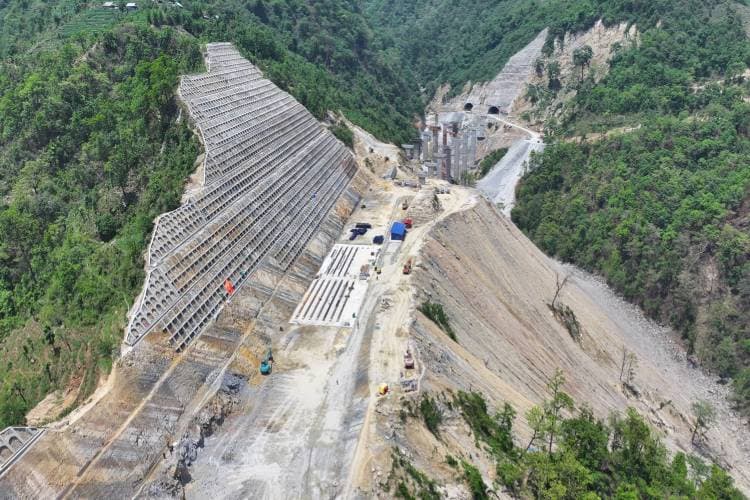
The Kathmandu–Tarai/Madhesh Fast Track expressway, one of Nepal’s biggest road projects, is now around 49% physically complete and has achieved just over 50% financial progress as of mid-July 2026, according to the Nepal Army.
Project status and scale
- Total length: about 71 km between Kathmandu and Nijgadh
- Implementing agency: Nepal Army, formally given the project in 2017
- Estimated total cost: around Rs 211.93 billion, making it Nepal’s largest ongoing road project by budget
Construction is moving ahead on most of the route:
- Work is divided into 13 packages, with 12 already contracted.
- The section from Khokana to Dukuchhap (Package 11) is still on hold.
- On completed sections, the Army is building roads, bridges, tunnels, toll plazas, interchanges and utility ducts at the same time.
The expressway cross-section will be about 25 m wide in the hills and 27 m wide in the Tarai, with separate service roads in some stretches.
Bridges, tunnels and road works
Bridges
- Total planned bridges: 89, covering nearly 13 km in length.
- Contracts awarded for 85 bridges; 4 bridges in the disputed Khokana area are still not tendered.
- 16 bridges are fully completed; foundation works are done on 57, and substructures on 38.
Tunnels
- Total tunnels: 7, together about 11.2 km.
- Lendanda Tunnel (1,622 m) and Dhedre Tunnel (1,690 m) have already achieved breakthrough.
- Lendanda’s secondary lining is finished; Dhedre is nearing final lining.
- Excavation of the Mahadevtar Tunnel (3,355 m, the longest) has reached close to 90%, with lining underway.
- Tunnel digging is also progressing at Chandrambhir, Devichaur, Sisautar and Mauribhir.
Road layers and asphalt
- Initial asphalt paving has started: about 1 km of main carriageway and 7 km of service road have been blacktopped in the Rajdamar area of Makwanpur.
- Sub-base has been laid on around 11 km, and base course on nearly 6 km in selected packages.
Environment and roadside facilities
To make way for the expressway, over 55,000 trees have been cut. In return, about 7 lakh saplings have been planted, with more than 1.5 lakh already handed over to relevant agencies for care.
Planned facilities include:
- Animal underpass already completed at Nijgadh to protect wildlife movement.
- Rest area at Budune.
- Interchanges and toll plazas proposed at Khokana, Budune and Nijgadh.
Starting point dispute: main reason for delay
Although most of the alignment is under construction, the official starting point near Khokana is still not settled. The current detailed project report (DPR) shows Khokana as the origin of the expressway.
However, land compensation disputes and strong local opposition have stopped work in this area. In February 2026, the government asked officials to explore alternative alignments instead of pushing ahead only with the existing Khokana plan.
Earlier technical studies placed three options on the table:
- Starting near Dukuchhap
- Starting near Bungamati
- A new route close to Sikali Ghat
More recently, Chobhar has also been mentioned as another candidate for the starting point.
The Nepal Army has already prepared and submitted a revised DPR with multiple alignment options. Formal construction and tendering for the Khokana–Dukuchhap package will begin only after the Cabinet approves one of these options.
Deadlines and what it means for road users
The project was first expected to be completed by August 2021, then pushed to mid-December 2024, and later extended again to mid-April 2027. With less than half the work finished and the starting section still undecided, observers now expect at least another three years of delay beyond the current deadline.
For future vehicle users, once the expressway is finally open:
- Kathmandu–Tarai travel time is expected to drop to about one hour.
- Annual savings of over Rs 50 billion are projected through lower fuel use and transport costs.
In simple terms, the Fast Track is moving ahead strongly in the middle sections, but until the government settles where exactly the road will start near Kathmandu, Nepal’s biggest highway project will remain behind schedule and out of reach for everyday motorists.
Writes on vehicle pricing, taxation and the Nepali auto market from ongoing tracking of distributor price lists. Editorial policy.