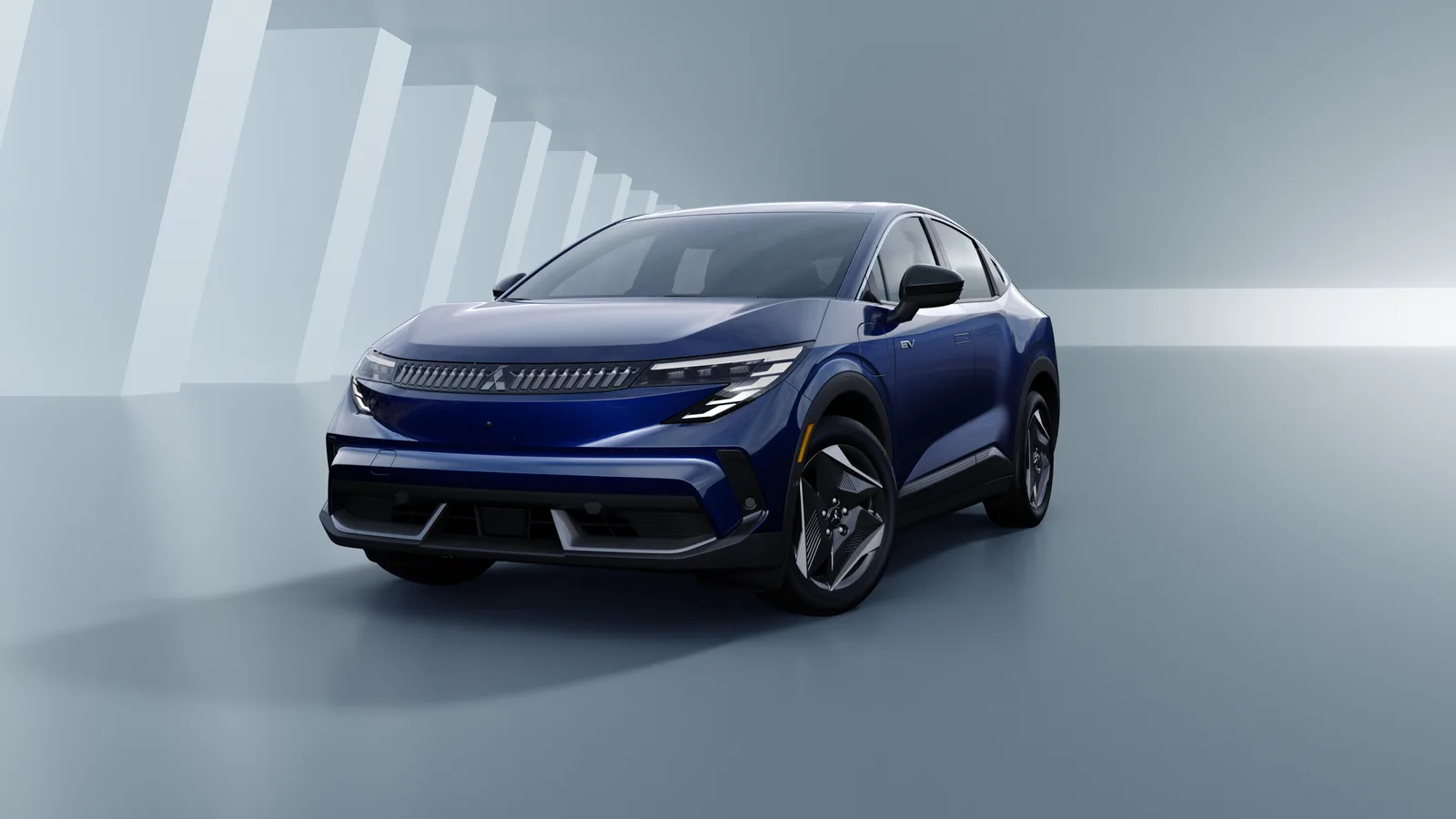
About the Mitsubishi Eclipse Sportback EV
The Mitsubishi Eclipse Sportback EV brings the Eclipse name back as a modern, fully electric subcompact SUV, now positioned in Nepal as a premium urban crossover with long‑range, everyday usability. Based on Nissan’s proven Leaf platform with Mitsubishi’s own styling and tuning, it targets buyers who want an electric upgrade from petrol crossovers like the Eclipse Cross without going to luxury European brands, at an ex‑showroom price of around Rs 1,35,00,000 for the launch-spec top variant in Nepal.
Design & styling
The Eclipse Sportback EV takes the familiar compact crossover silhouette and adds a coupe-like rear roofline for a sportier stance than traditional upright SUVs. Up front, Mitsubishi’s current design language shows up in a chunkier bumper and unique trim compared to the Nissan Leaf base car, so it looks like a proper member of the brand’s SUV family rather than a straight rebadge. At the back, the Sportback tail treatment and distinctive alloy wheel design help it stand out on Kathmandu roads that are increasingly full of generic-looking crossovers. On the top launch-spec variant offered in Nepal, buyers can expect full LED exterior lighting and premium wheel designs in line with what Nissan offers on higher Leaf trims. That positions it as a more upmarket EV than most Chinese compact electric SUVs in the market.
Performance & drivetrain
Mitsubishi has confirmed that the Eclipse Sportback EV is a battery-electric vehicle supplied by Nissan on an OEM basis and based on the Leaf’s CMF-EV architecture, with a single electric motor driving the front wheels. Internationally, the expected configuration is a liquid‑cooled lithium‑ion battery around 75 kWh paired to a front motor in the 174–214 hp range, with estimates of roughly 480 km of driving range on a single charge depending on final tuning and test cycle. This gives the Sportback EV the kind of effortless torque and smooth, single‑gear acceleration typical of modern EVs. It should feel particularly relaxed in stop‑start city traffic and steep urban climbs compared to the 1.5‑litre turbo petrol in the Eclipse Cross currently sold in Nepal. The top launch-spec Nepal variant is expected to mirror the higher-output Leaf powertrain and DC fast‑charging capability up to about 150 kW. Owners able to access high‑power chargers can anticipate a 10–80% fast charge in a little over half an hour as per global communications.
Interior, features & practicality
Because the Eclipse Sportback EV is based on the latest Leaf platform, cabin layout and packaging are tuned for everyday usability rather than extreme sportiness, with comfortable seating for five and a practical hatchback‑style boot suited to mixed city and highway use. Buyers in Nepal can expect an interior that blends Mitsubishi’s trim and branding with Nissan’s underlying dashboard architecture, including a digital instrument display and a central touchscreen with smartphone connectivity, since these are now standard fare on Leaf‑based EVs in global markets. The top launch-spec variant sold here is likely to align with higher global trims, so features such as keyless entry and start, automatic climate control and advanced driver assistance systems like adaptive cruise control and lane‑keeping support are expected, given that the Leaf offers such safety tech and Mitsubishi has indicated it will carry over many of these systems. Practicality should be good for a compact SUV. The under‑floor battery keeps the centre of gravity low without intruding heavily into cabin space, making it suitable for family use on mixed surfaces and for carrying luggage for city‑to‑hill drives, provided ground clearance is respected on the roughest rural tracks.
Ownership in Nepal — price positioning, running cost & who it suits
For Nepal, the Mitsubishi Eclipse Sportback EV launch-spec top variant is positioned at an ex‑showroom price of Rs 1,35,00,000, placing it roughly a tier above the petrol Eclipse Cross GLS (S-AWC), which sits at Rs 1,19,00,000 ex‑showroom. This pricing reflects the higher cost of a long‑range imported EV platform compared to a turbo‑petrol crossover, while still undercutting many European EVs and premium hybrids that go well beyond the Rs 1.5–2 crore mark. Running costs should be significantly lower than an equivalent petrol SUV over time, especially for owners with home or office AC charging access, since electricity per kilometre tends to be cheaper than imported fuel in Nepal, and EVs have fewer routine service items, aligning with global experience from Leaf‑based cars. The Eclipse Sportback EV will appeal most to urban and peri‑urban buyers who already consider vehicles like the Eclipse Cross, Nissan Leaf or similar compact EVs, but now want the combination of Japanese brand trust, long‑range electric capability and SUV‑style practicality for regular drives within the Kathmandu Valley and occasional trips to nearby hill towns where public fast charging is gradually improving.
Verdict
The Mitsubishi Eclipse Sportback EV arrives in Nepal as a timely upgrade path for existing Japanese crossover owners who want to move to electric without jumping into unfamiliar brands or experimental platforms. Its Leaf‑derived mechanicals promise mature EV behaviour, strong real‑world range and fast‑charging flexibility, while Mitsubishi’s styling and positioning make it feel like a distinct member of the brand’s SUV family rather than a simple rebadge. At around Rs 1.35 crore for the launch-spec top variant, it is not an entry‑level EV, but it offers a credible alternative to similarly priced petrol crossovers and mid‑range imported EVs, especially for buyers who value Japanese reliability and a balanced mix of performance, practicality and environmental credentials. For Nepali car‑buyers willing to invest in a long‑term EV and who mostly drive in and around major cities, the Eclipse Sportback EV looks set to be one of the more convincing all‑round electric SUVs in its segment.
Editorial overview compiled from official specs and Nepali/Indian auto sources · as of 29 Jul 2026.
| Variant | Ex-showroom price |
|---|---|
| Eclipse Sportback EV (launch spec – price range midpoint inferred from comparable Eclipse Cross/PHEV positioning in Nepal) | रु 1,35,00,000 |
Ex-showroom prices researched from official Mitsubishi Motors (authorized Nepal importer – model and price data cross‑checked from multiple Nepal auto portals; no dedicated official Mitsubishi Nepal distributor website or price‑list PDF could be located) sources.
Mitsubishi Eclipse Sportback EV rivals in Nepal
Other cars in Nepal priced close to the Mitsubishi Eclipse Sportback EV.
| Ex-showroom price (Eclipse Sportback EV (launch spec – price range midpoint inferred from comparable Eclipse Cross/PHEV positioning in Nepal)) | रु 1,35,00,000 |
| First-year road tax (51 – 125 kW) | रु 15,500 |
| Third-party insurance (Above 50 kW) | रु 8,485 |
| Estimated on-road price | रु 1,35,23,985 |
Engine/motor size isn't officially disclosed for this variant, so this uses a typical 60kW figure for the band — enter your exact kW above for a precise number. Third-party insurance is compulsory; comprehensive cover is optional — see the full insurance calculator or tax calculator for more detail.
Work out your exact figures: insurance calculator · EMI calculator. Bank lending rates vary (Asar 2083 (June/July 2026)); insurance figures follow the NIA motor tariff.
- great gas mileage
- amazing product for camping
- Price is significantly lower than other EV crossovers available in Nepal
- Good feature set for the money, including modern infotainment and safety features
- Attractive sporty design compared to typical budget EVs
- Electric powertrain offers instant torque and smooth acceleration
- Modern design with sleek, minimalistic interior
- high price compared to other cars
- build quality feels cheap
- rough ride quality
- poorly made leather seats
- Concern about long‑term battery health and replacement cost in Nepal
- Uncertainty about Mitsubishi’s after‑sales service network and spare parts for Eclipse in Nepal
- Doubt about resale value of a lesser‑known EV model in Nepali market
- Range anxiety for highway trips outside Kathmandu due to limited DC fast charging infrastructure
- Discussion is limited because Mitsubishi Eclipse Sportback EV is still very new/rare in Nepal market, so real owner feedback is scarce
- Buyers repeatedly compare Eclipse price and features with MG ZS EV, BYD Atto 3, Tata Nexon EV and see Eclipse mainly as a cheaper alternative
- Potential buyers worry about rural road conditions, ground clearance and suspension durability on Nepali highways and village roads
- Charging infrastructure is seen as adequate inside Kathmandu valley (home charging + a few public chargers) but weak along major highways like Mugling–Pokhara or East‑West Highway
- Many questions focus on warranty terms in Nepal (battery years/km, motor warranty) and whether parts will be stocked locally by the official Mitsubishi distributor
- Potential challenges with charging infrastructure in Nepal
- Service and spare parts availability may be limited
“this box is more expensive than my damn car itself” — YouTube
“the build quality feels cheap—there's a lot of plastic, and the leather seats seem poorly made” — YouTube
“it does offer great gas mileage” — YouTube
“Many people are asking if the new Mitsubishi EV is real value or just cheap specs compared to MG and BYD, since the price looks low for a crossover.” — Facebook
“In comments under a Nepali review, viewers keep asking about actual range on Kathmandu–Pokhara and whether charging stations are enough for Eclipse owners.” — YouTube
“On a local auto group, a few buyers said they like the Eclipse price but are worried about spare parts and long‑term battery support in Nepal.” — Facebook
AI-compiled from public online discussion (Reddit, Quora, YouTube comments, Nepali auto groups & forums) · confidence: medium · as of 29 Jul 2026. Quotes are paraphrased summaries of common opinions, not verbatim. Sources: youtube.com, youtube.com, youtube.com, youtube.com, reddit.com, youtube.com
No customer reviews yet. Owned or driven the Mitsubishi Eclipse Sportback EV? Be the first to review it.
Frequently asked questions
What is the price of Mitsubishi Eclipse Sportback EV in Nepal?
As of July 2026, the Mitsubishi Eclipse Sportback EV costs Rs 1.35 crore (ex-showroom) in Nepal across 1 variant.
Who is the official distributor of Mitsubishi in Nepal?
Mitsubishi Motors (authorized Nepal importer – model and price data cross‑checked from multiple Nepal auto portals; no dedicated official Mitsubishi Nepal distributor website or price‑list PDF could be located) is the authorized distributor of Mitsubishi cars in Nepal.
Where can I buy the Mitsubishi Eclipse Sportback EV in Nepal?
Mitsubishi has authorized showrooms in Bhaktapur, Biratnagar, Kathmandu, Lalitpur, Pokhara. Showroom addresses and phone numbers are listed on this page.
What is the build quality like?
Some commenters say the build quality feels cheap with a lot of plastic parts, which is noticeable compared to other cars sold in Nepal.
How is the gas mileage?
Commenters noted that it offers great gas mileage.
What are the safety features?
One commenter mentioned it looks super safe.
What is the range of the Mitsubishi Eclipse Sportback EV in Nepal conditions?
Official WLTP/NEDC figures are higher, but Nepali reviewers and commenters expect practical city range to be lower under Kathmandu traffic and hilly roads, so they see it as a mid‑range EV mainly for daily urban use and moderate intercity trips with planned charging.
Why is the Mitsubishi Eclipse Sportback EV so cheap compared to other EVs in Nepal?
Online discussions point out that Eclipse is priced aggressively by the importer, likely using smaller battery options and leaner feature packs than premium rivals, plus Nepal’s EV‑friendly taxation; this makes it feel cheaper but not necessarily inferior for basic use.
What is the EMI for the Mitsubishi Eclipse Sportback EV in Nepal?
With banks financing up to 60% of the price (NRB cap) at an indicative 7.5% p.a. over 60 months, the Mitsubishi Eclipse Sportback EV base variant (Rs 1.35 crore) works out to roughly रु 1,62,307 per month after a 40% down payment. Actual rates vary by bank (Asar 2083 (June/July 2026)).