Where The Hector Actually Sits In Nepal's Crowded SUV Shelf
MG's Hector lands in Nepal in 2026 through Paramount Motors and G.O Automobiles, and it lands at a price that will surprise anyone expecting it to compete with mid-size crossovers. At Rs 64.99 lakh for the entry Shine manual and climbing to Rs 78.25 lakh for the range-topping Sharp CVT, this is priced into large-SUV territory, closer to seven-seat family flagships than to compact SUVs wearing the same rupee badge elsewhere. That positioning tells you exactly who MG is chasing: buyers who want a big, well-equipped petrol SUV with genuine road presence, and who are willing to pay Nepal's import duty structure on a larger-displacement, feature-rich vehicle rather than settle for something smaller and cheaper to run.
It's worth being clear about what this Nepali-spec Hector is and isn't. Global markets have been talking about a Hector "Tomahawk" generation with plug-in hybrid and full-electric versions, but the car Paramount Motors and G.O Automobiles are bringing to Nepal is a conventional 1.5-litre turbo-petrol SUV across all five variants. There's no hybrid assistance, no plug, no EV range to quote. That's a meaningful distinction for anyone cross-shopping on running costs, and we'll come back to it, but it also means the Hector's job in Nepal is simpler: be a spacious, well-finished, comfortable petrol family SUV, and let the cabin and equipment list do the talking.
Grille-First Design That Reads Bigger Than It Is
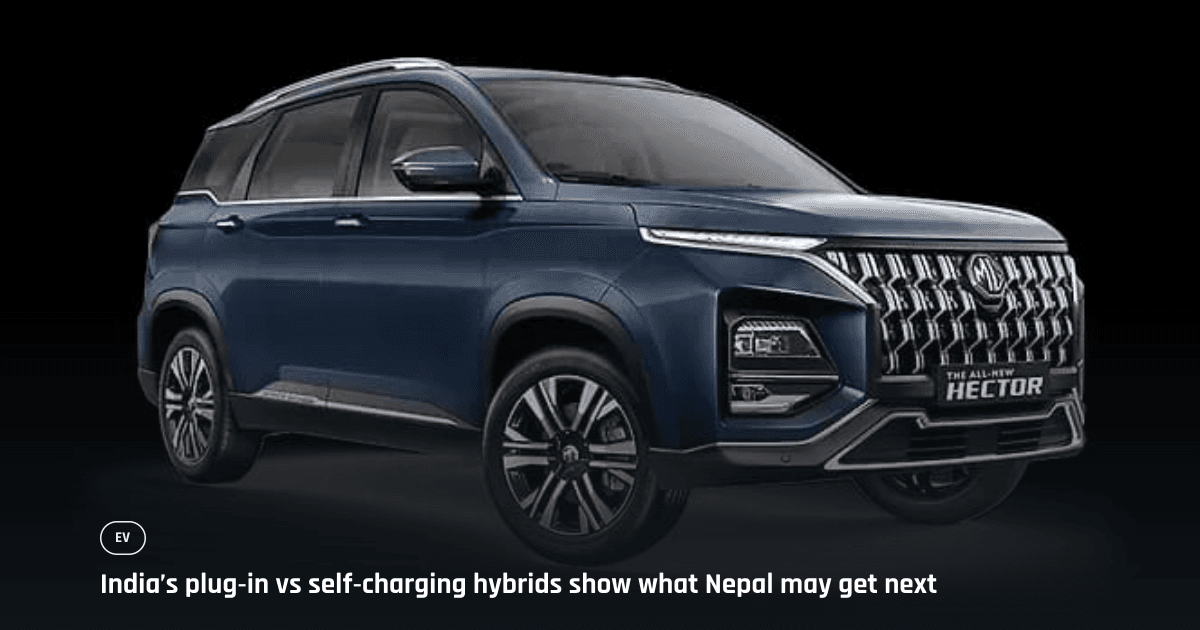
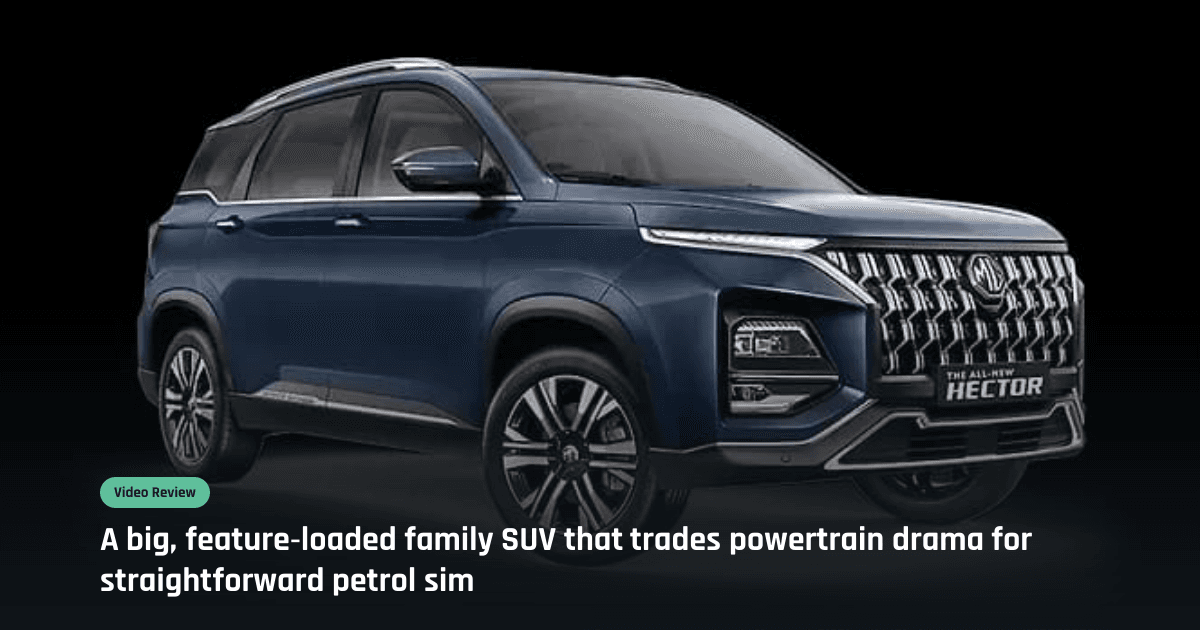
The Hector's face is its strongest visual argument. A large, heavily detailed front grille dominates the nose, flanked by sleek LED headlamps with the daytime running lights positioned above them rather than integrated into the same cluster — a layout that gives the front end a layered, premium look rather than a single flat lighting bar. The MG logo at the centre of the grille is illuminated, a small but effective touch that catches attention at dusk and in showroom lighting alike. Lower down, a rugged bumper design adds visual weight and suggests capability, even though this remains a road-focused SUV.
Where the Hector is less convincing is in profile. Side-on, it reads as a tall, comfortable family SUV rather than a muscular one, and next to something like the Mahindra XUV700 — with its more sculpted flanks and sharper creases — the Hector's sides look plainer and softer. It's not an unattractive shape, but buyers cross-shopping purely on kerbside drama may find the Hector's strongest angle is directly from the front. The rear redeems some of that with stylish LED tail-lamps carrying a distinct light signature that helps the car stand out after dark, giving the back end more personality than the sides manage.
The Only Colours You'll See On The Showroom Floor, For Now
Nepal-market colour choices haven't been exhaustively documented in what we've seen so far, though showroom units and press cars circulating in the region have generally appeared in a light silver or champagne metallic finish that suits the Hector's premium grille treatment well, catching the chrome detailing nicely under showroom lighting. Buyers wanting a more understated, formal look should ask their dealer directly about darker options, as metallic greys tend to suit this shape's height and bulk without exaggerating it.
A Big Screen, Few Buttons, And A Column-Mounted Gear Lever
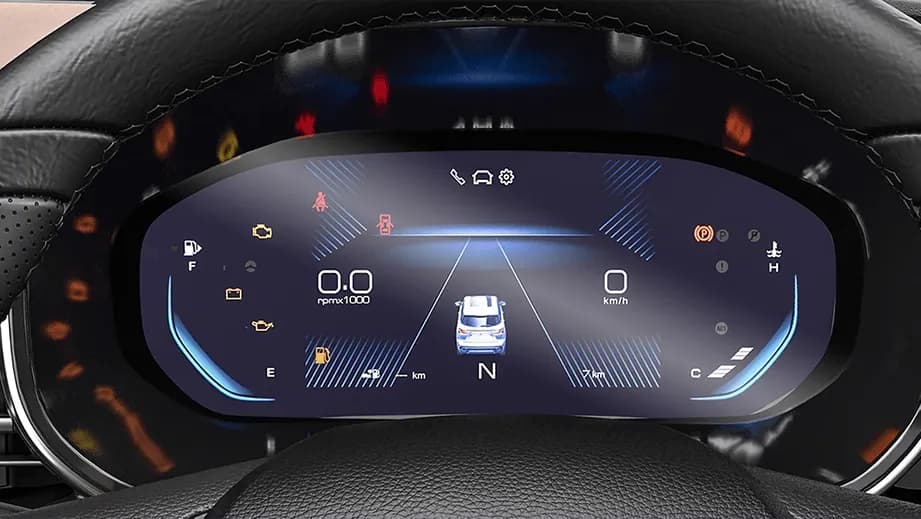
Step inside and the dashboard's dominant feature is its touchscreen — MG quotes a 25.7cm HD unit for the standard Hector variants sold in Nepal. It's the centrepiece of a cabin that leans deliberately minimalist: physical buttons are kept to a bare minimum, with MG retaining just enough hardware — climate shortcuts and the hazard light switch — to avoid forcing every routine adjustment through a touchscreen menu. That's a sensible compromise for a market where buyers still want tactile controls for the things they use daily.
The gear selector itself is mounted on the steering column rather than the centre console, a layout choice that frees up console space for storage rather than being purely about seven-seat practicality (the column-mount approach shows up on the wider Hector family, including versions built around the larger Hector Plus body with its 35.56cm display and 7-seat layout). On the Nepal-spec petrol Hector, that translates into a genuinely useful floating console design underneath the shifter area, giving buyers somewhere to stash phones, wallets and bags that would otherwise clutter the front seats.
Beyond the screen, exact trim-by-trim feature counts for ventilated seats, memory function or specific convenience kit haven't been fully disclosed for the Nepali lineup, so we'd encourage buyers to walk each of the five variants at the dealership rather than assume higher trims automatically carry everything. What is clear is that MG is positioning the Hector as a technology-forward cabin rather than a bare-bones family hauler, and that ambition is visible the moment you sit in the driver's seat.
The 1.5-Litre Turbo-Petrol, In Manual Or CVT Form
All five Nepali variants run the same basic recipe: a 1.5-litre turbo-petrol engine, offered with either a manual gearbox or a CVT automatic depending on trim. The Smart and Sharp trims explicitly list the 1500cc displacement and give buyers a genuine choice — Smart MT at Rs 67.99 lakh against Smart CVT at Rs 70.60 lakh, and Sharp MT at Rs 73.99 lakh against Sharp CVT at Rs 78.25 lakh. The entry Shine trim comes only as a manual at Rs 64.99 lakh.
Front-wheel drive is implied across the range rather than officially quoted, which is standard practice for this segment and shouldn't concern buyers who aren't planning serious off-road use. Turbo-petrol power in this displacement class typically favours in-town response and highway overtaking over outright low-end grunt, and the CVT option should appeal to buyers who spend most of their driving in Kathmandu Valley traffic and want to avoid clutch work, while the manual variants will suit those who still prefer direct control and, often, a lower purchase price for the same trim level.
Riding On Sensible Rubber Rather Than Showy Wheels
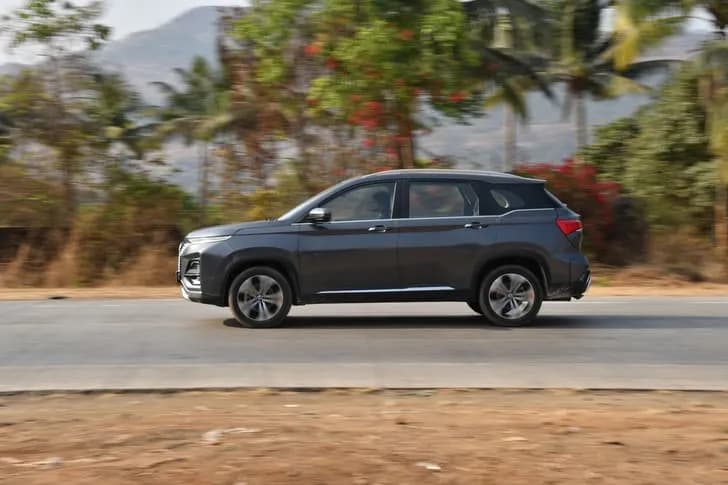
Official ride and handling data — wheelbase, ground clearance, suspension tuning specifics — hasn't been disclosed for the Nepal-spec Hector, so we're cautious about overstating anything here beyond what buyers can verify themselves at a test drive. What we can say with confidence, based on how comparable Hector-platform vehicles have been received more broadly, is that big alloy wheels on this body style have occasionally drawn criticism for looking slightly undersized relative to the SUV's overall bulk — something worth checking in person, since wheel-and-tyre proportions affect both looks and how planted the car feels on Nepali road surfaces, from Kathmandu's patched inner roads to longer highway stretches toward Pokhara or the Terai.
Second-Row Space Is The Genuine Highlight
This is where the Hector earns its keep. The second row offers genuinely generous legroom, even with the front seat pushed back for a tall driver — a configuration that regularly exposes cramped rear quarters in rival SUVs but doesn't here. Backrests recline and the second-row bench slides fore and aft, letting families tune the balance between legroom and boot space trip by trip. The completely flat second-row floor is a small but real win for anyone regularly carrying three across, removing the usual centre-seat foot-splay that makes middle-row journeys uncomfortable on long drives.
The one caveat, relevant mainly to buyers considering the 7-seat Hector Plus layout mentioned in MG's own Nepal-market specifications rather than the standard 5-seat Hector, is the third row: knees-up seating with no meaningful thigh support is the honest description, and it's realistically a space for children or short journeys rather than adults on a highway run. Front seats, meanwhile, are comfortable and power-adjustable on higher trims, though exact ventilation and memory-function availability by variant isn't fully confirmed for Nepal, so buyers should check this directly against their preferred trim.
What We Actually Know About Its Safety Kit
MG's Nepal-facing material doesn't spell out a full safety equipment list for the Hector lineup at the time of writing, and we won't invent specifics that aren't confirmed. What has surfaced is a mention of ADAS Level 2 tied to a specific upcoming variant elsewhere in the Hector family, though this hasn't been confirmed as standard or even available across Nepal's five Hector variants. Buyers who consider advanced driver assistance a priority should ask the dealership directly which trims, if any, carry it in the Nepal-spec car, rather than assuming it's fitted across the board.
Running A Petrol SUV Of This Size, Realistically
With no hybrid or electric variant in the Nepal lineup, running costs here are governed entirely by the 1.5-litre turbo-petrol's real-world fuel consumption, which MG Nepal hasn't published as an official mileage figure for this market. Buyers should treat any efficiency numbers circulating from other regions' hybrid or electric Hector variants as irrelevant to this petrol-only Nepali lineup — this is a straightforward petrol SUV, and its running costs should be judged against other petrol SUVs of similar size and displacement, not against hybrid or EV benchmarks.
Picking A Variant: Where The Extra Money Actually Buys You Something
With five variants spanning close to Rs 13.3 lakh from bottom to top, the Hector range gives buyers real room to decide how much car they need. The Shine MT at Rs 64.99 lakh is the access point but comes without a confirmed displacement figure in our data and skips the CVT option entirely. Smart MT at Rs 67.99 lakh and Smart CVT at Rs 70.60 lakh both confirm the 1500cc turbo-petrol and represent, in our view, the sensible middle of the range for most buyers — enough equipment to feel current without paying flagship money.
The Sharp trims, at Rs 73.99 lakh for the manual and Rs 78.25 lakh for the CVT, sit at genuinely premium pricing for this segment in Nepal, and buyers stretching to that level should weigh whether the additional feature content justifies the jump over a Smart CVT, particularly since exact trim-by-trim comfort and safety differentiation hasn't been fully disclosed. Our instinct, based on where the meaningful equipment steps typically land in this kind of lineup, is that the Smart CVT represents the strongest value point in the range for buyers who want the automatic gearbox without paying for the top trim's badge.
The Mahindra XUV700 Is The Sharper-Handling, Better-Value Rival
The Mahindra XUV700 is the obvious cross-shop for anyone considering the Hector in Nepal, and it wins the argument on road presence: its side profile is more muscular and its overall stance feels more purposeful than the Hector's softer flanks. Cabin width is another area where the XUV700 has the edge — the Hector's cabin is narrower, which makes three-abreast second-row seating noticeably tighter than in the wider Mahindra. Buyers who regularly carry three adults across the back seat should test both cars specifically for this before deciding.
The Tata Safari Is The Established Seven-Seat Alternative
For buyers specifically weighing the 7-seat Hector Plus configuration against established family SUVs in Nepal, the Tata Safari remains the natural comparison point. Both aim at families wanting genuine third-row usability, and both share the honest reality that true adult-friendly third-row space is hard to deliver at this vehicle size — the knees-up seating position that affects the Hector's rearmost seats is a familiar compromise across this class, not unique to MG. The deciding factors for most buyers will come down to dealer network confidence, service costs, and which brand's showroom experience and pricing structure feels right, since Paramount Motors and G.O Automobiles' backing gives the Hector a credible distributor presence in Nepal.
Our Verdict: A Confident Cabin Looking For The Right Buyer
The Hector's case in Nepal rests almost entirely on space and presence rather than outright driving thrill or class-leading efficiency. The front-end design is genuinely striking, the second row is one of the more comfortable in its price bracket, and the choice of five variants across manual and CVT gearboxes gives buyers real flexibility. Set against that is a price range that starts high, a side profile that undersells the car compared to the XUV700, and a safety and dimensional specification sheet that Nepal's official channels haven't yet filled in completely.
This is a car for buyers who prioritise family-friendly cabin space, want a strong showroom presence for their money, and are comfortable running a straightforward petrol SUV without hybrid or diesel alternatives. It suits someone upgrading from a smaller SUV who wants more room and more screen, backed by an established local distributor, rather than someone chasing the lowest possible running cost or the sharpest handling in the segment.
Writes on vehicle pricing, taxation and the Nepali auto market from ongoing tracking of distributor price lists. Editorial policy.