Where it sits in Nepal’s market
The LETBE FLYGON 220cc is placed as a cross-terrain 220cc motorcycle rather than a pure commuter or a hard-core adventure bike. In Nepal, that gives it a split audience. One rider wants easy use in town. Another spends time on rough roads, gravel, and steep sections.
There are three listed variants in Nepal: the base 220cc, the 220 City at Rs 5,49,999, and the 220 Hills at Rs 5,74,999. The ex-showroom range sits around Rs 5.5 lakh to Rs 5.75 lakh, so it lands firmly in premium territory for a 220cc motorcycle.
The dealer footprint also shapes the story. Nepal currently has 11 showrooms and 1 service center, so the bike is visible in the market but still limited in aftersales reach compared with the most established mainstream brands. In this price band, that matters.
Looks, design and build
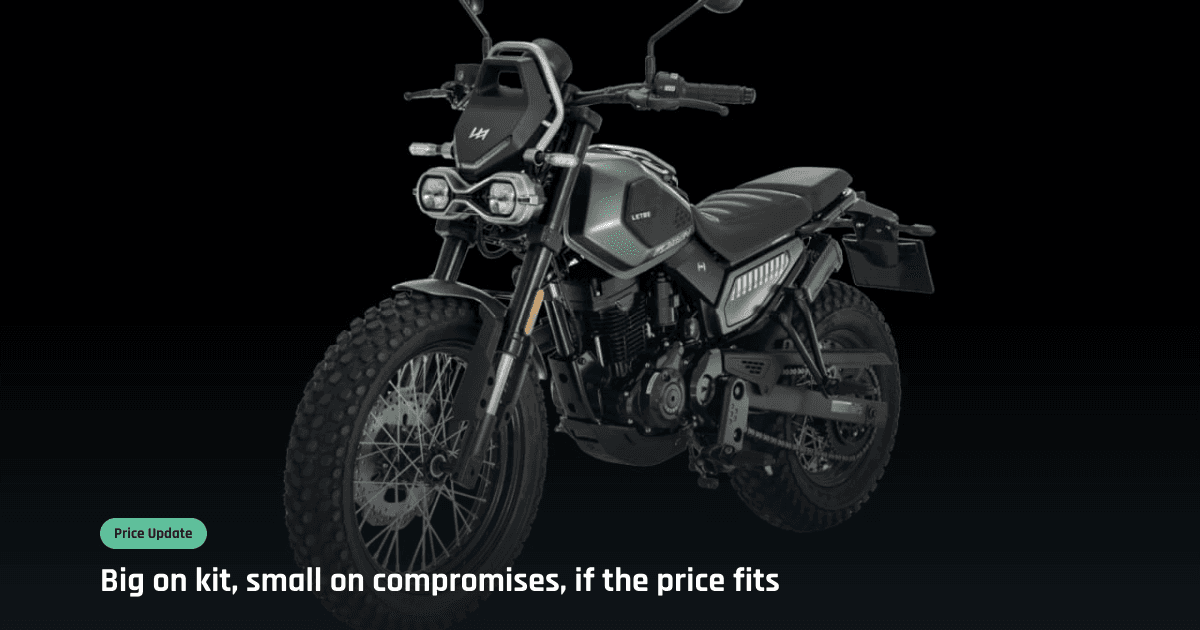
This is one of the FLYGON 220cc’s strongest points. The motorcycle leans into a retro-inspired scrambler / crossover look, with a chunky stance, wire-spoke wheels, and a fat-tyre visual presence that gives it more road presence than a typical 200–250cc commuter.
The design is not just for show. The City variant uses street-focused tyres, which makes it the more natural fit for urban riders and highway use on decent roads. The Hills variant keeps the same basic silhouette but gets knobby tyres. That shifts the bike toward gravel, broken tarmac, village tracks, and light trail use.
The proportions stay friendly rather than intimidating. The 780 mm seat height is unusually approachable for a bike that also claims 230 mm ground clearance. It looks tall and capable without becoming difficult for average-height riders to manage at stops. Short.
Features and equipment
The equipment list is one reason this bike stands out in its class. Both major variants are loaded with features that, on paper, belong to a higher segment.
Key equipment includes: - 2.8-inch full-colour TFT display - Smartphone navigation mirroring on the TFT - Passive keyless entry - Push-start ignition - Smart locking system with anti-theft alarm - All-LED lighting - Dual-channel ABS - Traction Control System (TCS)
That is a serious package for a 220cc motorcycle in Nepal. The TFT and navigation mirroring give it a modern feel, while keyless entry and smart locking add convenience that riders usually expect on more expensive bikes. The safety list is just as notable: dual-channel ABS and TCS are not common talking points in this class, and their inclusion helps the FLYGON feel more premium and more confidence-inspiring on uncertain surfaces.
The City and Hills variants are both similarly equipped, so the choice between them is mostly about intended terrain rather than a big technology gap. That is sensible product planning.
Engine, performance and drivetrain
Both the City and Hills versions use the same core powertrain: a 220cc single-cylinder, air-cooled Bosch EFI engine with 12.8 kW at 7,500 rpm and 17 Nm at 5,500 rpm. Power goes through a 5-speed gearbox and chain drive, and the engine is Euro 5 compliant.
This is not a high-strung performance motor. It is tuned for tractability, usable midrange, and relaxed real-world riding rather than aggressive top-end excitement. The torque figure is modest on paper, but the tuning should suit the bike’s crossover brief. Throttle response should stay easy to manage, overtakes should be manageable, and the engine should still have enough flexibility for hills and mixed roads.
The claimed fuel economy of 45–50 kmpl and the 12-litre fuel tank point to a practical touring range for mixed-use riding, especially if the bike is used at steady speeds rather than pushed hard. That makes the FLYGON 220cc a more believable long-distance companion than its styling first suggests.
For Nepal, the key point is not that it is the most powerful 220cc bike. It is that the engine spec looks balanced around accessibility, efficiency, and usable torque. That fits the country’s road mix better than a spec-sheet hero engine would.
Ride, handling and comfort
The FLYGON’s dimensions point to a bike built for comfort and control rather than aggression. The 140 kg kerb weight is manageable for a crossover-style motorcycle, and the 780 mm seat height should keep low-speed confidence high for many riders.
The 230 mm ground clearance is a major asset in Nepal. It gives the bike a meaningful buffer over speed breakers, broken roads, potholes, and rough rural surfaces. That is one of the clearest reasons the model exists in the first place. It is trying to look rugged and also deliver real clearance for mixed terrain.
The suspension feel will differ between the two variants. The City should be the calmer and more stable road companion, especially on asphalt and daily commuting routes. The Hills is the more purposeful machine for poor surfaces, and the knobby tyres will add confidence on loose ground, although they may also bring more road noise and less smoothness on clean tarmac.
The trade-off is straightforward. The bike’s comfort story is strongest when the route is imperfect. On smooth roads, the rugged hardware and crossover stance may feel like too much for some riders. On rough roads, that same setup becomes the point of the bike.
Practicality and running costs
Practicality is mixed, and that is where the FLYGON 220cc is less universal than some buyers may want. The bike has a useful fuel tank, credible mileage claims, and an upright crossover ergonomics package, but it is not a cargo-first machine.
Underseat storage is not officially disclosed, and the available information points to only typical motorcycle toolkit space. That means buyers should not expect scooter-like convenience. For daily urban use, this is fine. For touring, it means luggage solutions may need to be added externally.
Running costs should benefit from the claimed 45–50 kmpl figure, the 12-litre tank, and the Bosch EFI setup. Still, ownership economics will depend heavily on service access, parts availability, and how the market matures around the brand. With only 1 service center currently listed in Nepal, owners outside the main urban network will naturally think harder about maintenance convenience.
The other practical issue is resale confidence. As a new-name product in Nepal, the FLYGON 220cc still has to prove its long-term reliability reputation and used-market strength. That does not make it a bad buy. It does mean the ownership equation is less settled than with established rivals.
Price, variants and which one to pick
At Rs 5,49,999 for the 220 City and Rs 5,74,999 for the 220 Hills, the difference is only Rs 25,000. That is small enough that the choice should be driven by route type, not budget panic.
- 220 City: best for riders whose time is mostly spent in town and on paved roads.
- 220 Hills: the better choice if gravel, village roads, broken surfaces, and hill use are common.
- Base 220cc: if it is being offered separately in the market, buyers should compare its exact equipment and tyre spec before deciding, because the strongest value case here likely sits in the variant-specific packages.
My editorial view is that the City is the smarter all-round buy for most Nepali riders because it preserves the premium features while using tyres that make more sense for daily road use. The Hills only becomes the better value if the rider genuinely needs the knobbly tyre setup and rough-road bias.
How it compares with its real rivals in Nepal
The FLYGON 220cc does not compete like a typical commuter. Its closest rivals are other 200–250cc road-biased or adventure-leaning motorcycles that buyers cross-shop for style, versatility, and brand comfort.
Against mainstream 220–250cc options, the LETBE wins on feature density and probably on visual distinctiveness. Dual-channel ABS, TCS, TFT navigation, keyless entry, and anti-theft tech create a richer ownership experience than many simpler rivals can match.
Against more established brands, the challenge is trust, not specification. Familiar rivals usually offer broader service reach, a longer reliability track record, and a more predictable resale story. The LETBE answers with novelty and equipment, but it still has to earn the long-term confidence that older names already carry.
Against adventure-styled rivals, the FLYGON is less about pure off-road ability and more about *street-friendly crossover practicality*. The Hills variant in particular looks aimed at riders who want the visual and functional benefits of a rugged bike without moving into heavier, more expensive adventure territory.
Verdict and who it suits
The LETBE FLYGON 220cc is a well-equipped, thoughtfully positioned crossover motorcycle that makes a strong first impression in Nepal. Its combination of 230 mm ground clearance, 780 mm seat height, Bosch EFI, dual-channel ABS, TCS, TFT navigation, keyless entry, and all-LED lighting gives it a premium feel that is rare in this class.
It is not the obvious choice for buyers who care only about proven resale, the widest service network, or the lowest ownership risk. It is also not a machine you buy for bare-bones commuting value.
It makes the most sense for: - Riders who want a feature-rich 220cc motorcycle - Commuters who also face rough roads or broken surfaces - Buyers who like the scrambler/crossover look - Hill-region riders who can use the Hills variant properly
If the priority is everyday road use with a premium feature set, the 220 City is the cleaner recommendation. If the priority is traction and rough-road confidence, the 220 Hills justifies its premium. In either case, the FLYGON 220cc is best understood as a style-led, tech-heavy alternative to conventional 220cc motorcycles rather than as a simple commuter replacement.
Writes on vehicle pricing, taxation and the Nepali auto market from ongoing tracking of distributor price lists. Editorial policy.