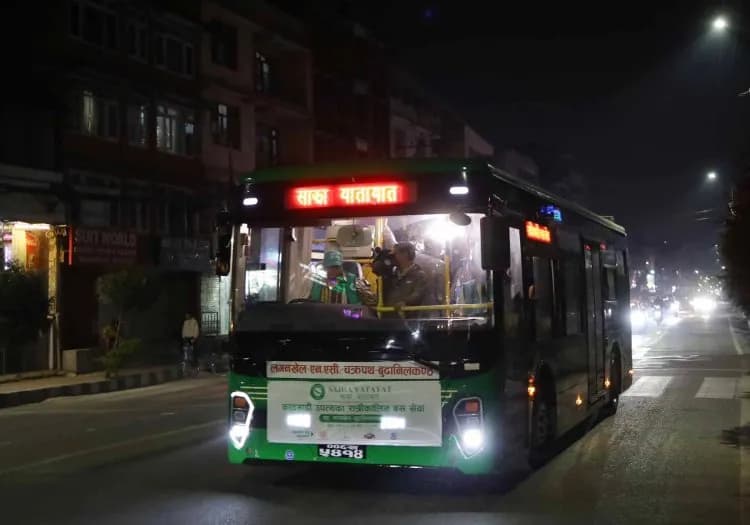
Kathmandu Metropolitan City is working on a major expansion of the Valley’s night bus service, with a plan to cover four new routes and deploy 28 buses.
More routes, more buses
- Night buses currently run on two corridors: Nagdhunga–Airport and Lagankhel–Budhanilkantha, using 7 buses.
- A study task force has proposed adding four new routes: Godawari–Budhanilkantha, Ring Road (both directions), Jagati–Thamel, and Kirtipur–Nepal Airlines.
- The idea is to connect major hospitals, commercial zones and key entry/exit points across eight municipalities in the Valley.
How the service could be funded
To make the higher-cost night operation sustainable, three approaches are on the table:
- Premium night fare: add Rs 12 on top of existing tickets to cover staff allowances and technical costs.
- Viability gap funding: eight municipalities jointly cover 50% of total operating loss, with the remaining 50% shared based on size, density and route distance.
- New passenger services: earn income from real-time bus location and timetable info and other programs to build rider trust.
Safety and governance focus
The proposal gives special priority to women, senior citizens and tourists, with suggestions for CCTV inside buses, GPS tracking and dedicated bus stops.

Greater involvement from Suryabinayak, Madhyapur Thimi, Godawari and Kirtipur is seen as key to strengthening the night-time economy and reducing dependence on private vehicles.
The plan also points to a future Urban Area Public Transport Authority to regulate and improve public transport governance in the federal capital.
What the pilot has shown so far
In the first three months of the trial, the existing night service carried 66,952 passengers.
- Each bus carried about 142 passengers per day, earning around Rs 3,134 in daily revenue.
- Average daily operating cost was Rs 4,814 per bus, leaving a daily loss of Rs 1,690 per bus — roughly 35% of operating cost.
Demand peaked between 8 PM and 9 PM, accounting for 41.56% of total riders, mostly office staff, workers and daily wage earners returning home late.
By route, Thankot–Airport handled 51.55% of passengers, while Budhanilkantha–Lagankhel carried 48.45%.
About 47% of riders travelled under 5 km, 32% medium distance and 21% longer trips.
Current fares are Rs 20 for short trips, Rs 25 for medium distance and Rs 30 for long distance.
Writes on vehicle pricing, taxation and the Nepali auto market from ongoing tracking of distributor price lists. Editorial policy.