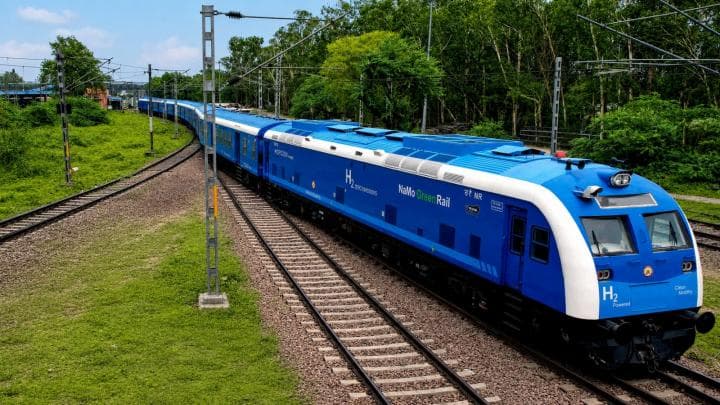
India has begun regular services with its first hydrogen-powered passenger train on the Jind–Sonipat section (around 89 km) in Haryana, setting a new marker for cleaner rail transport in the region.
What has been launched
- The new train is a 10-coach hydrogen fuel cell-powered set developed by Integral Coach Factory (ICF) in Chennai.
- It runs between Jind and Sonipat in northern India, on a section that is not fully electrified. The route is being used as a real-world test of how such trains can replace diesel on similar lines.
- The service has started as a pilot project to study day-to-day performance, energy use, safety and maintenance of hydrogen fuel cell systems in Indian conditions.
The train uses two 1,200 kW fuel-cell power cars (about 3,200 hp combined) and is cleared for up to 75 km/h in regular operation. The design speed is 110 km/h.
How the hydrogen train works
- The train carries hydrogen in high‑pressure cylinders onboard.
- In a hydrogen fuel cell, hydrogen reacts with oxygen from the air to generate electricity.
- This electricity powers traction motors, auxiliaries and onboard systems.
- The only direct emission is water vapour and heat, with no CO₂ exhaust. It offers a zero tailpipe emission alternative to diesel.
A dedicated hydrogen production and storage facility at Jind has been set up for the service. This plant uses electrolysis of water to produce hydrogen. When renewable electricity is used, it fits the idea of *green hydrogen*.
Capacity and passenger comfort
- The train can carry around 2,600 passengers per trip.
- It uses modern broad-gauge coaches with upgraded interiors, lighting and passenger information systems.
- The pilot will also track real‑world energy efficiency, noise levels and ride comfort compared with existing diesel services.
Why it matters for Nepal and the region
With this launch, India joins Germany, Japan, China and the United States in the group of countries that are already testing or operating hydrogen trains. For Nepal and other South Asian countries, the project is important because:
- It shows how non-electrified routes can move towards zero-emission operation without installing overhead wires.
- It provides a nearby example of hydrogen infrastructure in transport, including production, storage and refuelling.
- It may shape future cross-border rail planning, technology sharing and climate-focused transport policies in the region.
Plans are in place to expand hydrogen-powered services to more heritage and environmentally sensitive routes under a long-term programme. For Nepali readers, the key takeaway is that hydrogen fuel cell trains are now in actual passenger service in South Asia. Similar clean technologies could gradually appear in regional rail and heavy transport in the coming years.
Key facts at a glance:
- Route: Jind–Sonipat, Haryana, India (about 89 km)
- Train formation: 10 coaches, including 2 hydrogen power cars
- Power output: 2 x 1,200 kW (approx. 3,200 hp) fuel-cell system
- Approved operational speed: up to 75 km/h, design 110 km/h
- Passenger capacity: around 2,600 passengers
- Emission: only water vapour and heat, no CO₂ from onboard operation
Writes on vehicle pricing, taxation and the Nepali auto market from ongoing tracking of distributor price lists. Editorial policy.