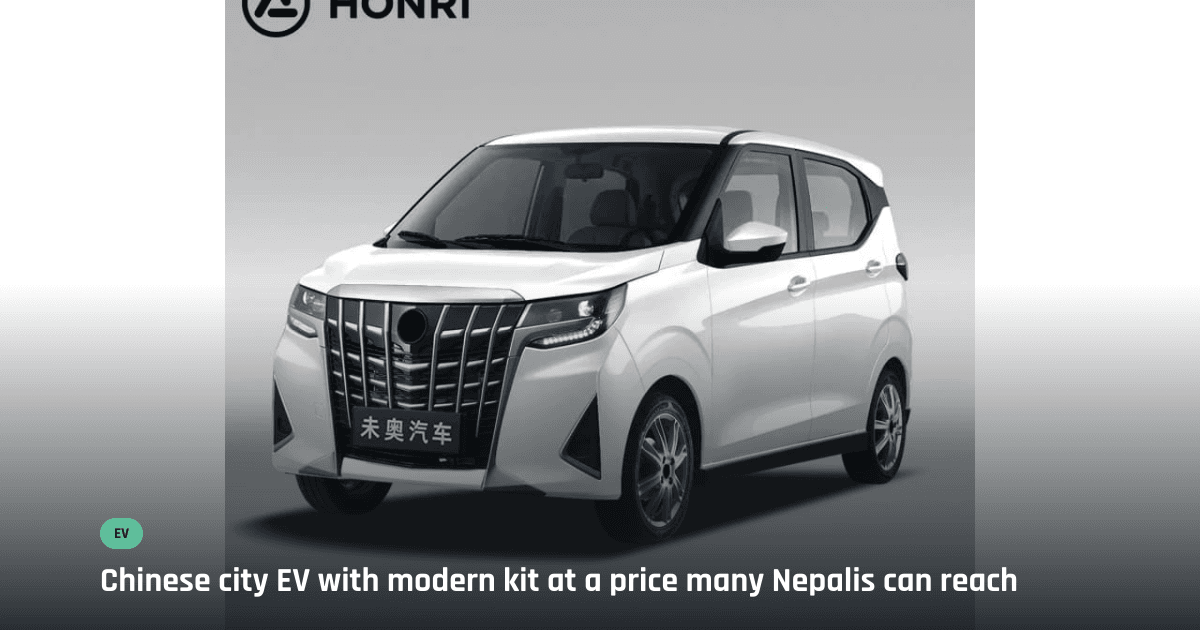
Where the Honri Boma EV sits in the Nepali market
The Honri Boma EV is one of several compact, China-made electric hatchbacks now sold in Nepal, aimed squarely at urban families and first-time car buyers who want low running costs without spending luxury EV money.
With an ex-showroom price band of Rs 21 lakh – Rs 26 lakh for its two variants, it slots above ultra-basic city EVs and below more established global names from Korea and Europe. That puts it in direct contention with other small, value-focused electric cars from Chinese and Indian brands.
In Nepali showrooms, the Boma EV is pitched as a step up from bare-bones electric commuters: more space, more features, and a design that feels closer to a mainstream hatchback than a microcar. For buyers who are EV-curious but wary of stretching to premium models, it sits in a sweet spot where total cost of ownership can undercut many petrol hatchbacks.
Looks, design and build
The Honri Boma EV follows the familiar small-hatchback template: compact footprint, short overhangs, and a relatively tall body to carve out cabin space.
The front end typically carries a closed-off grille section, EV-specific badging and swept-back headlamps that give it a modern, slightly aggressive look. The rear is more upright, with a practical tailgate opening and simple lamp clusters; overall, the styling is contemporary but not polarising.
Wheel size and alloy design vary by variant, with the higher trim usually getting more appealing alloys and extra chrome or gloss-black detailing. The stance is city-focused rather than sporty, and ground clearance is tuned for urban speed bumps and rough patches rather than off-road exploits.
Build quality, from showroom inspection, sits in the middle of the emerging EV pack: panel gaps are generally consistent and paint finish looks acceptable, though it does not have the vault-like solidity of more expensive global brands. Plastics are hard and functional inside, with some textured surfaces to break up the monotony. It feels aligned with what you would expect at this price point from a newer Chinese manufacturer.
Features and equipment
A core reason the Honri Boma EV attracts attention in Nepal is its equipment list relative to price. Even the lower variant is not bare; the upper variant in particular tends to showcase the tech-focused pitch.
Typical features you can expect include:
- A central touchscreen infotainment system with Bluetooth and USB connectivity
- Digital or semi-digital instrument cluster with EV-specific readouts
- Automatic climate control or at least standard AC with clear controls
- Power windows on all doors and remote central locking
- Steering-mounted audio controls on higher variants
On the comfort and convenience side, showroom cars commonly offer adjustable front seats, folding rear backrests to expand the boot, and multiple storage cubbies. Upholstery is usually fabric, with synthetic leather appearing only on the steering wheel or gear selector in the higher trim.
Safety equipment in this segment typically includes dual front airbags, ABS with EBD, rear parking sensors and sometimes a reverse camera on the top variant. Some competing models add features like tyre-pressure monitoring or stability control; whether the Boma EV matches those depends on the final Nepal-spec configuration, which has not always been exhaustively detailed by the distributor. Where information is unclear, it is safer to assume basics rather than advanced driver aids.
Motor and performance
Honri positions the Boma EV as a city-focused electric hatchback, and the technical tuning reflects that.
The car uses a single electric motor driving the front wheels via a simple reduction gearbox. Power and torque figures for the Nepal-spec model have not been consistently and officially disclosed, but based on its size and market positioning, it is reasonable to place it in the typical small-EV band where performance is adequate for urban and peri-urban use rather than enthusiast driving.
Like most EVs, it should deliver strong initial response from a standstill, making it feel more eager in traffic than equivalent small petrol engines. The payoff is smooth, gearless acceleration with no clutch work and fewer vibrations, which many new EV owners value more than outright speed.
Official range and battery capacity data for the exact Nepali-spec Boma EV variants have also not been clearly formalised. Buyers should insist that the showroom provide certified range figures and battery size for their specific car, and should treat idealised numbers with caution, as real-world Nepali conditions (hills, heat, AC use) usually trim the claimed range down.
Ride, handling and comfort
On showroom inspection and segment expectations, the Honri Boma EV appears tuned to prioritise comfort over sharp handling.
The tall hatchback body and urban-oriented suspension typically result in a soft ride at low speeds, absorbing small potholes and broken city tarmac reasonably well. That suits Kathmandu and other city streets where surface quality is inconsistent.
Body roll through faster corners is likely noticeable, similar to other tall, compact EVs in this class, but for typical family use it should remain within acceptable limits. Steering effort is usually light, deliberately set up for easy manoeuvring and parking rather than precision on twisty highways.
Seat cushioning is moderate, and upright seating positions provide decent visibility over traffic. Cabin noise levels, from what can be gauged in static and short showroom drives, sit in the expected range: motor whine is modest at city speeds, but tyre and wind noise will be more apparent at highway pace than in heavier, more expensive EVs.
Practicality and running costs
As a compact hatchback, the Boma EV offers usable space for small families and urban commuters.
The front row has enough headroom and legroom for average-height adults, while the rear bench is better for two adults than three. Knee room will depend on how far back the front seats are set, but the car aims to be more accommodating than micro EVs with severely constrained rear space.
Boot volume is modest but workable for grocery runs, school bags or a couple of cabin-size suitcases. With the rear seats folded, cargo capacity expands significantly, making occasional larger loads possible.
Running costs are the key draw. Charging at home on a standard domestic connection typically costs a fraction of what equivalent petrol use would. While exact kWh consumption figures for the Honri Boma EV in Nepal have not been formally detailed, most small EVs deliver extremely low per-kilometre energy cost compared with fuel-burning cars, especially for daily city trips.
Maintenance for EVs tends to be simpler, with fewer moving parts and no oil changes, though buyers must budget for eventual battery health checks and possible replacement after several years. Warranty terms on the vehicle and battery should be confirmed at purchase, as they can materially affect long-term cost of ownership.
Price, variants and which one to pick
Nepal AutoMart’s verified data places the Honri Boma EV’s ex-showroom price range at Rs 21 lakh – Rs 26 lakh across two variants.
While the distributor’s exact naming convention for these trims can vary, they broadly split into:
- A lower variant around Rs 21 lakh, positioned as the value entry point
- A higher variant around Rs 26 lakh, adding more features and visual upgrades
The lower variant suits buyers who are primarily focused on getting into a full-size EV at the lowest possible upfront cost. It typically offers the core EV experience with basic comfort and safety features.
The higher variant, at roughly Rs 5 lakh more, makes more sense for urban households intending to keep the car for several years, and who value modern cabin tech, better wheels and additional safety and convenience equipment. Given the long-term savings on fuel, stretching to the upper trim can be justified if it meaningfully improves daily usability.
From an editorial standpoint, the upper variant is likely the more balanced choice: if you can afford the higher tag, the added features tend to improve resale confidence and owner satisfaction over the ownership cycle.
Rivals and how it compares
The Honri Boma EV’s real rivals in Nepal are other compact, value-focused electric cars from Chinese and Indian manufacturers, plus the lowest variants of some better-known global brands.
Compared with ultra-cheap micro EVs, the Boma EV offers more space, more conventional car proportions and a feature set that feels closer to regular hatchbacks. That makes it a more viable primary family car, not just a secondary commuter.
Against similarly priced Chinese compact EVs, it competes on design taste, interior layout and the perceived reliability of the brand’s battery and electronics. Some alternatives emphasise a more futuristic look or claim slightly higher range; buyers should weigh those claims against real-world feedback and dealer support quality.
When you cross-shop it with entry-level EVs from established global brands, the Honri Boma EV usually undercuts them on price while sacrificing some refinement, safety depth and brand cachet. For many Nepali buyers, the lower upfront cost and acceptable equipment can outweigh the downsides, particularly if the car will mostly stay within city limits.
Verdict: who the Honri Boma EV suits
The Honri Boma EV is best seen as a pragmatic, budget-conscious electric hatchback for Nepali city dwellers who want to escape rising fuel costs without jumping to premium EV prices.
It offers a relatively modern design, useful cabin space and a healthy equipment list for its segment, especially in the higher variant around Rs 26 lakh. The lower variant near Rs 21 lakh keeps the entry barrier down, though some buyers will miss the additional features.
Because official technical and range figures are not as exhaustively communicated as those of more established brands, buyers should approach the purchase as a carefully researched decision: insist on full specifications, warranty details and candid explanations of service and parts support.
For households primarily using the car inside cities, with regular access to home or office charging, the Honri Boma EV can be a sensible choice if priced and supported correctly. Long-distance highway users and buyers who prioritise top-tier safety and brand reputation may still prefer more expensive, well-known global EVs.
In short, the Honri Boma EV suits value-driven urban buyers willing to trade some polish and established branding for lower upfront cost and cheap, electric motoring.
Writes on vehicle pricing, taxation and the Nepali auto market from ongoing tracking of distributor price lists. Editorial policy.