Where This Bike Sits In Nepal's Commuter Line-Up
The Hero HF Deluxe has been sold in Nepal since 2020 through CG Motors Pvt. Ltd., and it continues to occupy the most basic, most affordable rung of the commuter motorcycle ladder. At Rs 1.79 lakh ex-showroom for the sole HF Deluxe variant, this is not a bike built to impress anyone at a traffic light — it is built to get to work, to the market, and back, day after day, on the smallest possible budget. For a huge segment of Nepali buyers, particularly first-time owners in the Tarai and semi-urban towns where fuel economy and low upfront cost matter more than styling, that positioning is exactly the point.
It's worth being upfront about something before we go further: Hero also sells a costlier HF Deluxe Pro variant with a very different feature set. That model is not the subject of this review, but because the two are so closely related mechanically and so often cross-shopped, we'll reference the differences throughout, since they matter directly to what you're deciding to spend your money on.
A Look That Doesn't Try Too Hard
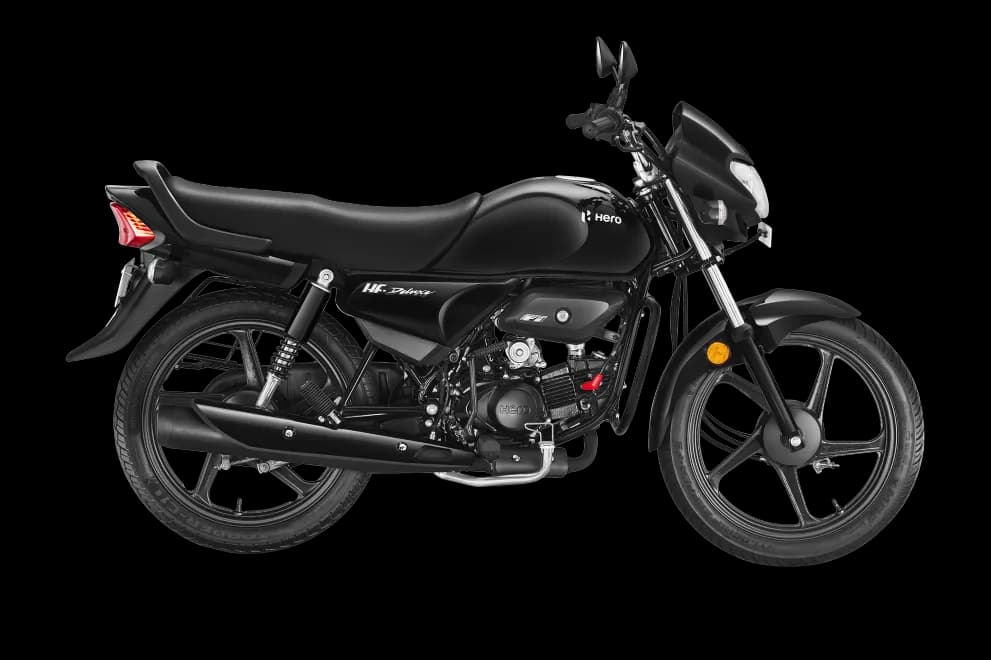
Where some rivals have chased flashier graphics and blacked-out engines to look more premium than their price suggests, the HF Deluxe doesn't bother with the pretence. It comes with silver and grey body panels set off by red graphics, a silver-finished engine casing, and silver alloy wheels. It's a straightforward, slightly old-school look that hasn't changed dramatically over the years, and next to newer 100-125cc commuters on a showroom floor, it does look a little dated. The side panel carries a simple "HF Deluxe" sticker rather than anything more elaborate.
The headlight is a plain halogen unit, without any daytime running light or LED treatment. It works, and it's the kind of thing a first-time buyer used to older motorcycles won't think twice about, but ride past a showroom window with the Pro variant's LED setup lit up next to it, and the gap is obvious. Build quality itself doesn't suffer for any of this — the panel fit, the number plate mount, and the visor fitting are all what you'd expect from a mainstream Hero product, just finished in a more utilitarian style than flashy.
Where The Features List Gets Deliberately Thin
This is really where the HF Deluxe separates itself from its own more expensive sibling, and where prospective buyers need to think hardest about what they actually need. The instrument cluster is a fully analog unit, with a speedometer, odometer and fuel gauge — nothing more. There's no digital display, no check-engine warning, no low-fuel alert beyond the gauge needle, and no neutral or side-stand indicator built into a digital panel.
For a lot of riders this genuinely doesn't matter. An analog speedometer does its one job perfectly well, and there's an argument that fewer electronic components means fewer things that can eventually go wrong. But it does feel old-fashioned in 2024, especially since the visual and functional upgrade Hero offers one step up is not subtle. There's also no i3S idle start-stop switch on the handlebar — a system that automatically cuts the engine at idle to save fuel in heavy traffic. Buyers who spend a lot of time in stop-and-go city riding, particularly around Kathmandu Valley, will feel that absence more than anyone doing highway or open-road commuting.
The Engine You're Actually Paying For
Strip away the trim differences and what you're left with is the mechanical heart of the bike, and here the HF Deluxe holds its own. It runs a 97.2cc engine producing 7.91 HP and 8.05 Nm of torque — modest figures by any measure, but entirely appropriate for a light commuter built to be economical rather than quick. This is the same engine and the same tune found across the HF Deluxe range, so nobody buying the base bike is getting a watered-down powertrain. Performance and refinement are identical to the costlier variant; the difference in price buys you cosmetics and electronics, not motor.
That's an important point for value-focused buyers to internalise. If your priority is simply reliable daily transport with predictable running costs, the drivetrain underneath the HF Deluxe is not compromised in any way relative to its pricier sibling.
Suspension And Handling Built For Load, Not Speed
The HF Deluxe uses an adjustable rear suspension setup, letting owners tune preload to suit whether they're riding solo, two-up, or carrying a heavier load — a practical touch for a bike that in Nepal often ends up hauling groceries, tools, or a passenger on the pillion seat rather than just the rider. Ride and handling characteristics are shared entirely with the rest of the HF Deluxe line, so there's nothing here that changes depending on which variant you choose. It's a bike tuned for stability and control at moderate speeds rather than outright sportiness, which suits its intended use perfectly.
A Seating Position Built For All-Day Use
At a seat height of 805 mm, the HF Deluxe sits at a comfortable, accessible level for the vast majority of Nepali riders, including shorter riders who might feel stretched on taller adventure or naked motorcycles. Riding posture is upright and relaxed, with nothing sporty or aggressive about the ergonomics — exactly what you'd want on a bike that's frequently used for long daily commutes rather than weekend blasts. Comfort and seating geometry are identical across the HF Deluxe range, so this is one area where spending more buys you nothing extra.
Braking Hardware That Punches Above The Price
Both ends of the HF Deluxe rely on 130 mm drum brakes, and Hero has equipped the bike with a combi-brake system that links front and rear braking for more balanced, predictable stopping power — a genuinely useful safety feature to find at this price point, where many rivals still rely on fully independent, driver-judgment-only braking setups.
There is one quirk worth flagging for owners: because the HF Deluxe uses an analog speedometer that reads off a mechanical cable at the front wheel, there are three cables running to that wheel in total — two for the combi-brake system and one for the speedometer. That third cable has a track record of being prone to snapping, which then requires a replacement at the owner's cost. It's a minor mechanical detail, but one that's worth being aware of if you're budgeting for the bike's first few years of ownership, since the Pro variant sidesteps this issue entirely by linking its digital speedometer straight to the engine rather than a cable.
What You Can Actually Carry And How Far
Practicality is consistent across the range: a 9.6-litre fuel tank gives reasonable range between refuelling stops, 165 mm of ground clearance is enough for Nepal's uneven urban roads and rural tracks alike, and at 109 kg kerb weight, the bike is light enough to be manoeuvrable in tight traffic, easy to push around a courtyard, and unintimidating for new riders.
What Ownership Actually Costs Month To Month
Mileage expectations are broadly similar across the HF Deluxe line, since the underlying engine and gearing don't change. Where the base bike gives up a little ground is in stop-and-go city traffic, where the Pro variant's i3S system can trim fuel use by shutting the engine off at idle. For riders doing mostly highway or steady-speed commuting, that gap narrows considerably, and the base HF Deluxe should deliver running costs that are perfectly competitive for its class. The other running-cost consideration is that speedometer cable — a small, occasional replacement expense the Pro variant simply doesn't have.
Deciding Between The HF Deluxe And Its Own Pro Sibling
With only the one officially listed variant at Rs 1.79 lakh ex-showroom in Nepal, the buying decision for the HF Deluxe itself is simple — there's no trim ladder to climb within this exact model. But because Hero's own HF Deluxe Pro sits so close to it in the market and shares its entire mechanical package, most shopping decisions in showrooms genuinely come down to base versus Pro. The extra money the Pro commands buys LED lighting, a fully digital instrument cluster, the i3S fuel-saving system, and notably sharper all-black styling with red and white graphics. For buyers who value a modern-feeling cockpit and don't mind the slightly higher spend, that upgrade is difficult to argue against. For buyers working with the tightest possible budget, or those who simply don't rate digital displays and LED lighting as essentials, the standard HF Deluxe does everything the mechanical package promises without asking for a rupee more than necessary.
The TVS Sport Undercuts It On Features For Similar Money
The TVS Sport is one of the most direct rivals the HF Deluxe faces in Nepal's budget commuter segment, aimed at exactly the same value-conscious buyer. It has built a reputation on offering a slightly more feature-rich package at a similar price point, making it worth cross-shopping before committing. Where the HF Deluxe answers back is with Hero's dominant service network and parts availability across Nepal, which for many rural and semi-urban buyers matters more than a marginally longer features list.
The Bajaj Platina 100 Is The Other Obvious Cross-Shop
The Bajaj Platina 100 has long been positioned as a comfort-focused, budget-friendly commuter and remains a natural alternative for anyone comparing the HF Deluxe on paper. It has traditionally leaned on ride comfort as its main selling point, whereas the HF Deluxe's case rests more on its straightforward mechanical reliability and Hero's brand trust in Nepal. Buyers deciding between the two would do well to sit on both in a showroom, since seat feel and riding posture preferences vary more than the spec sheets suggest.
The Verdict: An Honest, No-Frills Commuter
The Hero HF Deluxe isn't trying to be anything other than what it is: a basic, dependable, no-nonsense commuter motorcycle priced to be genuinely accessible. It gives up LED lighting, digital instrumentation, and fuel-saving idle-stop tech to its own Pro sibling, and the styling shows its age next to newer competition. But the engine, brakes, suspension and ergonomics underneath are exactly as capable as the costlier version, and the combi-brake system is a genuine safety plus at this price.
This is the right bike for buyers on a strict budget who want a new motorcycle from a trusted, well-supported brand and don't especially care about digital displays or LED lighting. Anyone who does care about those things, or spends significant time in heavy city traffic where the i3S system would pay for itself in saved fuel, should seriously weigh the small additional spend for the HF Deluxe Pro before signing the paperwork.
Writes on vehicle pricing, taxation and the Nepali auto market from ongoing tracking of distributor price lists. Editorial policy.