Start with the numbers
The model, at a glance
Top available variants, with prices in Nepalese rupees. Expand details to choose another variant.
| Vehicle | Ex-showroom price | Fuel | Selected variant |
|---|---|---|---|
| 01Denza B5 | Upcoming | Hybrid | Dynamic |
Ex-showroom prices exclude registration, road tax and insurance. Specifications can vary by trim. See individual source-check dates ↓
A New Name Asking Established Money in Nepal
The Denza B5 lands in Nepal through Cimex Inc. at a single, uncompromising ex-showroom price of Rs 2.97 crore, whichever of its two variants you choose. That places it firmly in territory usually occupied by well-established luxury SUV nameplates that Nepali buyers already trust with resale value and workshop backup. Denza itself is BYD's premium sub-brand, and the B5 is its first real attempt at the rugged, off-road-styled luxury SUV segment — a category with genuine demand here given the terrain outside the Valley and the aspirational pull of a boxy, upright 4x4 silhouette.
What makes the B5 interesting for Nepal is not just the price but the hardware behind it. A 1.5-litre turbocharged petrol engine works alongside BYD's DMO Super Hybrid system, dual electric motors, and a 31.8 kWh Blade Battery pack built on Cell-to-Chassis technology. On paper this is not a soft-roading crossover pretending to be tough — it has locking differentials front and rear and a claimed 850 km combined range. Whether that translates into a car worth recommending at this price is the real question, and it depends heavily on how the car actually behaves once you're driving it rather than reading its spec sheet.
Boxy, Upright, and Built to Be Noticed
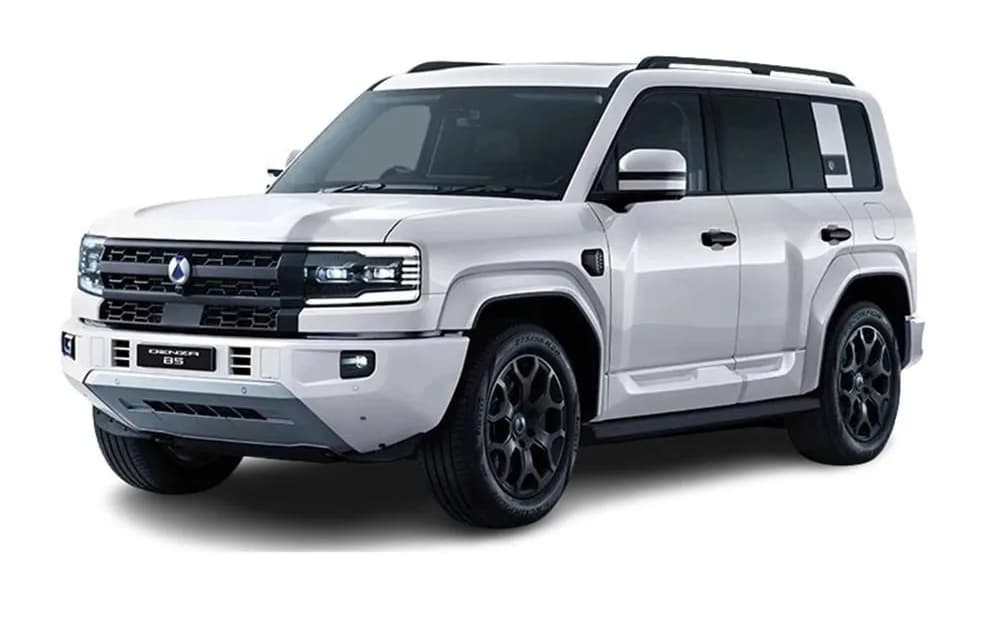
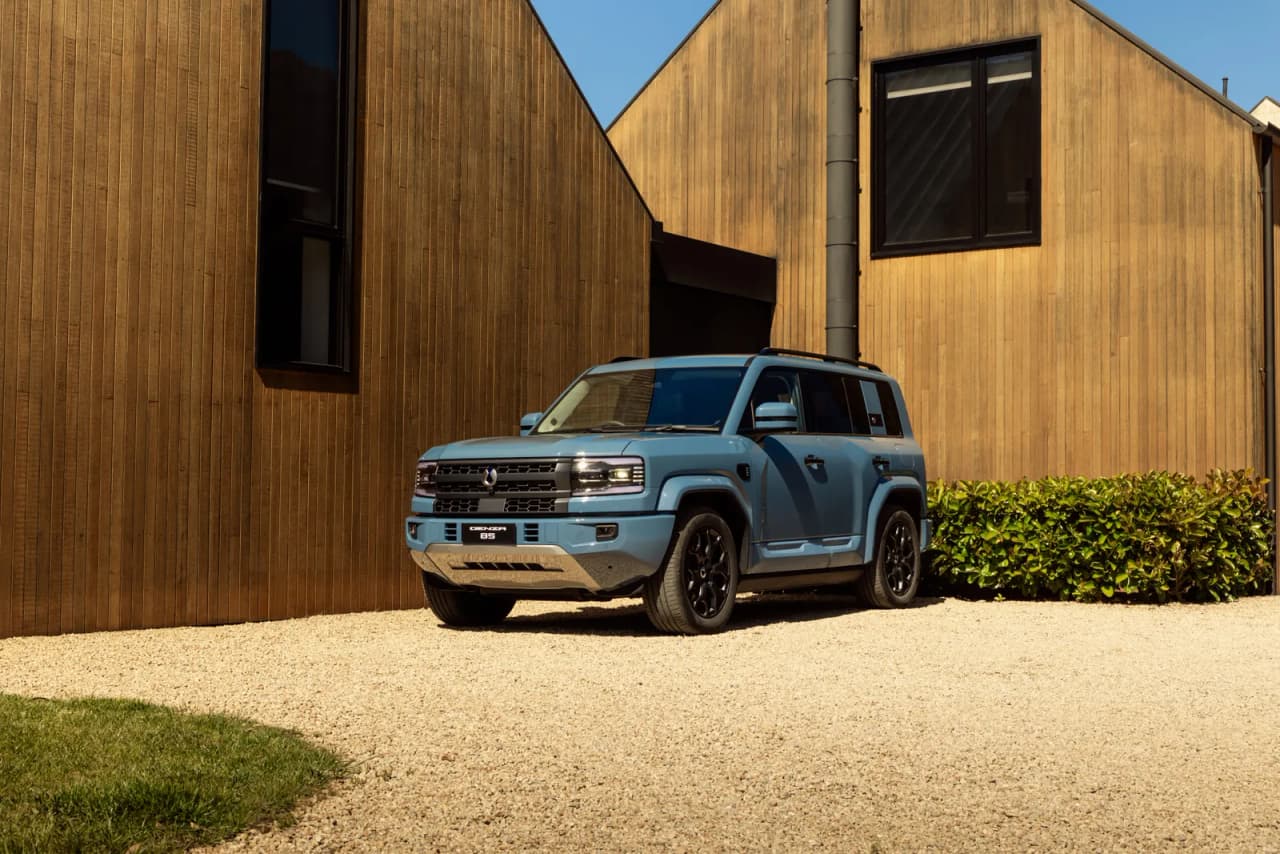
The B5's design language is deliberately rugged rather than sleek. It has a tall, boxy stance, a large front grille flanked by full LED headlights with dynamic running lights, and a front bumper shaped for off-road departure angles — one with enough physical play in its mounting to suggest it's designed to absorb minor knocks rather than crack. The side profile carries body-coloured wheel arches and plastic side steps, while the rear gets vertically stacked LED taillights and a tailgate-mounted spare wheel cover with a prominent Denza logo, giving the back end real presence in traffic.
Build quality at first contact feels solid. Doors close with a reassuringly soft, dense thud rather than a tinny clang, and panel gaps and touchpoints around the cabin entry points feel deliberately finished rather than assembled to a budget. This is a vehicle designed to feel expensive from the moment you approach it, and largely succeeds. The one asterisk, which we'll come back to under safety, concerns what's happening underneath the car rather than what you can see from outside.
Colour Choice Is Limited, At Least For Now
Nepal AutoMart's data shows both the Dynamic and Premium variants sharing identical mechanicals and pricing, and early market stock has leaned toward conservative, premium-feeling paint rather than anything flashy. Buyers used to a wide palette on rival luxury SUVs should ask their Cimex Inc. showroom directly about available colours before ordering, since stock in a newly launched market like this can be limited compared to what's shown in Denza's global materials.
A Cabin That Feels the Price, Even If the Badge Is New
Step inside and the B5 does a genuinely good job of justifying its position. The dashboard is built around a large central infotainment touchscreen and a separate digital instrument cluster, both finished with soft-touch materials at the points your hands and eyes spend the most time. The interior widely earns praise for feeling high-end and representative of its price point, and on the showroom floor that impression holds up — this doesn't feel like a car wearing an unfamiliar badge to disguise cut corners.
The party piece is the center console fridge, a compartment that both cools and heats, controlled by a digital temperature dial — a genuinely practical feature for Nepali summers and winters alike, not just a gimmick. The Devialet sound system is a serious name to have on the spec sheet, even if in practice it performs solidly rather than spectacularly. The infotainment system supports full-screen Apple CarPlay and Android Auto and is generally easy to navigate, with a swipe-down shortcut menu.
Where the B5's tech ambition works against it is the driver-assist suite. Lane departure warning and driver monitoring systems are widely reported to be poorly tuned, triggering fatigue alerts too readily and fighting steering inputs near lane markings rather than assisting them. For a car this technologically loaded, this is the one area where the software clearly hasn't caught up to the hardware, and it's a pattern buyers consistently flag rather than an isolated complaint.
Numbers That Belong to a Performance Car, Not an Off-Roader
The powertrain is genuinely the B5's headline act. The 1.5-litre turbo petrol engine alone makes 181 hp and 260 Nm, but paired with dual electric motors — a 200 kW unit up front and a 285 kW unit at the rear — combined output reaches 425 kW and 760 Nm. BYD and Cimex Inc. quote a 0-100 km/h time of 4.8 seconds, which puts the B5 in company few boxy SUVs of this size can match. All-wheel drive with locking differentials on both axles underlines that this is meant to be as capable off the tarmac as it is quick on it.
In everyday use, response in normal driving modes is reported to lag noticeably between throttle input and power delivery — a common trait of hybrid systems tuned for efficiency first. Switching into a sportier mode sharpens things considerably, and using the dedicated launch control produces genuinely explosive acceleration that comfortably disguises the vehicle's considerable weight. The transition between electric and petrol power is largely smooth, though the engine becomes audibly busier when it's working to recharge the battery rather than simply propel the car.
Where the Ride Struggles to Match the Powertrain
This is the B5's weakest area, and it's a significant one for a vehicle at this price. The ride quality is widely described as busy and inconsistent, never quite settling even on smooth highway surfaces, with the suspension tuning swinging between overly firm and excessively soft depending on the road. During faster cornering there's pronounced body roll, and running over successive bumps at speed reveals a front and rear axle that don't feel properly coordinated, leading to pitching and bouncing rather than composed absorption.
For a car built around locking differentials and off-road ambition, the 20-inch wheels are wrapped in road-oriented Pirelli-style tyres that lack the tread depth for serious unsealed work — a mismatch between the drivetrain's off-road intent and the tyre choice that undercuts the SUV image the styling is selling. Buyers drawn to the B5 for its rugged looks should understand this is a car tuned more for wide, fast roads than for genuinely rough terrain.
Comfortable Seats, A Cabin Built for Long Journeys
Where the B5 recovers ground is in outright comfort. Front seats are well-shaped, supportive and perforated, with heating, ventilation and a massage function that few rivals offer at any price in Nepal. The steering wheel adjusts for both tilt and reach, and the driver's seat gets electric adjustment with memory settings including lumbar support — genuinely useful on Nepal's longer highway stretches.
The second row is spacious, with generous legroom, headroom and toe room reported even for taller passengers, and outboard rear seats get their own heating and ventilation — a rare inclusion at the rear in this segment. The one ergonomic niggle is a central infotainment screen angled slightly toward the passenger side, which can throw distracting reflections back at the driver in certain light.
Stopping Power That Matches the Straight-Line Speed
Braking hardware includes large, cross-drilled discs, and reports of the B5 hauling itself down from 100 km/h in around 39 metres suggest genuinely strong, reassuring stopping performance for a heavy SUV. Pedal feel is described as slightly inconsistent, lacking the last degree of progressive feedback, but the actual retardation is effective and confidence-inspiring, which matters given how quickly this car can build speed.
A Serious Underbody Concern Buyers Should Ask About Directly
The most serious issue reported around the B5 concerns its underbody protection plate detaching during sustained high-speed driving — folding back and dragging on the road surface. This is a body-on-frame vehicle, and Nepal AutoMart's own data confirms that construction along with the AWD and locking differential setup as genuine strengths for durability. But a component failure of this nature, if representative of a wider build issue rather than an isolated unit, is the kind of flaw that should be raised directly with Cimex Inc. before signing any paperwork, particularly given Nepal's mix of highway speeds and rough approach roads.
Enough Boot for a Weekend, Not Necessarily a Family Trip
Boot space is rated at 470 litres, which is on the tighter side for a vehicle this large and could feel cramped once a pram or oversized luggage is loaded for a family trip. Folding the second row flat expands that to 1,064 litres, a reasonable gain. The tailgate swings open sideways on a gas strut, and there's a small under-floor tray for charging cables and a puncture kit — sensible additions given the plug-in nature of the drivetrain. Cabin storage is otherwise practical, with a decently sized glovebox, door pockets and a sunglasses holder.
What Running One Actually Costs Day to Day
The B5's plug-in hybrid nature means real running costs depend heavily on how disciplined an owner is about charging. With 100 kW DC fast charging and 11 kW AC charging supported, topping up is quicker than most legacy plug-in hybrids allow, and the claimed 850 km combined WLTP figure suggests strong range when the petrol engine and battery are both used together. Nepal AutoMart's data confirms an electric-only range of around 80 km depending on specification, which should cover most in-city commuting on electricity alone if charged regularly.
The catch, and it's a real one, is what happens once that battery charge is depleted on a longer journey. Fuel consumption is reported to rise sharply in that scenario, into the 13-15 litres per 100 km range, a consequence of the car's substantial kerb weight. For buyers planning frequent long highway runs to the Tarai or further without regular charging access, this is worth budgeting for honestly rather than assuming hybrid efficiency will hold throughout.
Two Variants, One Price — So the Choice Comes Down to Trim, Not Spec
Both the Dynamic and Premium variants are priced identically at Rs 2.97 crore ex-showroom and share the same 1500 cc powertrain and mechanical package, so the decision between them will come down to trim finish and equipment preference rather than performance or efficiency. Given that neither variant offers a meaningful price advantage, buyers should ask Cimex Inc. showrooms directly what distinguishes Premium's cabin appointments from Dynamic's before paying the same figure for either.
The Toyota Land Cruiser Prado Remains the Safer, More Familiar Choice
For buyers cross-shopping in this price bracket, the Toyota Land Cruiser Prado is the obvious comparison and the one most Nepali buyers will already be considering. It's slightly larger than the B5, carries decades of proven reliability and resale value in this market, and has a service and parts network that the newly arrived Denza brand simply cannot match yet. The B5 outguns it comprehensively on paper — in power, in acceleration, in charging tech — but the Prado's appeal has never been about outright numbers. It's about buyers knowing exactly what they're getting and knowing it'll hold value a decade from now, something no new entrant can promise on day one.
The BYD Shark Shows Where This Platform Came From
The B5's plug-in hybrid AWD system is closely related to the one found in the BYD Shark utility vehicle, but the B5 adds front and rear differential locks along with a two-speed reduction gear on the rear axle, effectively giving it a low-range transfer case equivalent that the Shark doesn't offer. For buyers deciding between the two badges, the Shark is the more overtly utilitarian, load-bed-focused option, while the B5 leans further into luxury SUV territory — the price difference in Nepal should reflect that positioning.
The Mitsubishi Outlander PHEV Highlights How Far Charging Tech Has Moved
Buyers who've considered a Mitsubishi Outlander PHEV as a plug-in hybrid benchmark will find the B5 a generational leap in charging capability, supporting 100 kW DC fast charging against the far more modest capacity legacy plug-in hybrids typically offer. The Outlander PHEV remains a smaller, more affordable, more proven option for buyers who simply want hybrid efficiency without the B5's performance ambitions or price tag, but it can't match the Denza on outright capability or luxury feel.
Our Verdict: Talented, Flawed, and Not Yet Fully Proven for Nepal
The Denza B5 is a car of real contradictions. It has a genuinely premium cabin, class-leading straight-line performance for its category, strong braking, and charging technology that outclasses most plug-in hybrids on the market. Set against that is a ride quality that struggles for composure, driver-assist software that actively frustrates rather than helps, compromised efficiency once the battery is depleted, and a reported underbody component failure that any serious buyer should raise directly with Cimex Inc. before committing.
At Rs 2.97 crore, with no established service history in Nepal and a rugged design that isn't fully matched by its tyres or ride sophistication, the B5 suits a very specific buyer: someone drawn to genuinely cutting-edge hybrid technology, generous luxury features, and explosive performance for city and highway use, who isn't planning serious off-road touring or heavy towing and is comfortable being an early adopter of a brand new nameplate in this market. For buyers wanting a known quantity that will hold its value and never surprise them on a service bill, the established rivals remain the safer route.
Explore full specifications, variants & ownership context
Know the product
Key specifications, features & ownership context
Choose a variant to see its recorded specifications and features. Equipment and prices can change across trims.
Latest catalog and directory records supplement the original analysis. Figures may have changed since publication; individual specification and price-check dates appear below.
Price not confirmed ex-showroom · source-check date not recorded
Engine & performance
| Specification / feature | Dynamic |
|---|---|
| Engine displacement | 1500 ccResearched · confirm · 10 Sept 2026 |
Battery & charging
| Specification / feature | Dynamic |
|---|---|
| Battery | 31.8 kWhResearched · confirm · 26 Aug 2026 |
| Claimed range | 850 km (WLTP)Researched · confirm · 26 Aug 2026 |
Dimensions & weight
| Specification / feature | Dynamic |
|---|---|
| Boot space | 470 LResearched · confirm · 10 Sept 2026 |
Claimed range uses the stated test cycle. Different cycles are not a like-for-like range comparison; actual range depends on roads, load, speed and weather.
Showroom & service support
Distributor: Cimex Inc.
4 listed brand showrooms · 2 listed brand service locations
Listed cities include Kathmandu, Lalitpur.
Brand-wide directory coverage. Confirm that your nearest workshop supports this exact model, powertrain and warranty work; ask about parts availability and booking time.
Market buzz & buyer priorities
Compiled discussion, including buyer reactions and ownership reports; this is not a verified owner survey or a reliability score. Research dated 13 Oct 2026.
What people like
- High-end luxury interior and premium build quality
- Powerful plug-in hybrid performance with significant electric-only range
- Strong road presence and sophisticated design
Concerns to investigate
- rear door opens the wrong way
- concerns about spare parts and service
- High price point makes it inaccessible for average buyers
More feedback
- Concerns regarding long-term maintenance costs for premium hybrid systems
- Limited charging infrastructure for maximizing electric-only range in remote areas
What buyers ask for
- Reliability of the plug-in hybrid powertrain
- Ground clearance for diverse Nepali road conditions
- Resale value of high-end luxury vehicles
Nepal ownership context
- Officially launched in Nepal by Cimex Inc. at the NAIMA Mobility Expo 2026
- Available in two variants: Dynamic and Premium
- Service and support are managed through the established BYD network in Nepal
More feedback
- The Denza B5 is not yet on sale in Nepal, so no Nepal price or launch date is published here.
- Nepal-specific ownership evidence for reliability, service cost, spare-parts availability, resale value and real-world fuel economy has not yet been established.
Use these facts alongside the article’s full analysis. Check the final quotation, warranty terms and exact equipment before booking.
Evidence & next steps
Check the details before you buy
Use this guide to build a shortlist. Ask for a written quotation for your chosen variant, including registration, taxes, insurance, finance charges and any charger installation. Confirm the nearest authorised workshop supports that model.
Price sources and dates
These are the recorded distributor-source checks for the selected overview trims. They are separate from the article update and catalog read dates; they do not mean every trim was rechecked today. Confirm the final price with the distributor.
Overview photos come from the corresponding model records; additional article photos carry their own credits. Running costs depend on usage, energy prices, maintenance, insurance and resale value.