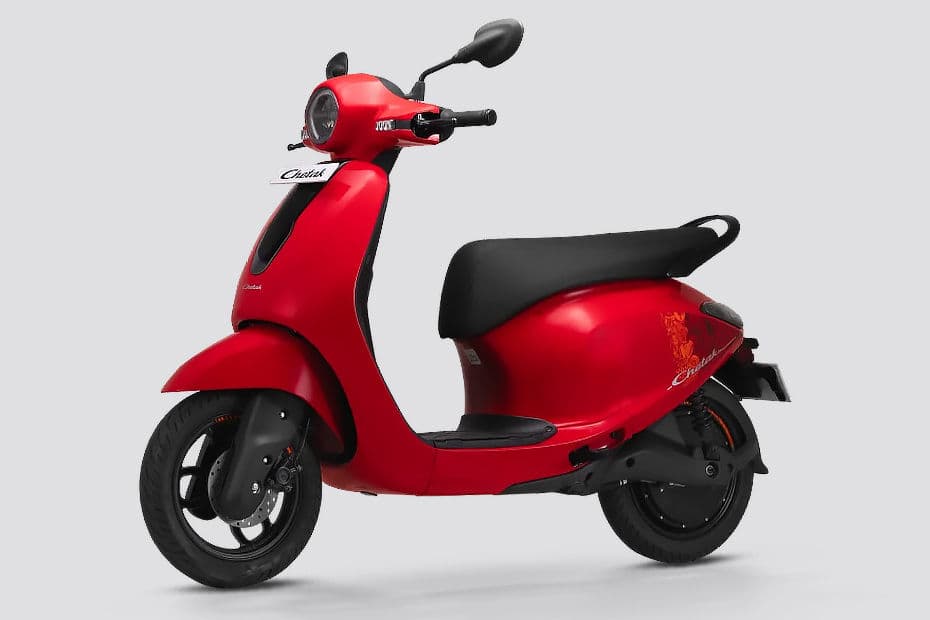
Bajaj has filed a design patent for the Chetak C25 electric scooter with Brazil’s INPI, registering it to qualify as an electric moped with up to 50 km/h top speed and 2,200 watts motor output. That sets up the Chetak C25 as Bajaj’s mass-market EV for Brazil, using the same basic hardware already seen in India.
In Nepal, the Chetak line is announced but not yet on sale, so there is no official ex-showroom price for the Chetak C25 or its siblings here. Buyers currently choosing Bajaj bikes are looking at petrol models such as the Platina 100 ES at Rs 2.17 lakh – Rs 2.60 lakh, Discover 125 at Rs 2.57 lakh, Discover 125 ST at Rs 2.59 lakh, Platina 100 at Rs 2.60 lakh, and Pulsar 125 at Rs 2.73 lakh – Rs 3.05 lakh. Any Chetak EV price for Nepal will have to be understood against this bracket.
What the Chetak C25 offers

The Chetak C25 uses a 2.5 kWh battery pack with a claimed range of 113 km on a single charge. Charging from 0 to 80% takes about 2 hours 25 minutes, making it suitable for overnight home charging as well as a quick top-up during the day. In India, the scooter runs at around 55–60 km/h, but in Brazil its top speed will be electronically capped at 50 km/h to meet moped rules.
Design is centred on a neo-retro look. The scooter has a curvy all-metal body, a retro-style headlamp, handlebar-mounted indicators, a dual-tone front section and a distinctive tail-light. There is a long seat, single-piece grab rail and a flat floorboard that helps with daily load carrying. Under the seat, riders get around 25 litres of storage, enough for a helmet or small bags.
On the tech side, the Chetak C25 features a colour LCD display with call and music access, Eco and Sports ride modes, and a reverse mode to help in tight parking. Braking uses a front disc and rear drum setup. Some markets get software extras such as Guide Me Home Lights through an optional pack.
Why Brazil’s moped tag matters to Nepal
Brazil classifies electric mopeds based on motor output below 4,000 watts and top speed at or under 50 km/h. Bajaj has tuned the Chetak C25 to fit inside this band, letting it compete there against the Yamaha NEO, which offers up to 71 km range with dual lithium-ion batteries and a top speed of 45 km/h.
For Nepali buyers, this Brazilian move shows how Bajaj is positioning the Chetak C25 as a lower-power, city-focused EV scooter in international markets. That is close to how urban riders in Kathmandu, Pokhara or Bharatpur actually ride: short commutes, stop-start traffic and limited parking.
If Bajaj and its Nepali distributor choose to bring the Chetak C25 here, its 113 km range, 2.5 kWh battery and compact size suggest a product aimed at daily city use rather than highway touring. The likely price band will sit above current 100–125 cc Bajaj petrol bikes, but exact Nepal pricing and launch date are not yet confirmed.
What Nepali riders should watch
- Local launch status: Chetak is already exported to multiple markets, and Nepal is on that list, but sales and ex-showroom prices for the Chetak C25 are still unannounced here.
- Running-cost equation: A 113 km-per-charge EV could cut monthly fuel spend for riders now using Bajaj Platina or Discover, though upfront price will be higher.
- City comfort and storage: Features like the flat floorboard and 25-litre underseat storage line up well with Kathmandu’s daily haul of office bags, groceries and courier packages.

For now, Nepali buyers can only watch the Chetak C25’s rollout abroad and wait. Nepal pricing, variants and delivery timelines have not been confirmed, so the scooter is not yet a live showroom option here.
Writes on vehicle pricing, taxation and the Nepali auto market from ongoing tracking of distributor price lists. Editorial policy.