Where it sits in the Nepali market
The Scram 440 is Royal Enfield’s middle-ground motorcycle for Nepal. It sits closer to the road than a full adventure bike, yet feels tougher than a commuter, and it is priced just under the psychological Rs 7 lakh barrier. In Nepal, Alpha Automotive Pvt. Ltd. sells it through 28 showrooms and 22 service centers. That matters almost as much as the motorcycle itself, because Royal Enfield ownership here often comes down to convenience, spares access, and familiar dealer support.
The line-up stays simple. Trail is the purist scrambler, Scram 440 is the base nameplate, and Force is the more practical version for day-to-day use. At Rs 6,89,900 for Trail, Rs 6,94,900 for Scram 440, and Rs 6,99,900 for Force, the spread is narrow. The choice is more about which wheel and equipment package suits the rider.
Looks, design and build
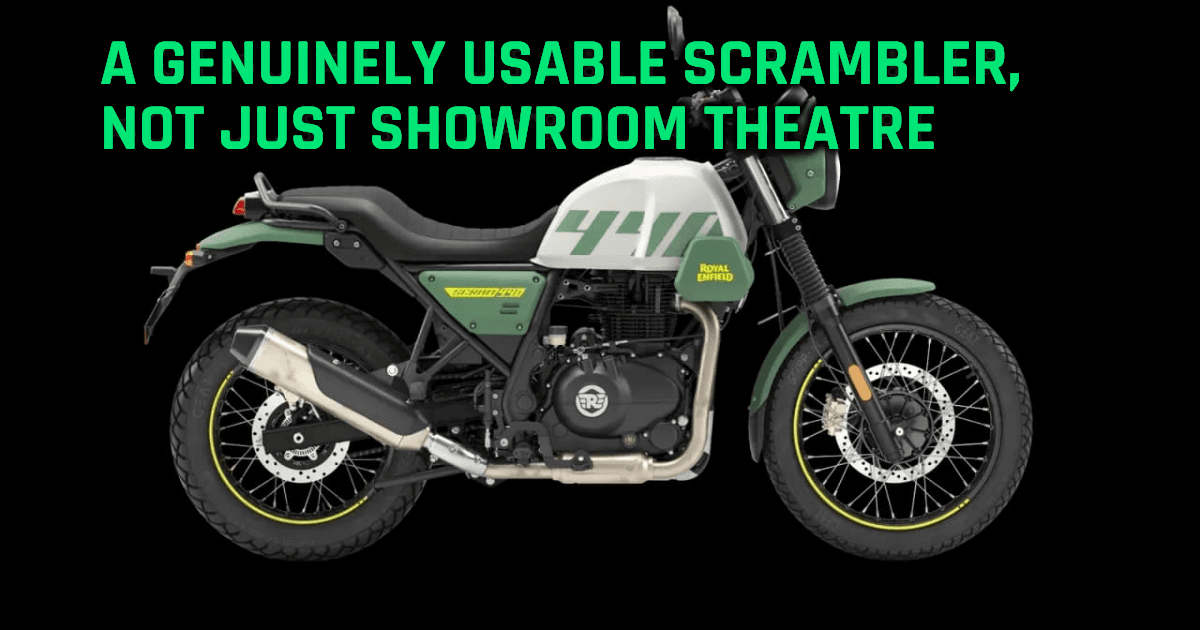
The Scram 440 keeps the compact, muscular Royal Enfield scrambler shape. It uses a half-duplex split cradle frame, with a 2165 mm length, 840 mm width, and 1170 mm height. That gives it a planted stance without making it look oversized. The 795 mm seat height is one of its most useful numbers in Nepal. It makes the bike approachable for a wider range of riders than many taller adventure machines.
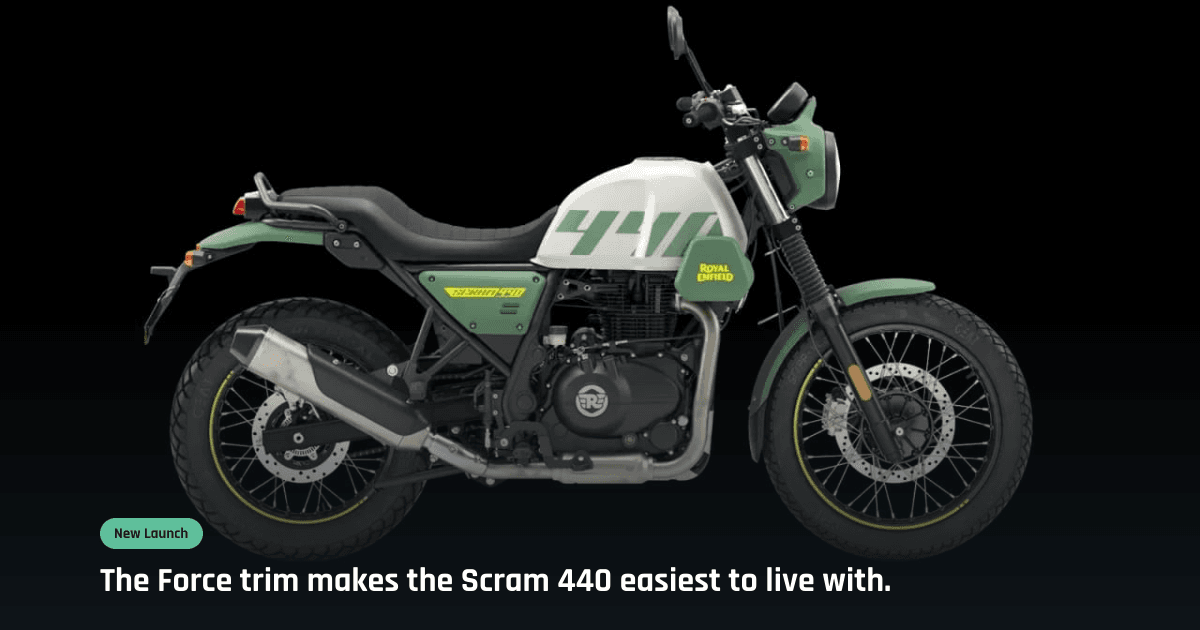
The design is honest rather than flashy. It wears a 19-inch front and 17-inch rear wheel setup, a 14/12W LED headlamp, an LED tail lamp, and an upright silhouette that looks built for mixed roads rather than polished boulevard use. Trail and Force split the personality clearly. Trail is more old-school with spoke wheels and tube tyres, while Force leans toward easier ownership with alloy wheels and tubeless tyres.
Build quality is part of the appeal. This is not a lightweight, highly styled machine. It is a dense, substantial motorcycle with a kerb weight of 196 kg. That heft supports the Scram’s rugged image. It also means the bike feels serious at low speeds and in parking-lot maneuvering.
Features and equipment
The Scram 440 is sensibly equipped, not lavishly loaded. The core feature set includes a digital-analogue cluster, a Tripper navigation pod, and a USB Type-A charging port. That is enough for most Nepal buyers who want guidance, charging, and basic ride information without extra electronics.
Safety hardware is straightforward and appropriate for the segment. The bike uses 300 mm front and 240 mm rear hydraulic disc brakes, both paired with dual-channel ABS, with the rear ABS switchable. That setup gives the Scram 440 a more confident braking package than many smaller-capacity bikes, especially on mixed-surface roads where rear-wheel controllability matters.
The equipment split between variants is where the real logic lies. Trail is the more authentic scrambler with spoke wheels and tube tyres, while Force brings alloy wheels and tubeless tyres. That is easier to live with when punctures happen far from a workshop. The Tripper pod is another meaningful addition on the Force, especially for riders who tour outside the Kathmandu valley.
Engine and performance
Mechanically, the Scram 440 uses a 443 cc single-cylinder, four-stroke, SOHC, air-cooled, fuel-injected engine with a bore and stroke of 81 x 86 mm and a compression ratio of 9.5:1. Output is rated at 25.4 bhp and 34 Nm, delivered at 6,250 rpm and 4,000 rpm respectively, and the bike pairs that with a 6-speed gearbox, wet multi-plate clutch, and chain final drive.
Those figures tell you exactly what kind of motorcycle this is. It is built for accessible torque, not headline horsepower. The 34 Nm peak arriving at 4,000 rpm should make the bike feel relaxed in city traffic and on uphill roads, which fits Nepal’s mix of dense urban riding and hilly intercity routes. This is the kind of engine that should feel more useful than exciting.
The claimed mileage of around 30–35 km/l and the 15-litre fuel tank give it respectable touring reach for a 443 cc motorcycle. That does not make it an economy bike, but it does make it sensible for long commutes and weekend use. In market terms, the Scram 440 is less about outright speed and more about usable, low-stress momentum.
Ride, handling and comfort
This is where the Scram 440 earns much of its appeal in Nepal. The front uses 41 mm telescopic forks with 190 mm travel, while the rear uses a monoshock with linkage and 180 mm travel. That is a properly useful suspension setup for broken urban surfaces, expansion joints, and uneven rural roads.
The bike’s 200 mm ground clearance is another practical strength. It is not an extreme off-roader, but it gives enough margin for rough road conditions, speed breakers, and occasional trail use without making the motorcycle feel awkwardly tall. Compared with the trail-focused alternative in the line-up, the Scram 440’s geometry is slightly more compact, with a 1460 mm wheelbase versus 1490 mm on the Trail and Force variants in the wider family data.
Comfort is one of the bike’s best selling points. The upright riding position, wide handlebar, and single-piece seat make it easy to settle into for longer rides. The seat height is low enough to inspire confidence, yet the riding posture still has the relaxed leverage that Nepal’s road conditions reward. The trade-off is the kerb weight. At 196 kg, the bike will never feel light in a tight parking lot or in slow, technical terrain.
Practicality and running costs
The Scram 440 makes sense for riders who want one motorcycle to do several jobs. It is practical for commuting, reasonable for weekend highway use, and capable enough for bad road sections that would rattle a more street-oriented bike. The 15-litre tank helps reduce fuel-stop frequency, and the 30–35 km/l claimed economy is adequate for the class.
The Force variant is the most practical ownership choice because tubeless tyres are easier to repair and less disruptive than tube-type wheels. That matters in Nepal, where a puncture can become a major inconvenience if the bike is far from a proper workshop. The Tripper pod also adds real value for touring and unfamiliar routes.
Cargo space is limited, as expected in this category. Underseat storage is minimal, and factory luggage solutions are not a major part of the stock package. Riders planning regular long-distance travel will still need aftermarket luggage or accessories.
Price, variants and which one to pick
The pricing is one of the Scram 440’s smartest attributes. At Rs 6,89,900 for Trail, Rs 6,94,900 for Scram 440, and Rs 6,99,900 for Force, the entire range sits within a tight band that makes the decision mostly about use case rather than affordability.
- Trail: Best if you want the most authentic scrambler feel and prefer spoke wheels.
- Scram 440: A middle-spec choice, but its appeal is narrower than the Force.
- Force: The best all-round pick for most Nepali buyers.
If you are buying with Nepal’s road reality in mind, the Force makes the strongest case. The tubeless wheels and Tripper navigation are not gimmicks. They are genuine ownership advantages. The Trail is more characterful, but it asks you to accept a few compromises for that character.
How it compares with its real rivals in Nepal
Its closest real-world rivals in Nepal are other mid-capacity scrambler and adventure-style motorcycles that target the same buyer who wants posture, torque, and rough-road ability rather than pure performance. The most relevant comparison set includes the Royal Enfield Himalayan 450, the Triumph Scrambler 400 X, and other road-biased middleweight singles that sit near this price and usage band.
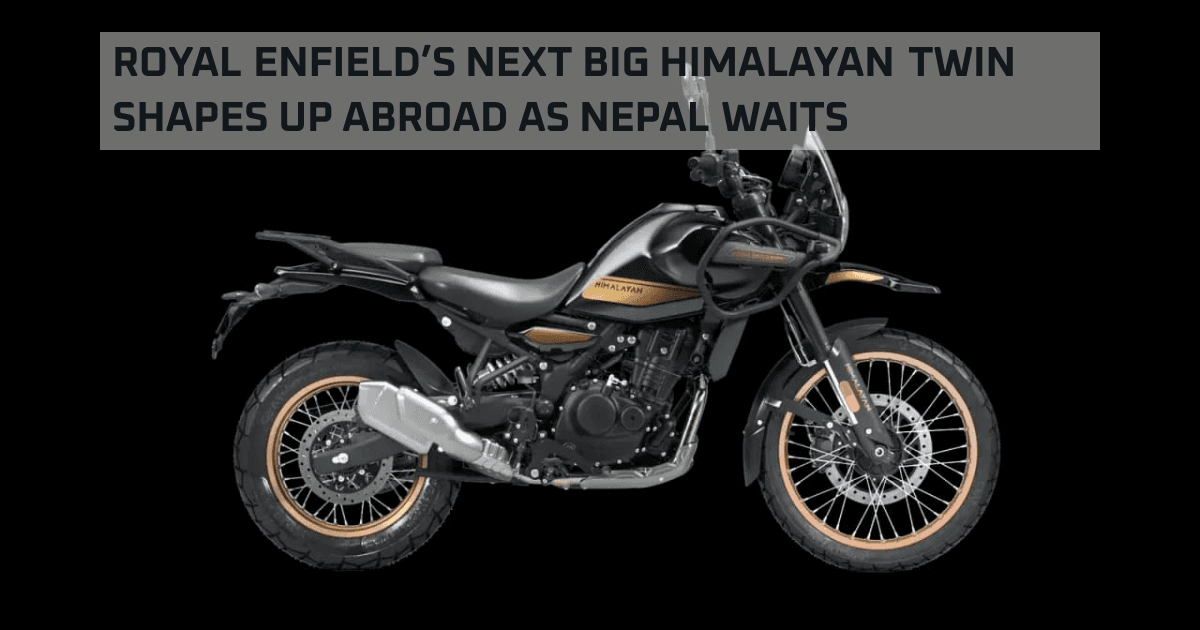
Against the Himalayan 450, the Scram 440 is lower, simpler, and less ambitious. That makes it easier to live with for riders who do not need full adventure-bike height and hardware. Against the Scrambler 400 X, it offers a more old-school, heavier, more torque-led feel, with a distinctly Royal Enfield character and a more approachable seat height.
Its biggest edge in Nepal is not one dramatic specification. It is the combination of price, network reach, and usable ergonomics. A motorcycle that has 28 showrooms and 22 service centers behind it, with a narrow price spread and an easily understandable feature ladder, is naturally easier to recommend than a more exotic option.
Verdict and who it suits
The Scram 440 is a strong fit for Nepali riders who want a relaxed, torquey, road-biased scrambler that can handle bad surfaces without becoming intimidating. It is especially relevant for riders moving up from smaller bikes who want better comfort, more confidence on hills, and a machine that can tour without feeling overcomplicated.
It is not the best choice for riders who prioritize light weight, sharp off-road agility, or lots of factory touring hardware. The 196 kg kerb weight is real, and the motorcycle does not try to disguise it. For the majority of buyers who want Royal Enfield character, familiar mechanicals, and practical ownership, it lands in the right place.
If the question is which version to buy, the answer is straightforward: Force. It preserves the Scram 440’s core strengths and adds the everyday conveniences that matter most in Nepal.
Writes on vehicle pricing, taxation and the Nepali auto market from ongoing tracking of distributor price lists. Every price in this piece is read live from the Nepal AutoMart catalog — how we verify prices.