Where it sits in the Nepali market
The Omoda E5 lands in a very specific part of Nepal’s EV market: above the budget-focused electric crossovers, but below the point where buyers expect luxury-brand badge value. With an ex-showroom spread of Rs 51.59 lakh to Rs 62.49 lakh across five variants, it is positioned as a premium-feeling electric SUV rather than a value-first commuter. The authorized distributor is **SPG Automobiles Pvt. Ltd. / Omoda Jaecoo Nepal Pvt. Ltd., and the brand’s footprint is meaningful on paper, with 47 showrooms and 18 service centers** in Nepal.
That matters because EV buyers here do not judge a car only by the brochure. They also look at whether the distributor looks serious enough to support the product over time. On that front, the E5’s current setup suggests a brand that wants to be taken seriously, not treated as a one-model curiosity.
Looks, design and build
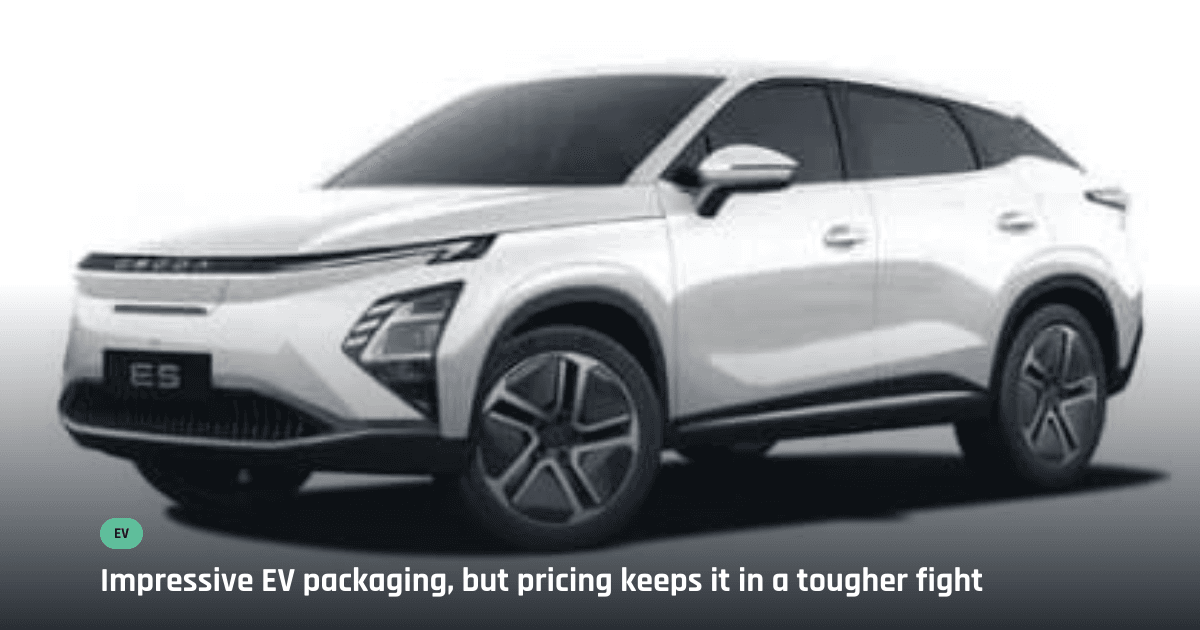
The E5 has the sort of design that works well in a showroom: sharp surfacing, neat proportions and enough visual detail to feel more expensive than its class position. At 4,545 mm long, 1,830 mm wide and 1,588 mm tall, it sits in the familiar compact-to-mid-size SUV zone, but the stance is tidy rather than bulky. The 2,630 mm wheelbase gives it the proportions of a practical family EV without making it look oversized for urban Nepal.
The front-end treatment is especially important to the car’s appeal. The LED headlamps, Crystal Edge daytime running lights and phantom wing taillights give it a modern, slightly futuristic identity that will be a major part of the buying decision for many customers. The design is not subtle, but that is the point: the E5 is aimed at buyers who want their EV to look unmistakably current.
The 18-inch alloy wheels, rear spoiler, shark fin antenna and clean body sides add to the upscale impression. The Dual Tone variant also brings an electric sunroof and exterior colour options including Cloud Blue, New Carbon Black, Aviation Silver, Bloodstone Red, Phantom Grey and New Khaki White, which helps the car feel more lifestyle-oriented.
Features and equipment
This is where the Omoda E5 makes its strongest case. Even the Pro variants are loaded in a way that many buyers will immediately notice when they step inside. The cabin is anchored by a 15.6-inch widescreen display paired with an 8.88-inch instrument cluster, giving the dashboard a modern and high-tech appearance. The car also gets a 540-degree surround-view camera, 8 Sony speakers, a 50W wireless phone charger, Android Auto + Apple CarPlay, smartphone integration, and an intelligent voice assistant.
The convenience equipment goes well beyond the basics. There is keyless entry, electrically folding mirrors, front and rear parking sensors, one-touch power windows, an auto-dimming rear-view mirror, automatic climate control, and a long list of small touches that make everyday use easier. The presence of camping mode and pet mode is also notable; these are the kind of features that sound gimmicky at first, but they do reflect a broader effort to make the E5 feel more flexible than a conventional urban EV.
Comfort features are another major selling point. The E5 offers a sunroof, electric tailgate, column shifter, multi-color ambient lighting, front dual-layer windows with noise reduction, acoustic front glass, and a cabin layout that is clearly designed to feel airy. Seat equipment is unusually rich for this price band: driver seat 6-way electrical adjustment, driver seat ventilation, driver lumbar support, driver massage function, front passenger seat 4-way electrical adjustment, and front passenger seat ventilation are all included in the listed equipment.
Engine, motor and performance
The E5 is powered by a single motor driving the front wheels. Output is listed at 99 kW and 288 Nm, with a 0–100 km/h time of 7.2 seconds and a top speed of 171 km/h. In practical terms, that puts it in the brisk, everyday-usable EV category rather than the performance-EV category. It is quick enough for city gaps, highway merges and confident passing, but not the sort of car that exists to impress with outright pace.
The battery is a 50.7 kWh LFP lithium iron phosphate unit, and the claimed WLTP range is 350 km. That is a useful figure for Nepal because it gives the car enough headroom for routine city use and regular intercity driving without forcing the owner into constant charging anxiety. The chemistry choice also points toward durability and pragmatic ownership rather than headline-grabbing numbers.
Charging ability is another important part of the story. The E5 supports 6.6 kW AC charging and 110 kW DC charging. The fast-charging figure is particularly relevant, because it makes the car far more usable for owners who will rely on public charging or occasional quick top-ups rather than only home charging.
The Dual Tone variant adds a 3.3 kW vehicle-to-load system, which is a genuine lifestyle advantage if the owner wants to run small devices or equipment from the car’s battery.
Ride, handling and comfort
The underlying chassis figures suggest a car aimed at balanced road manners rather than sporting sharpness. The E5 uses McPherson strut front suspension and multi-link independent rear suspension, a combination that should help it feel more settled than simpler rear-suspension setups often found in this segment. Braking is handled by ventilated discs at the front and disc brakes at the rear.
The listed ground clearance of 191 mm is one of the E5’s quietly important strengths for Nepal. It is not a rough-road specialist, but that clearance should make it more relaxed on speed bumps, broken urban surfaces and imperfect driveway angles than lower-slung EVs. The 5.4 m turning radius also suggests reasonable maneuverability in crowded city use.
Comfort is clearly a central part of the product brief. The seats are broad and heavily equipped, the cabin has noise-reduction details, and the car’s overall dimensions should give it enough room for four adults to travel comfortably, with five seats available when needed. The 442-litre boot is respectable and makes the E5 useful for families, weekend travel and airport runs.
Practicality and running costs
From a day-to-day ownership perspective, the Omoda E5 makes sense in the ways buyers in this price band care about most. The LFP battery should appeal to those who prefer a chemistry associated with everyday durability and easier charging habits. The 350 km WLTP range is not class-leading in absolute terms, but it is sufficient to avoid feeling compromised for most urban and mixed-use owners.
Practicality is helped by the car’s packaging: 2,630 mm wheelbase, five-seat layout, 442-litre boot, and the abundance of driver-assistance and camera tech that reduces stress in tight parking situations. The front and rear parking sensors, 540-degree camera, and electrically folding mirrors are not just brochure ornaments in Nepal; they genuinely improve usability in congested urban environments.
Running costs should be lower than an equivalent petrol SUV in the same price range, though the exact cost advantage will depend heavily on electricity rates, charging habits and how much fast charging the owner uses. The data provided does not officially disclose service pricing or battery warranty terms, so those should be treated as undisclosed unless the distributor states them separately.
Price, variants and which one to pick
The verified range runs from Rs 51.59 lakh to Rs 62.49 lakh, but the specific variants most clearly listed in the available data are the Pro at Rs 51,59,000 and the Pro Dual Tone at Rs 51,99,000. Based on the equipment list, these two are already well specified, with the Dual Tone gaining the visual upgrade and vehicle-to-load functionality.
For most buyers, the Pro looks like the smarter value choice. It already includes the core EV hardware, the 15.6-inch display, 540-degree camera, Sony audio, ADAS suite, ventilation, massage functions, sunroof, electric tailgate and the essential comfort kit.
The Pro Dual Tone makes sense if you care about style, want the exterior differentiation, and will actually use the 3.3 kW V2L function. If that feature matters, the small premium is easy to justify. If it does not, the standard Pro is probably the cleaner buy.
How it compares with its real rivals in Nepal
In Nepal, the E5’s real competition is not just other EVs; it is other EVs that also promise premium looks, meaningful range and a generous feature list. The most obvious rivals are other imported or semi-premium electric SUVs that sit in the same broad price band and target buyers who want more than basic urban transport.
Against that field, the Omoda E5’s strengths are clear: it feels generous on equipment, respectable on range, strong on charging speed and unusually polished in its cabin presentation. Its weaknesses are equally clear: the pricing is ambitious, and buyers at this level will compare the badge, long-term support confidence and resale expectations as much as the spec sheet.
What makes the E5 interesting is that it does not ask buyers to accept a stripped-back EV in exchange for range. It offers a proper feature experience first, then adds the practical EV fundamentals. That is a strong formula if the showroom experience and ownership support hold up.
Verdict and who it suits
The Omoda E5 is best understood as a well-equipped, comfort-focused electric SUV that tries to justify its price with substance rather than novelty. It has the design, the cabin tech, the useful range, the fast charging, and the everyday usability to make sense for buyers moving up from smaller EVs or looking to replace a petrol family crossover with something more modern.
It suits buyers who want a premium-feeling EV without stepping into luxury-brand territory, and who value features like seat ventilation, massage functions, camera coverage and a properly laid-out cabin. It is less compelling for buyers who are purely price-driven or who want the strongest possible range-per-rupee equation.
If the goal is a stylish EV that feels thoughtfully equipped and genuinely usable in Nepal’s roads and charging environment, the Omoda E5 makes a persuasive case.
Writes on vehicle pricing, taxation and the Nepali auto market from ongoing tracking of distributor price lists. Editorial policy.