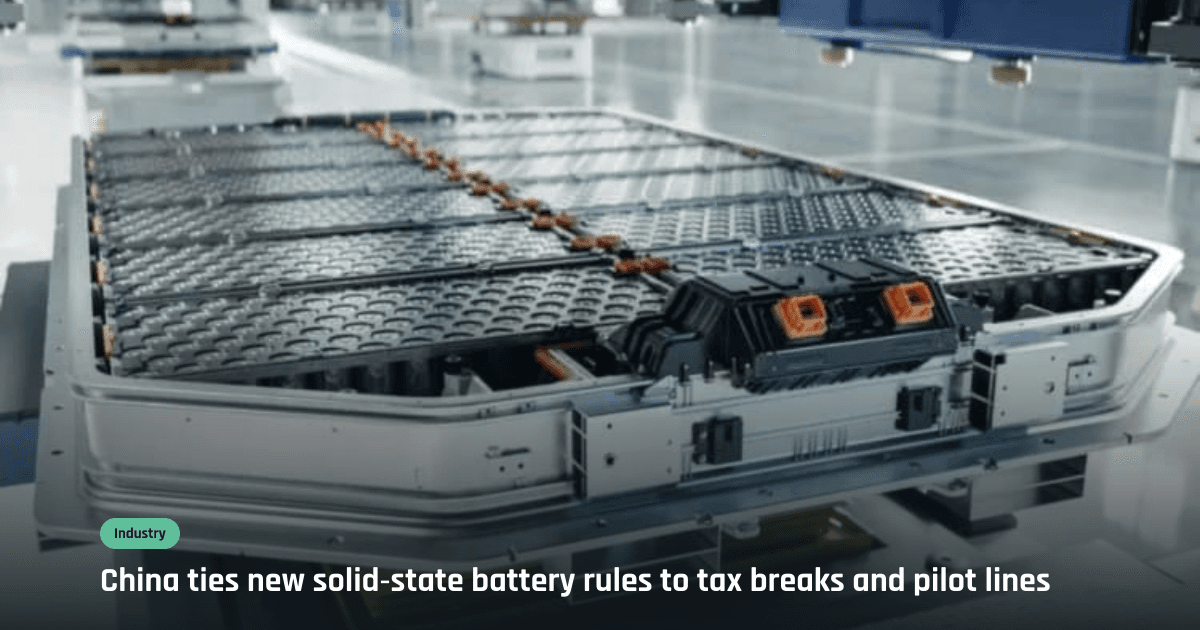
China has taken the lead in drafting the first global standard for solid-state EV traction batteries, with the International Electrotechnical Commission approving the project on 21 August 2026. Experts from China, France, Japan and South Korea are part of the working group.
What the new solid-state standard will test
- The standard is expected to take 24–36 months to finalise.
- It will set common testing and application requirements for solid-state batteries used in electric vehicles.
- A proposed identification method treats a cell as all-solid-state only if it loses no more than 0.5% of its mass after six hours in a 120°C vacuum chamber.
- Cells with more mass loss would be classed as using volatile components, which matters because some "solid-state" designs still rely on semi-solid liquid electrolyte.
China's new battery tax rules
From 1 September 2026, China resumes consumption tax on conventional batteries:
- Lithium-ion battery products are taxed at 2%, rising to 4% from September 2027.
- Solid-state batteries, sodium-ion batteries and fuel cells are exempt until 31 December 2028, provided they meet the relevant national standards.
These policies are designed to push investment towards next-generation battery technologies.
Pilot production in China
Chinese battery makers are already building pilot lines to match the upcoming standards:
- Sunwoda has a dedicated solid-state sample production line with planned capacity of 0.2GWh per year. Its first-generation polymer-based cell targets 400Wh/kg energy density, with vehicle trials aimed for late 2026 and 2027.
- EVE Energy has developed a 60Ah solid-state cell that can operate under stack pressure up to 5MPa.
- Multiple firms report promising nail-penetration test results, though these are cell-level tests and do not yet prove full-vehicle safety.
Cost remains a major hurdle. LPSC sulphide solid electrolyte was assessed at about 4,300 yuan (around Rs 0.09 lakh) per kg in August 2026, compared with roughly 30–50 yuan (about Rs 600–1,000) per kg for typical liquid electrolyte.
Global timelines for all-solid-state EVs
Outside China, Toyota and Idemitsu Kosan are targeting commercialisation of all-solid-state EV batteries in 2027–28. Broad use in mass-market electric cars is expected to take longer, with industry forecasts generally pointing to around 2030 or later.
For Nepali buyers, these moves matter because they can accelerate safer, higher-density batteries and potentially lower long-term EV running costs, but true all-solid-state EVs are still several years away from mainstream production and export.
Writes on vehicle pricing, taxation and the Nepali auto market from ongoing tracking of distributor price lists. Editorial policy.