Where It Sits In The Nepali Market
The Royal Enfield Hunter 350 sits in an interesting corner of Nepal’s motorcycle market. It uses the same 349cc engine and underlying architecture as the Meteor 350 and Classic 350, but the body is smaller, lighter and more city-friendly. Priced between Rs 4.64 lakh and Rs 4.83 lakh ex-showroom depending on variant, it sits at the accessible end of Royal Enfield’s Nepal lineup, distributed officially by Alpha Automotive Pvt. Ltd. since its 2022 launch here. For buyers who want the brand’s retro character and thump without moving up to the bigger, heavier 350cc siblings or the 650cc twins, the Hunter is the entry point. It feels like a credible one.
Looks, Design And Build
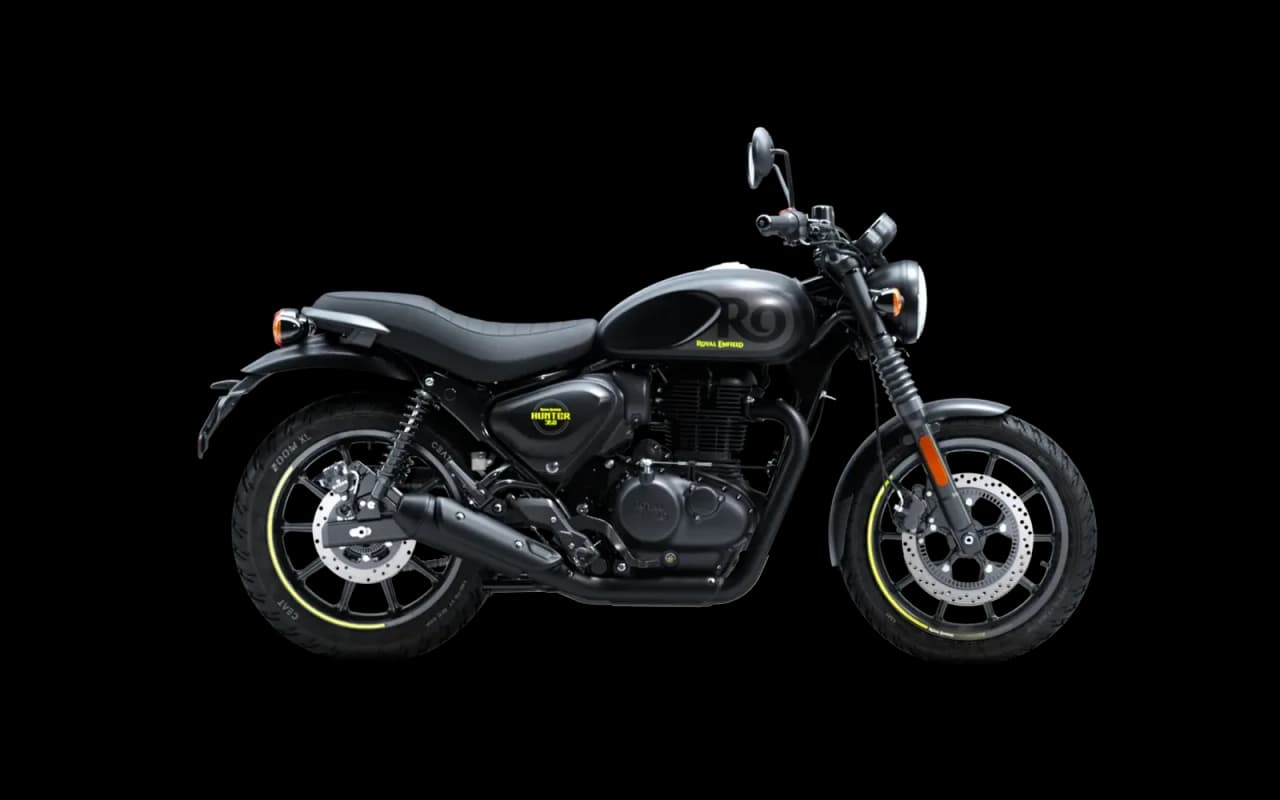
The Hunter 350 wears a standard, upright retro roadster silhouette that reads as more modern and street-focused than the Classic’s vintage-military look. In showroom comparisons, it draws favourable comparisons even to Royal Enfield’s larger 650cc twins. That is no small compliment for a 350. The blacked-out treatment on the engine casings, exhaust, and 17-inch cast wheels gives it a purposeful, slightly aggressive stance despite the retro theme. The fuel tank’s knee-recess shape with bold ‘Royal’ script branding is one of the more distinctive touches on the bike. There is a clear visual kinship with the modern retro-roadster school of design more broadly, and Royal Enfield has built this to appeal to buyers who want heritage styling without it tipping into costume-bike territory.
Colours Available
Nepal Automart’s dataset lists three variants on offer through Alpha Automotive: Retro Factory Black, Metro Dapper Ash, and Metro Rebel Red. The Retro trim comes in at the lowest price point of Rs 4,64,000, while the two Metro shades — Dapper Ash and Rebel Red — sit higher at Rs 4,79,200 and Rs 4,83,200 respectively, reflecting the twin-tone paint and slightly higher trim finish typically associated with the Metro range. Globally the Hunter is offered in a wider six-colour spread, but for Nepali buyers the choice narrows to these three. So the decision mainly comes down to whether you prefer the plain factory black or the costlier two-tone Metro finishes.
Features And Equipment
Equipment is kept deliberately simple, in keeping with the bike’s role as an honest, no-frills commuter. The instrument cluster is a digi-analog unit with a single speedometer scale in kmph and a digital insert for secondary information. It is easy to read at a glance and appropriately retro in character. The switchgear uses a distinctive rotary design on the handlebar that feels tactile and adds to the retro appeal, a deliberate departure from the ordinary toggle switches most commuters use. A Type-C USB port is fitted as standard for fast charging, and the bike is compatible with Royal Enfield’s Tripper navigation pod, though buyers should specifically confirm whether it is fitted or available to retrofit at their local showroom, since supply of this accessory has been inconsistent globally. Don’t expect riding modes, traction control or any smartphone-linked electronics here. This is a mechanically simple motorcycle by design.
Engine And Performance
Power comes from the familiar 349cc single-cylinder, air-oil cooled engine, tuned here for 20.2 bhp at 6,100 rpm and 27 Nm of torque at 4,000 rpm, run through electronic fuel injection and a 5-speed constant mesh gearbox with a slip-assist clutch. On paper this is modest output, and it is. This engine was never built to chase big numbers. What it does deliver is strong, usable low-end torque and a responsive throttle that makes stop-start city traffic genuinely pleasant rather than a chore. The single-cylinder thump has real mechanical character and a satisfying exhaust note that is part of the Royal Enfield experience regardless of displacement. Where it runs out of breath is on the open highway. Sustained higher speeds expose the engine’s ceiling, and overtaking manoeuvres need to be planned rather than casual. For anyone doing serious highway distances in Nepal’s hill and Tarai stretches, this is worth weighing carefully. For city and short-highway use, it is more than adequate.
Ride And Handling
This is where the Hunter separates itself from its 350cc siblings. The chassis uses revised geometry — a steeper head angle and reduced trail — paired with 17-inch wheels front and rear instead of the larger wheels on the Meteor, and the result is noticeably sharper, more flickable steering. At 181 kg kerb weight (with 90% fuel and oil), it is the lightest bike in Royal Enfield’s 350cc range. That combination of light weight and tighter geometry makes it easy to thread through the dense, unpredictable urban traffic found across Kathmandu, Pokhara and other Nepali cities. Suspension duties are handled by 41mm telescopic forks up front and twin shocks with 6-step adjustable preload at the rear. It is a straightforward, functional setup that does its job around town but does not have the sophistication to properly absorb rougher, broken tarmac at speed. The stock tyres are similarly adequate rather than impressive. They offer average grip that is fine for commuting but not something enthusiastic riders will rave about.
Comfort And Ergonomics
The 790mm seat height is low enough that most riders — anyone around 5'9" and under — will comfortably flat-foot at a standstill, an important consideration in Nepal’s mixed urban terrain where quick stops and tight manoeuvring are routine. The handlebar is wide and set at a relatively high position, encouraging a naturally upright, relaxed posture rather than any forward lean. Footpegs sit slightly higher and further back than on the Meteor 350, giving a touch more ground clearance and lean angle for the sportier intent of this model. The one caveat worth flagging clearly is for taller riders. Those at 6 feet or taller may find the riding triangle a little cramped, and should sit on the bike in person before buying rather than assume it will fit. Pillion riders are well looked after, with a decently sized rear seat, rubber-damped footpegs to cut vibration, sturdy grab rails as standard, and heat shields near the exhaust to protect against accidental burns. Small details, but they matter.
Braking And Safety
Braking comes from a 300mm front disc with a twin-piston floating caliper, paired with either a 153mm rear drum on the base variant or a 270mm rear disc with single-piston caliper on higher trims, and ABS is available in both single-channel and dual-channel configurations depending on variant. The brakes do their job reliably but do not have a particularly sharp or powerful bite. They are adequate rather than anything that inspires aggressive braking confidence. Dual-channel ABS on the top-spec version is a welcome safety net for Nepali riding conditions, where sudden braking on mixed surfaces and in traffic is a daily reality, and safety-conscious buyers should steer toward whichever variant includes it.
Practicality
As a city motorcycle, the Hunter does exactly what it is built to do. Its compact dimensions — 2055mm long, 810mm wide without mirrors — combined with the light kerb weight make it easy to park in tight spaces and manoeuvre through congested lanes that larger motorcycles struggle with. The 160mm ground clearance is a genuine practical advantage on Nepali roads, where potholes, speed breakers and uneven surfaces are the norm rather than the exception.
Running Costs
With a 13-litre fuel tank and the efficiency inherent to this engine tune, the Hunter offers a genuinely long range between fill-ups, translating into low running costs for daily commuters. The mechanical simplicity — a single-cylinder air-oil cooled engine with no complex electronics — should also keep servicing and maintenance costs down over the ownership period. That matters for buyers comparing total cost of ownership rather than just the sticker price.
Price, Variants And Which One To Buy
Across the three variants available in Nepal, the price spread is a relatively narrow Rs 4.64 lakh to Rs 4.83 lakh. The entry Retro Factory Black at Rs 4,64,000 gets you the same mechanical package as the pricier Metro versions, so buyers purely focused on value should look hard at it. The Metro Dapper Ash (Rs 4,79,200) and Metro Rebel Red (Rs 4,83,200) command a premium largely for their twin-tone paint finish and trim level. That is a reasonable upcharge if the styling matters to you, but not essential if you are buying on substance. Given the safety benefits, prospective buyers should specifically confirm which variant carries dual-channel ABS before deciding, as that is a more meaningful differentiator than paint alone.
How It Compares With Rivals
Against its own stablemate, the Meteor 350, the Hunter is lighter, more agile, rides on smaller 17-inch wheels, and offers a more upright commuter-friendly stance rather than the Meteor’s cruiser lean. Against the Classic 350, the difference is one of character. The Hunter goes for a modern retro-roadster look while the Classic leans into vintage military styling, so the choice there is largely about which aesthetic you prefer. Outside the Royal Enfield family, buyers occasionally cross-shop with more premium retro-styled options, though these typically come at a noticeably higher price point, reinforcing just how competitively the Hunter is positioned within its own segment.
Verdict And Who It Suits
The Royal Enfield Hunter 350 is a stylish, honest, and genuinely likeable city motorcycle that does its core job — comfortable, agile daily commuting with real retro appeal — very well. It is an excellent first motorcycle for new riders who want something manageable and non-intimidating, and equally sensible as an affordable, good-looking second bike for experienced riders who mostly ride around town. It makes less sense for buyers planning long highway hauls or taller riders who may find the ergonomics tight. For everyone else navigating Nepal’s cities and short intercity routes, it is one of the more complete packages available at this price.
Current prices on Nepal AutoMart
- Royal Enfield Hunter 350 price in Nepal: Rs 4.64 lakh – Rs 4.83 lakh ex-showroom, 3 variants
Writes on vehicle pricing, taxation and the Nepali auto market from ongoing tracking of distributor price lists. Editorial policy.