Where it sits in the Nepali market
The Jaecoo J6T is placed as a premium electric SUV for buyers who want road presence, a long feature list and a more upscale feel than a typical budget EV. In Nepal, SPG Automobiles Pvt. Ltd. (Omoda Jaecoo Nepal) distributes it. The brand has 41 showrooms and 24 service centers, which gives it a wider footprint than many niche EVs at this price level.
At Rs 66.99 lakh to Rs 69.99 lakh, the J6T sits in a competitive but still relatively exclusive part of the market. That pricing puts it in the same conversation as imported premium EVs and higher-spec SUVs. Buyers will weigh badge appeal, equipment, running costs and after-sales support together rather than shop on price alone.
Looks, design and build
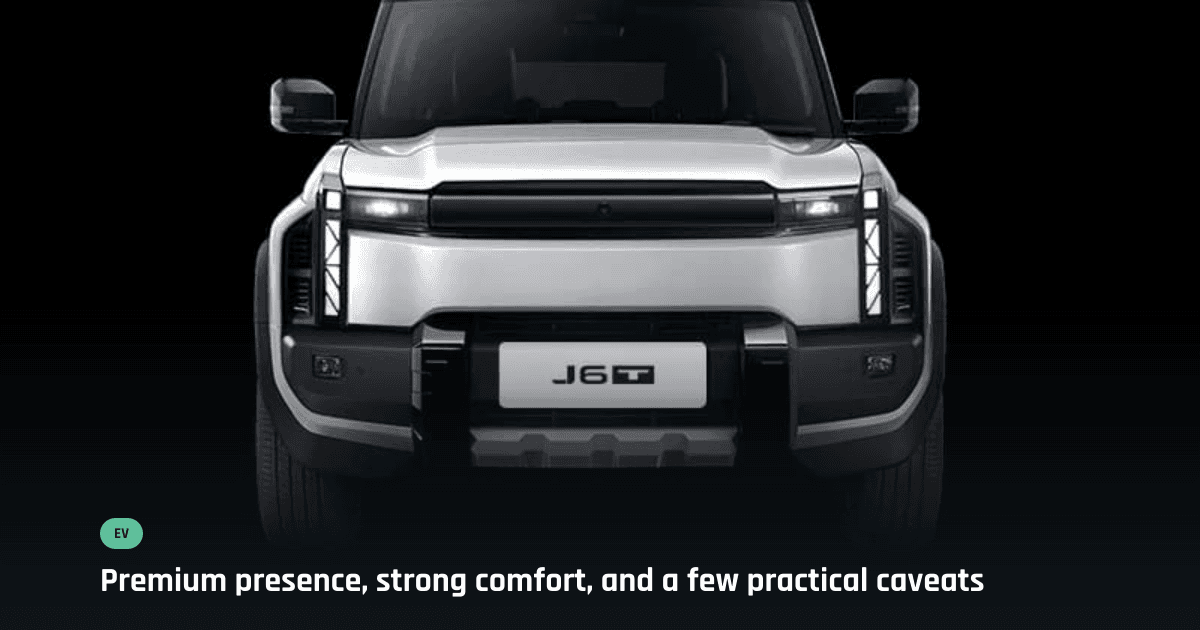
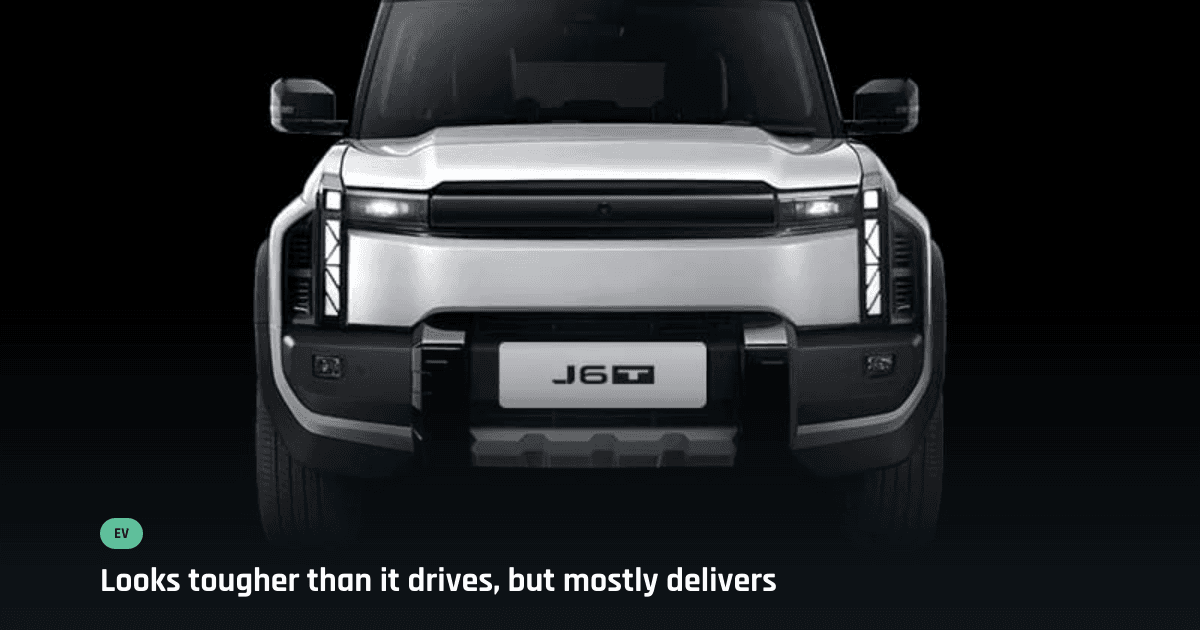
This is one of the J6T’s biggest selling points. It has a rugged, squared-off design that makes it stand out immediately. The visual effect is more premium than quirky.
Its stance is helped by a 4,545 mm length, 1,830 mm width, 1,588 mm height, 2,630 mm wheelbase and 191 mm ground clearance. A 5.4 m turning radius should make it easier to live with in the city than its chunkier styling suggests.
The design package is intentionally dramatic rather than minimal. It gets LED headlights, LED daytime running lamps, electrically folding mirrors, a rear spoiler, a shark-fin antenna, 18-inch alloy wheels, crystal-edge DRLs and phantom wing taillights. Color choices are broad too, with Cloud Blue, New Carbon Black, Aviation Silver, Bloodstone Red, Phantom Grey and New Khaki White.
The cabin theme follows the same formula. Wide, modern, loaded with visible equipment. The impression is of a product aimed at buyers who want their EV to feel a step above mainstream commuter models.
Features and equipment
This is where the J6T looks expensive in a way that is easy to understand. It gets a 15.6-inch central display, an 8.88-inch instrument cluster, 8 speakers, a 50W wireless charger, smartphone integration with Android Auto and Apple CarPlay, voice assistance, front-row USB and Type-C charging, a rear USB port and a 540-degree camera system.
The comfort kit is unusually rich for the segment. It includes a sunroof, electric tailgate, column shifter, multi-color ambient lighting, leather steering wheel, driver seat ventilation, driver seat massage, 6-way power adjustment for the driver, 4-way power adjustment for the front passenger, front passenger ventilation, automatic air conditioning, keyless entry, acoustic front glass, auto-dimming rear-view mirror and one-touch power windows.
That is a serious list. It also shows how much of the J6T’s appeal rests on daily comfort and novelty. It is less about mechanical simplicity. The car arrives with everything switched on.
Motor, battery and performance
The verified Nepal specification is straightforward. The J6T uses a single-motor, front-wheel-drive setup with 99 kW and 288 Nm. The battery is a 50.7 kWh lithium iron phosphate pack, and the claimed WLTP range is 350 km. Charging support is rated at 6.6 kW AC and 110 kW DC, and the car also offers a 3.3 kW V2L system.
Performance figures are respectable rather than explosive. The claimed 0-100 km/h time is 7.2 seconds, with a top speed of 171 km/h. That points to a J6T that should feel brisk in normal use, especially around town and on overtakes.
What matters more in Nepal is the balance between claimed range and real-life use. The official number is usable on paper, but long trips will still require planning, especially if charging infrastructure, gradients and load are part of the equation. That is the trade-off with this car. It promises flexibility, but not carefree long-distance EV ownership.
Ride, handling and comfort
The J6T’s strongest dynamic quality is likely to be highway composure. Feedback around the car suggests it feels confident at speed, remains comfortable over long distances and supports relaxed family cruising well. The seat design and equipment list reinforce that impression.
The suspension and chassis tune appear to suit smoother roads better than serious rough use. The car’s rugged styling gives it a more adventurous appearance than its underlying role really supports. In practical terms, it should handle urban roads, highway runs and typical broken surfaces adequately. It is not the sort of EV that invites genuine off-road expectations.
Noise isolation is a mixed story. The acoustic glass and dual-layer window treatment help create a more polished cabin, but the common complaint pattern is that the sunroof and rear trunk area can develop noise over time. For buyers in this price bracket, that matters because refinement is part of what they are paying for.
Practicality and running costs
With 5 seats and a 442-litre boot, the J6T is properly usable as a family SUV. The folding rear backrest, armrest with cup holder and decent cabin packaging make it a practical daily companion, while the wide cabin and supportive front seats are part of the car’s appeal.
Its 1735 kg curb weight and 2085 kg gross vehicle weight are not small. It is clearly not a featherweight urban EV. That helps explain why the car feels substantial, but it also means efficiency and tyre wear are worth watching.
Running costs are where the ownership story becomes more nuanced. The electrical side should be simpler than a fuel SUV in everyday use, but the main caution is that spare parts and some repairs are considered expensive in Nepal. That does not make the J6T a bad purchase. It does mean the premium price should be matched by a premium maintenance budget.
The network footprint is a plus here. With 41 showrooms and 24 service centers, owners should find the brand easier to support than some newer EV names. That matters as much as the spec sheet once the car is in long-term use.
Price, variants and which one to pick
There are two variants listed in Nepal:
- Launch price: Rs 66.99 lakh
- EV: Rs 69.99 lakh
Both variants share the same core hardware in the verified dataset. The battery, motor, range, dimensions, cabin equipment and safety package are the same. The decision is less about engineering differences and more about pricing strategy and what the dealer package includes at the time of purchase.
On the numbers provided, the lower-priced variant is the sensible choice. The top version does not clearly add enough obvious hardware to justify the gap. Unless there is a dealer-specific value bundle or equipment difference not captured in the verified data, the Launch price variant looks like the smarter buy.
How it compares with real rivals in Nepal
The most relevant comparison set is with other premium EV SUVs in Nepal that aim to combine style, range, equipment and a showroom-led buying experience. In that company, the J6T’s strengths are its feature density, road presence, supported network and the sense of being more distinctive than a generic crossover.
Its weaknesses in the same field are equally clear. Some rivals may offer higher real-world range confidence, more established parts ecosystems or a stronger reputation for long-term value. The J6T does not dominate on outright performance. It is not the obvious choice for buyers who want the most efficient long-distance EV possible.
What it does better than many rivals is make the ownership decision feel emotionally rewarding. It looks premium, feels loaded and gives the impression of getting a lot for the money, even if some of that value is in presentation rather than hard mechanical superiority.
Verdict and who it suits
The Jaecoo J6T is best understood as a style-led premium EV SUV with real usability, solid equipment and enough network support to make it a serious option in Nepal. It suits buyers who care about design, comfort and features first, and who want an EV that feels special every time they walk up to it.
It is less ideal for buyers who want the lowest possible ownership risk, the simplest parts situation or the most proven long-range EV package. If your priorities are family comfort, highway manners, strong visual presence and a packed cabin, the J6T makes a convincing case. If your priorities are maximum range certainty and the cheapest long-term upkeep, it asks for more compromise than its badge and styling might suggest.
Writes on vehicle pricing, taxation and the Nepali auto market from ongoing tracking of distributor price lists. Editorial policy.