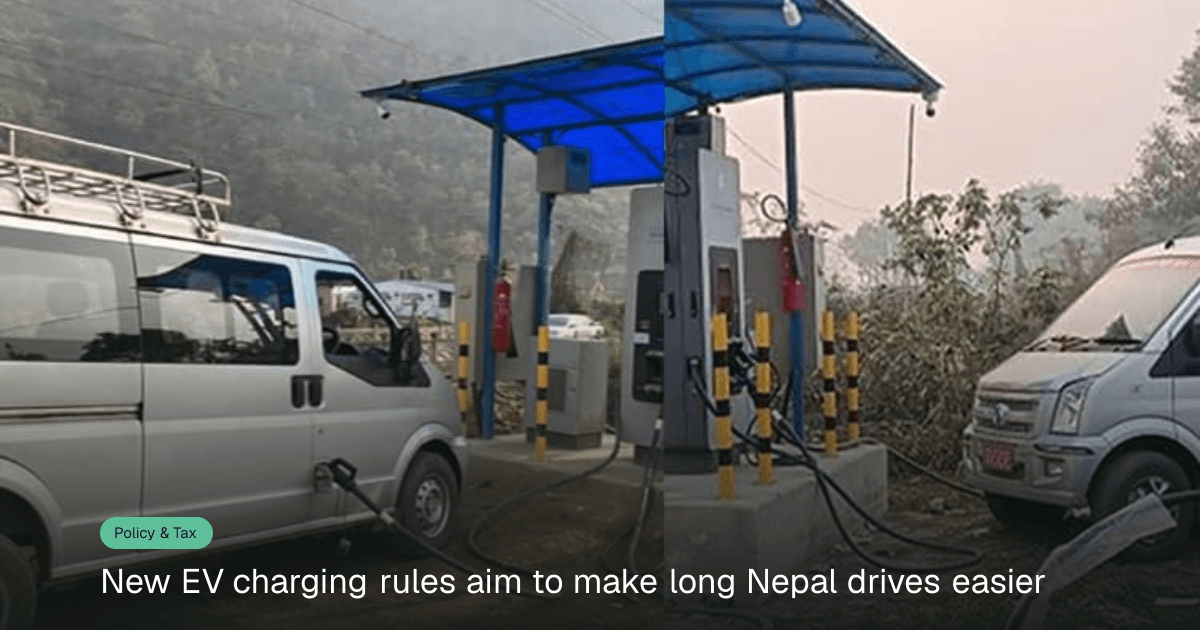
Nepal’s government is moving to standardise how and where electric vehicles can charge across the country, a key step for buyers worried about range and long-distance travel.
National guidelines for EV charging
The National Transport Policy 2083, recently approved by the Cabinet, instructs the Ministry of Physical Infrastructure and Transport to prepare national guidelines for EV charging and battery swapping within one year.
According to the policy, the new guidelines will:
- Set clear rules for charging station locations, with separate norms for highways, cities and rural areas.
- Define minimum charger capacity and technical standards, with specific categories for fast and ultra-fast chargers.
- Specify the maximum allowed distance between charging stations along major corridors, so drivers can plan trips with more confidence.
- Include safety and technical requirements for equipment and installation, aimed at reducing fire and electrical risks.
For EV owners, this should mean a charging network that grows in a planned way, with stations placed at set intervals instead of the current scattered approach.
Rapid growth of EVs in Nepal
The policy notes that around 70% of new passenger car sales are now electric in Nepal, a sharp shift away from fuel-powered cars.
It also estimates that about 63,000 electric vehicles are already on Nepali roads, including cars, two-wheelers and public transport vehicles. EV use in buses, taxis and microbuses is described as steadily increasing, beyond just personal cars.
Focus on electrifying public transport
To cut fuel imports and improve air quality, the government has adopted a phased e-mobility transition strategy. A core part of this plan is giving priority to electric public transport:
- In the next 1–3 years, the government plans programs to convert existing fleets to electric buses, electric taxis and electric microbuses.
- Over 3–5 years, a Public Transport Fleet Modernization Program is planned, with electric buses getting first preference.
For commuters, this could bring more electric options on busy city routes and intercity corridors as the charging rules push for better coverage along highways.
Support for large electric buses
To draw private operators into big electric vehicles, the policy proposes Viability Gap Funding (VGF). Under this scheme, the government may offer subsidies or concessional loans to help companies purchase large electric buses.
For buyers and operators, VGF could lower upfront costs and speed up the arrival of more modern, quieter and cleaner buses. For individual EV owners, a stronger public transport and charging ecosystem should gradually make owning and using an EV in Nepal more convenient and reliable.
Writes on vehicle pricing, taxation and the Nepali auto market from ongoing tracking of distributor price lists. Editorial policy.